Reputation Monitoring Online: A Restaurant Guide for 2026
Saturday night can feel fine and still cost you next weekend. The pass is clear, the bar has thinned, and a couple who waited for a table they thought was held have already written about it. You seat the room, the kitchen catches up, and the till looks ordinary. On Monday the booking page is softer, and the reason is already public.
That is reputation monitoring online for a small room. It is the habit of reading what guests say, matching it to the shift, and fixing the cause while the next person is still choosing where to eat.
Table of Contents
- What Online Reputation Monitoring Means for Restaurants
- Where Diners Post and What to Track on Each Channel
- Metrics That Reveal Problems Before Ratings Drop
- A Daily and Weekly Monitoring Routine With Alert Rules
- Spotting Fake and AI-Written Reviews Before They Hurt
- Response Templates for Praise, Complaints and Fake Reviews
- Setting Up Monitoring in One Week by Venue Type
What Online Reputation Monitoring Means for Restaurants
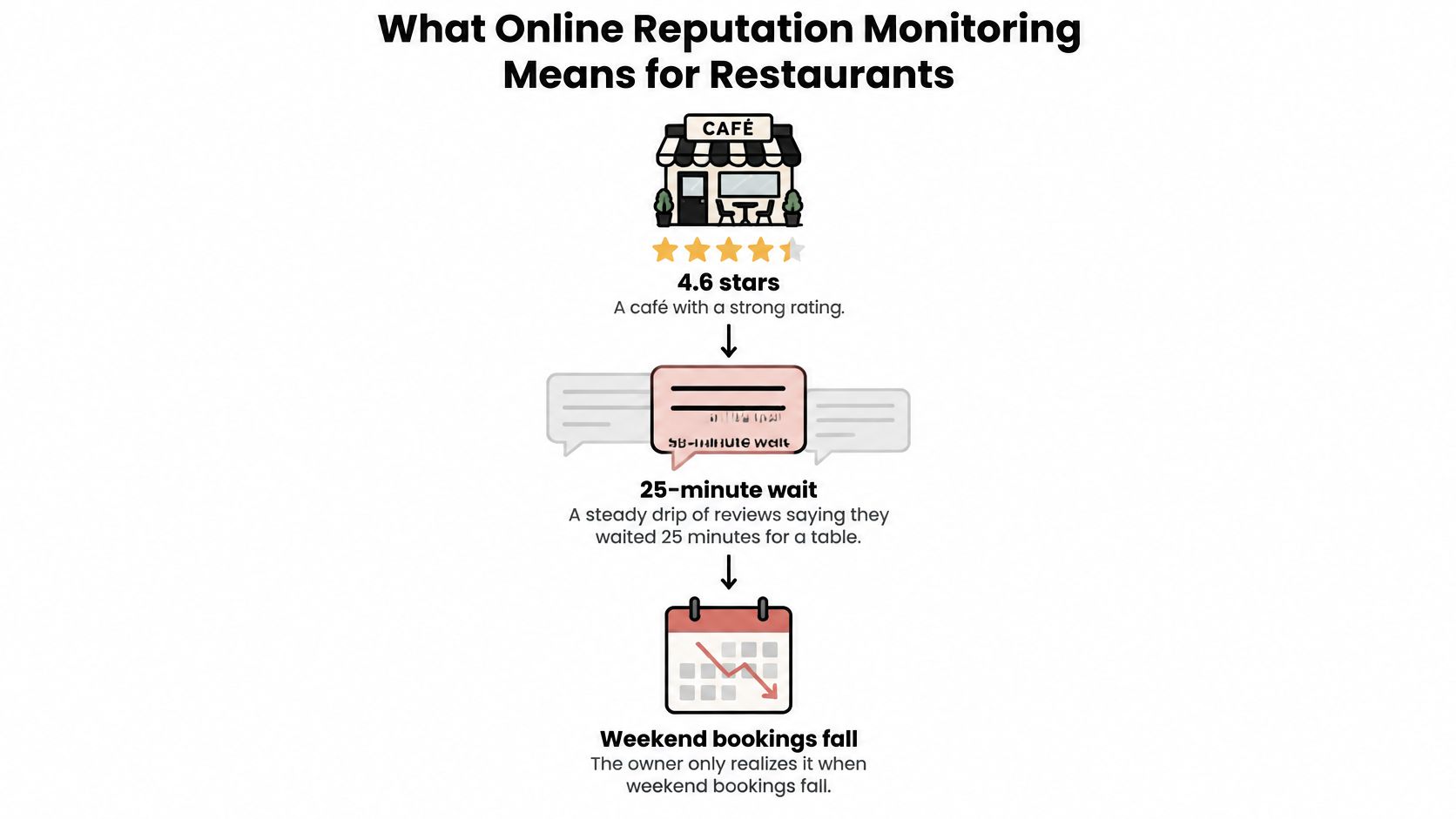
A 40-seat café can sit at 4.6 stars and still be losing Saturdays. Reviews kept saying guests waited about 25 minutes for a table they believed was reserved. The average barely moved. Weekend bookings fell, and the owner only saw the pattern after the diary had already thinned. The stars were reassuring. The sentences were the warning.
Reputation monitoring online is the ongoing collection, reading and response to what people say about you wherever they say it. Review sites, Google Maps, social posts, booking platforms, delivery apps and private guest notes all belong in the same loop. It is not a folder you tidy after a bad month.
Treat it as a smoke alarm, not a newspaper archive. An archive stores last season. An alarm tells you a small fire is still small enough to put out, whether that fire is a host stand, a missed allergen note or a terrace you do not have.
The listen, understand, act loop
- Listen: pull new mentions into one view, so an Instagram tag is not invisible because you only opened Google.
- Understand: group them into themes such as wait time, noise, allergens or staff. Three notes about the same wait beat one angry outlier.
- Act: change the roster, the seating rule or the card, then reply so the next reader sees both the complaint and the fix.
People read reviews before they try an unfamiliar room. A complaint left unanswered for weeks is still on the listing when the next couple decides. This work is not buying reviews, and it is not a one-off scrub. A drafted reply still needs a person. AI responses that protect brand reputation is worth reading, because a smooth paragraph that never names the visit sounds worse than a short honest one.
Monitoring is how you learn what guests already told the internet before the next guest decides.
Where Diners Post and What to Track on Each Channel
A guest can complain in three places before you have finished your morning coffee. The couple who waited 40 minutes past their booking on Friday leaves a Google review, tags a photo on Instagram and ticks a low score on the booking platform's follow-up. If your routine only opens Google, two thirds of that story never reaches you.
| Channel | Why diners use it | What to track | How often to check |
|---|---|---|---|
| Google Business Profile | Default search and map listing for most diners | New reviews, star trend, unanswered reviews | Daily |
| TripAdvisor | Common with travellers and visitors in many cities | Reviews by language, recurring complaints | Weekly |
| Facebook and Instagram | Tags, comments and direct messages | Mentions, tagged photos, complaints in DMs | Daily |
| Booking platforms (such as TheFork or OpenTable, where used) | Reviews from people who booked through them | Reservation complaints and no-show notes | Weekly |
| Delivery apps (such as Uber Eats, Deliveroo or Just Eat, where used) | Ratings on delivered orders | Missing items, cold food, allergy notes | Weekly, daily at peaks |
| Private post-visit feedback | Honest criticism diners will not post publicly | Low scores, allergens, wait times, staff | Daily alerts, weekly summary |
| Local press and food blogs | Shape how new diners see you | New articles and mentions | Monthly |
Google Business Profile earns the daily pass because it is the first thing a searching guest usually sees. A single-platform habit still misses part of the picture. In 2024, BrightLocal's local consumer review survey reported that 77% of U.S. consumers use at least two review platforms when researching a business, based on a representative sample of 1,141 people. The pattern holds outside the U.S. as well. Customer Alliance found that 91% of 750 consumers across Germany, Austria, Switzerland, France and Italy read online reviews at least once a month.
Two channels that get skipped
Private post-visit feedback catches the criticism a guest will not post under their own name. A low score about a nut trace or a cold starter reaches you before it becomes a public thread. Send a short form after every visit and show the public review button to every diner, not only the tables that smiled.
Booking-platform notes show reservation trouble before the guest walks in. A comment about a lost table, a wrong party size or a misunderstood no-show policy is an operations signal you can trace to a fixable cause, whether that is the confirmation message, the floor plan or the host's script. Ask at booking which sites your guests use and read the reservation source field, then weight your checks to match instead of monitoring every channel at the same intensity.
If the listing is not claimed yet, add your restaurant to Google Business Profile before you chase replies. In the Bookings section, choose Add link and paste your reservation URL. A booking page you control can reuse that same address on Google, Instagram, the website and the menu, so guests are not routed to a marketplace that charges per cover.
Metrics That Reveal Problems Before Ratings Drop
A dining room usually tells you before Google does. The fourth table in a row asks why the mains took 35 minutes, a regular mentions a gluten note that never reached the kitchen, and Friday's no-shows leave the pass exposed at 8pm. The star average falls later, after the pattern has already cost covers.
Use the triggers below as working thresholds from service logs, then tune them after four weeks of your own numbers.
| Metric | How to calculate | Watch for | Action trigger |
|---|---|---|---|
| Average rating by platform | Sum of star ratings in the period divided by number of reviews, per platform | Falling trend over 30 days | Read every review from the drop period before replying |
| Response rate | Replied reviews divided by all reviews in the period | Any open reviews after the weekend | Reply to every open review within 48 hours |
| Response time | Median hours from review posted to reply | Over 48 hours | Name a backup responder for days off |
| Recurring theme count | Reviews naming one issue such as wait time, noise or allergens | 3 or more mentions in 30 days | Fix the cause, then mention the fix in replies |
| Private feedback low-score share | Forms rated 1 or 2 out of 5 divided by all forms | Above 10% in one week | Check that shift, dish or table for the pattern |
| No-show rate by service period | No-shows divided by confirmed covers, split by lunch, dinner and weekend | Rising above your own 8-week baseline | Test reminder timing before changing deposit rules |
| Review authenticity flags | Suspicious reviews logged per month | Three or more similar reviews in one week | Escalate through the platform's reporting route |
Theme counts move first. Three mentions of the same wait, the same cold pass or the same allergen miss point to a station, a shift or a menu line. Private low scores catch guests who will never post under their own name. Response rate and response time show whether the loop closed after the complaint landed. Split every metric by language, location and meal period, because a terrace Saturday and a Tuesday lunch behave like different businesses.
No-shows belong in the same log
No-show rate is a reputation metric because guests feel the empty table as a wait, a rushed turn or a cancelled booking. Keep a weekly log of confirmed covers, arrivals, cancellations, late cancellations and walk-ins admitted to released tables. Cut it by service period, party size and booking source. A 2025 study of cancellation barriers found that stricter policies and harder cancellation methods reduced people's intention to skip, and also reduced their intention to book. Published no-show rates vary by country, deposit rule and booking channel, so treat them as context and build your own baseline. State terms clearly, make cancelling easy, and test reminder timing before you touch deposits.
Treat authenticity as an operations check too. If AI helps draft replies, judge the draft the way a guest would: does it name the dish, the shift and the fix, or could it sit under any restaurant? A fast generic reply can read as hollow even when the review is fair. Allergen themes need the same urgency as a falling score, so send a public complaint about a missed nut or gluten note back to the pass and to an allergen compliance checklist before you write a single public sentence.
A Daily and Weekly Monitoring Routine With Alert Rules
Ten minutes before the pre-shift meeting catches more than an hour you never find on Friday. The routine only works if it fits a service day.
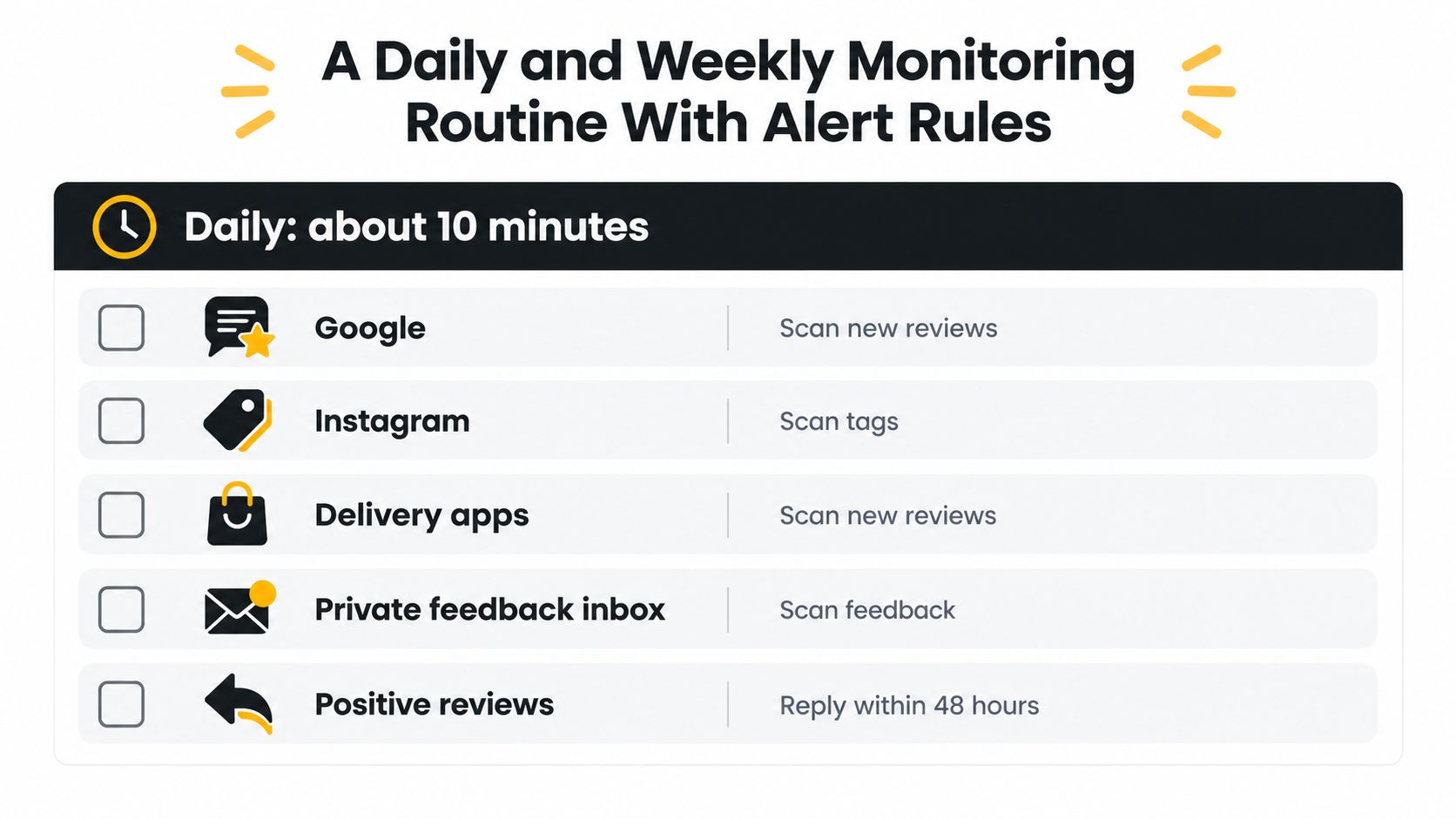
Daily, about 10 minutes
- Google: scan new reviews and anything still unanswered.
- Instagram: scan tags, comments and complaint DMs.
- Delivery apps: scan new ratings, especially after a busy dispatch night.
- Private feedback inbox: scan overnight scores before the pre-shift meeting.
- All new reviews: reply within 48 hours and tag every complaint with a theme. "Slow seating" and "cold plates" are themes you can fix. "Bad night" is not.
Weekly, about 30 minutes. Count recurring themes, compare last week's metrics with this week's, and pick one fix to test. A second host at 7pm is a test. A new deposit rule is not the first move. I run this on Monday while the weekend is still fresh; by Wednesday the details have gone soft.
Monthly. Compare location and service period, not a single house score. A Friday terrace and a Tuesday lunch are different businesses.
If tags and DMs mention regulars, it helps to enrich CRM records with social data so a complaint from a known guest is not treated like a stranger's. Match the name to the booking before you reply.
Alert rules and owners
- Same day: a private form rated 1 or 2 out of 5, or any mention of food safety, illness or allergens. Owner on the floor, backup is the manager off shift.
- Within 24 hours: any new public review of 1 or 2 stars. Owner is whoever holds the inbox that day, backup is named on the roster.
- Weekly: a theme appearing three or more times in 30 days. Owner is the person who can change the cause, whether or not they write the replies. A cold-plates theme belongs to the kitchen lead.
- Spike: several reviews in seven days from accounts with no prior history. Owner logs them and checks the book before anyone replies.
A translated inbox matters when guests write in several languages. Low-rating alerts from a private guest feedback form, set up as described earlier, keep a 1-star note from sitting until Monday. If the form lives on a QR menu, update your QR menu in real time so the code on the table still opens the page you think it does.
Spotting Fake and AI-Written Reviews Before They Hurt
Three five-star reviews land on a Saturday night praising the courtyard terrace. Your café has no terrace. That is the shape of a fake review, and once it sits unanswered for a week it starts to look true.
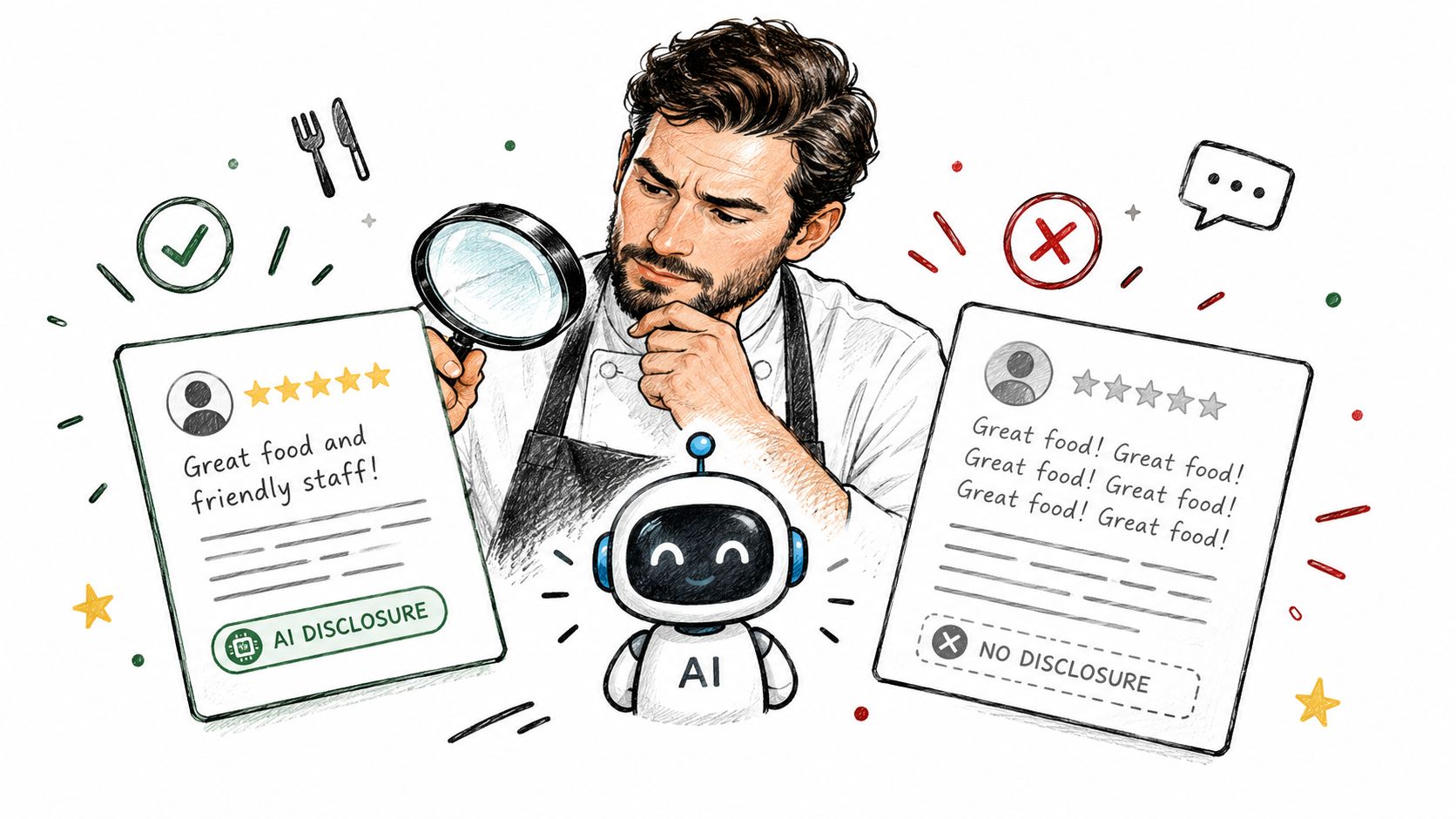
Guests already doubt what they read. Fake and machine-written reviews are common enough now that readers bring that suspicion to every glowing paragraph, including the ones your replies sit under. The risk sits with undisclosed, generic or unedited AI. A draft can help. An unedited draft that invents a dish cannot.
Checks before you treat a review as real
- Repeated phrasing: the same compliments or complaints across several reviews in a short span.
- Praise with no detail: no dish, server, time or occasion, only generic warmth.
- A sudden burst: several reviews landing together from accounts you have never seen.
- No match in the book: the visit lines up with no booking, receipt or table.
- A fact you know is wrong: praise for a terrace, a dish or a room you do not have.
Log the review with a screenshot, compare it with bookings and receipts, and report it through the platform's own route. Don't accuse the author in public. A calm note that you can't match the visit is enough for everyone else reading.
Replies get the same test. What matters is whether the posted reply sounds like it came from this house, this week. This walk-through covers replying to guest reviews:
Run every AI draft through a human check: read it, match it against the book, edit it for that visit and post it under a named person. Have a native speaker read translated replies. Translation flattens tone and repeats stock phrases, which is exactly what makes a real house sound synthetic.
Never buy reviews, and never ask only happy guests to post. Showing a review button only to people who liked the meal counts as review gating under Google's rules for contributed content, and it trains guests to distrust the rest.
Response Templates for Praise, Complaints and Fake Reviews
The reply is read as carefully as the review. In 2024, a Prodege survey of 2,000 U.S. consumers, published by Reputation.com, found that 85% consider how businesses respond to negative reviews when they decide. Search Engine Journal reported that 48% of consumers felt more positive about a business when reviews were written by named individuals, up from 40% in 2023. Names and specifics do the work. Stock warmth does not.
A good reply also points back to the operations signal: a late seating, an unclear allergen note, a booking that never reached the floor. Placeholders sit in square brackets. Rewrite them for the visit, and have a named manager send the answer.
Praise
Thank you, [name]. The [dish or moment] on [day] is good to hear about. If you're back midweek, ask for [table or bar seat]; it's usually calmer then.
Wait-time complaint
[Name], you're right about the wait on [day]. We've changed [specific fix] from [time] at peak. Email [address] if you want the detail of what changed.
Food or allergen complaint
We're sorry. Allergy safety has to be checked, not debated in public. Please email [address] with the dish and the time so we can trace that order off this thread. Dishes are listed on our allergen menu.
Unverifiable or suspected fake review
We can't match this visit to a booking, receipt or table on [date]. Please email [address] with a name and time. We'll leave it there in public.
Non-English review
Thank you, [name]. The note about [dish or issue] matters to us. If anything needs a private answer, write to [email].
Have a native speaker approve the final wording before posting.
Rules behind every reply
Reply within 48 hours. Never offer compensation in public. Never paste the same paragraph twice. Name the issue in the first sentence, whether it is the wait, the dish or the fact that you can't find the visit. If the same complaint shows up twice, fix the cause before drafting the next answer.
Private replies in other languages can go through a translated feedback inbox. TopFoodApp's core tools are free, and an optional Pro plan adds fuller AI translation and branding. It does not replace the named person who sends the note. If the complaint is about a dish the guest couldn't picture, a photo menu you can update yourself stops the next guest guessing from a PDF.
Setting Up Monitoring in One Week by Venue Type
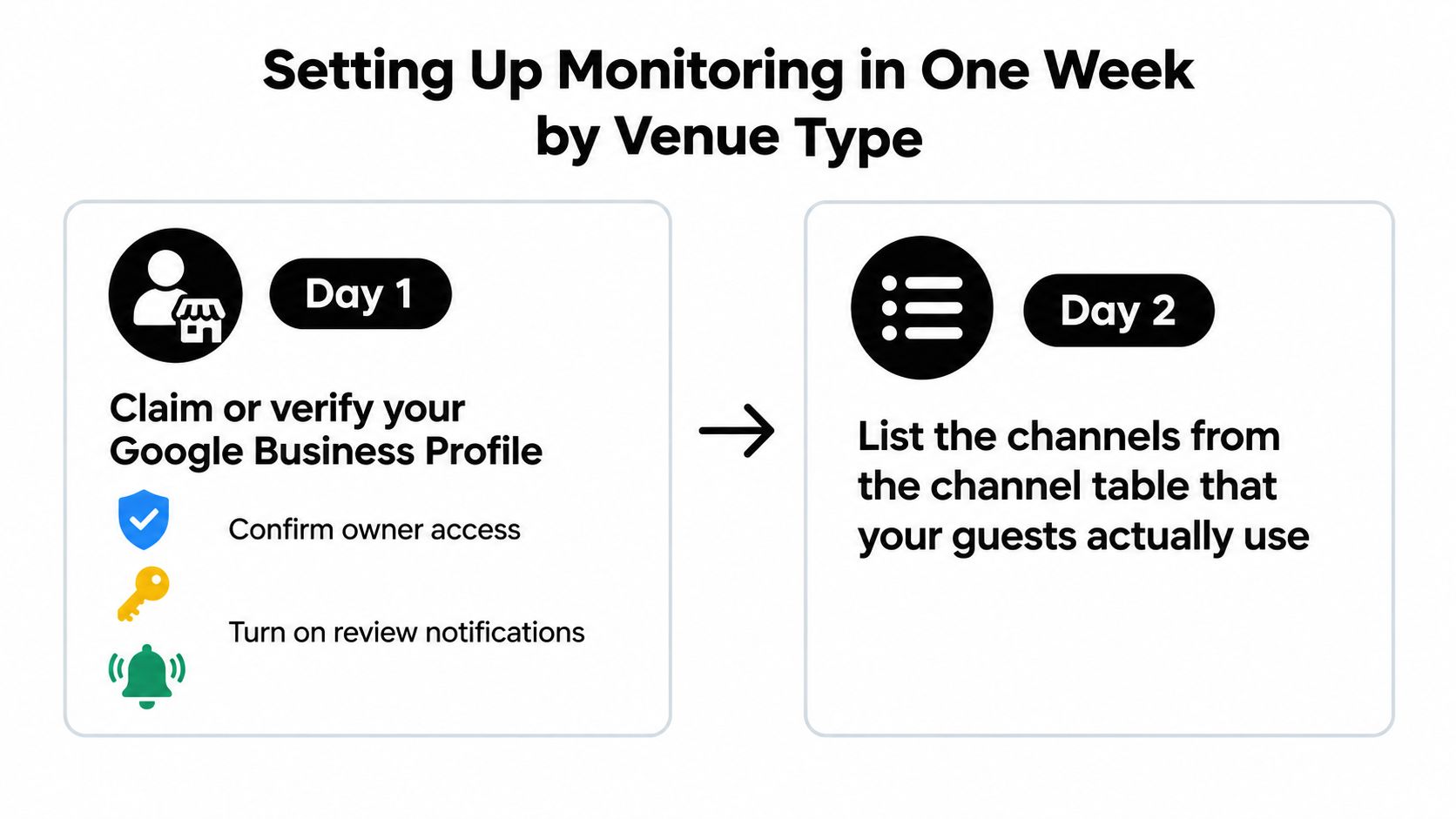
A week from today, a one-star review about Saturday's wait could be sitting unanswered, or it could already be in the shift notes. Seven short sessions separate those two outcomes. Each day has one job, and day 7 only works if the earlier days produced somewhere to look.
Day 1. Claim or verify your Google Business Profile, confirm owner access and turn on review notifications.
Day 2. List the channels your guests use and add one shared alert email for each. Skip the sites nobody in your book mentions.
Day 3. Build the private post-visit feedback form covered earlier and print a code from a free QR code generator for receipts and table tents. Keep the public review button in front of every diner.
Day 4. Set up the direct booking page, then connect it. In the profile's Bookings section, choose Add link, paste the URL and save. Google's booking help distinguishes that manual link from the blue booking button, which needs a provider with a direct API integration. The link still works from Search and Maps without that button. Put the same URL on Instagram, the website and the digital menu.
Day 5. Set the alert rules and name an owner and a backup for each.
Day 6. Write the reply templates and agree which drafts need a human check before they go up.
Day 7. Pull whatever history already exists: past ratings, booking records, response times and no-shows by service period. That becomes your baseline, however rough. Where no history exists, today is day one of the log, and you tune the alert thresholds after four weeks of real entries. Either way, the numbers worth watching are the operational ones: waits, allergen slips and reservation problems that trace back to a cause you can fix.
Tourists who can't read the local menu need one they can use. AI menu translation belongs next to the feedback form, since an allergen reply still needs a native speaker's eye.
Who starts where
| Venue type | Start with | Review cadence | Who owns replies |
|---|---|---|---|
| Independent restaurant or café | Google Business Profile and the private feedback form | Daily 10-minute check | Owner or head of floor |
| Bar, pub or brewery | Google, Instagram tags and delivery apps | Daily, with extra checks after weekend peaks | Shift manager on duty |
| Hotel or B&B | Google, TripAdvisor, OTA reviews and in-room feedback | Daily | Guest relations lead, with a sign-off step |
| Food truck or pop-up | Instagram, Google and event pages | After each event | Owner |
| Multi-location group | All channels, with a dashboard per location | Daily alerts and a weekly regional report | Central team drafts, location manager replies within 24 hours |
Hotels and B&Bs should put room service on a hotel digital menu so an in-room complaint points at a real dish list. Trucks and pop-ups can run a QR menu built for food trucks and check channels after the event, once the rush is over.
TopFoodApp gives independent restaurants a commission-free booking page, a private guest feedback form and a QR menu, so the comments you read connect to the tables you run. Set up the channel you already check each morning at TopFoodApp.