Menu Descriptions That Sell and Stay Accurate
The menu on your tables was printed in spring. Two dishes have gone, the fish supplier has changed twice, and the dessert still says "homemade" because it was homemade when you typed it. At table four a guest is asking whether the sauce contains nuts, and the newest member of your team is guessing.
That gap between what the menu says and what the kitchen does is where most menu descriptions fail. Not because the writing isn't pretty, but because it isn't true, and it isn't structured enough to help anyone decide. A useful dish description is 10 to 20 words of checked information: what the dish is, what's in it, how it's cooked, where it comes from when that matters, and what it contains that could hurt somebody.
Table of Contents
- A 10 to 20 Word Formula for Every Dish
- Varied Description Styles With Examples
- Before and After Rewrites That Show the Gap
- Allergens and Hidden Ingredients Guests Ask About
- Provenance Claims You Can Verify
- What Descriptive Wording Does to Orders
- Publish Your Descriptions This Week
A 10 to 20 Word Formula for Every Dish
A dish description is short operational information that answers a diner's questions in order: what the dish is, what it's made of, how it was cooked, what it tastes and feels like, where it comes from, and what it contains.
That order is not a writing style, it's a specification. Menu descriptions work best when they're engineered as structured information rather than promotional prose, answering the diner's decision questions in sequence and avoiding unsupported claims such as "authentic," "healthy" or "best," as the analysis of menu language hosted by Stanford sets out.
Here's how each element works in practice.
| Element | What to include | Example |
|---|---|---|
| Dish name | The name guests will recognise | Grilled halloumi |
| Main ingredients | Two to four nouns, most important first | Tomatoes, cucumber, mint |
| Cooking method | One term that describes the preparation | Charred or slow-braised |
| Texture or flavour | One sensory cue you can deliver on the plate | Crisp, smoky |
| Origin or provenance | Only when you can verify it | Cornish mussels |
| Allergens | Declared clearly, with the 14 EU allergens marked | Milk, gluten |
Now run one dish through all six rows. Take the chicken you already sell: the dish name is roasted chicken, the ingredients are chicken, buttermilk marinade, thyme jus and seasonal vegetables, the method is roasting, the texture is crisp skin, the origin is your farm if you can name it, and the allergen is milk from the buttermilk.
Printed, it reads: "Crisp roasted chicken, buttermilk marinade, thyme jus, seasonal vegetables. Milk." That's ten words. It fits the range, and every word of it is checkable.
The kitchen check: the description is not finished until the person cooking the dish has read it against the recipe card. Ingredients, method, portion implication and allergen statement all get verified before the line goes to print.
One trap to avoid: equating "healthy" with restrictive wording. Research analysing 22 qualitative themes across thousands of menu descriptions found that items marketed as healthy were described with fewer appealing cues, such as excitement, indulgence, texture, spice and taste, and with more deprivation or nutrition-focused language than standard items. Describe the roasted vegetables by char and seasoning, then state the dietary fact separately in its own short clause.
A complete description beats a poetic one every time a guest is choosing around an allergy. The same formula works for a bowl of soup (roast tomato, basil oil, sourdough. Gluten, milk) and for a seven-course tasting menu, where each line just carries more weight per word.
Varied Description Styles With Examples
A menu where every dish is described the same way reads like a spreadsheet. Match the style to the dish type, then keep the allergen line in exactly the same position on every entry.
Technique-led, for mains. "Slow-braised beef shin, red wine jus, carrots, horseradish mash. Celery." The cooking method does the selling and you haven't used a single adjective. This style suits braises, roasts and anything with a long cook, because the time invested is the story.
Ingredient-led, for starters. "Beetroot, whipped goat's cheese, toasted walnuts, honey vinaigrette. Milk, nuts, mustard." Every named ingredient gives someone a reason to order, and someone else a reason to skip. That's useful, not a loss.
Format-led, for sides and sharing plates. "Charred padrón peppers, flaky sea salt, lemon wedge." Say how it arrives, whether that's a shared board, a single portion or something to pick up. Guests ordering for a table need to know how many plates to ask for.
Drink-led, for bars and cafes. "Cold brew, oat milk, house vanilla syrup, served over ice. Check the oat-milk brand for gluten." Name the base, the milk or syrup and the serve. If you swap oat-milk brands, the allergen note changes with it, so the line has to live somewhere you can edit.
Dessert-led. "Lemon posset, shortbread crumb, blackberries. Egg, milk, gluten." Name the fat or the sweetener carrying the flavour, because that's what people are deciding on.
Across all five, use one sensory or method word, not three. "Crisp, golden, succulent, flame-grilled" reads as noise and dates fast.
The reading-aloud test
Read each new line next to the dish beside it on the menu, out loud. If a guest couldn't tell the two apart from the descriptions alone, add the one ingredient or method that separates them. Two chicken dishes both described as "grilled chicken with seasonal vegetables" is a menu that makes people ask the server, and the server is busy.
A description earns its space by removing a question. If it doesn't remove one, it's decoration.
Photos help here, and the guide to building a digital menu with photos shows how to pair a short description with one image per dish so the two do different jobs.
Before and After Rewrites That Show the Gap
"Delicious" is the most expensive word on a menu. It promises something, describes nothing, and every dish on the page is claiming it at once. "Homemade" and "our famous" fail the same way, because they are claims rather than information, and nothing on the plate proves them.
The fix is mechanical. Replace the adjective with a verifiable specific.
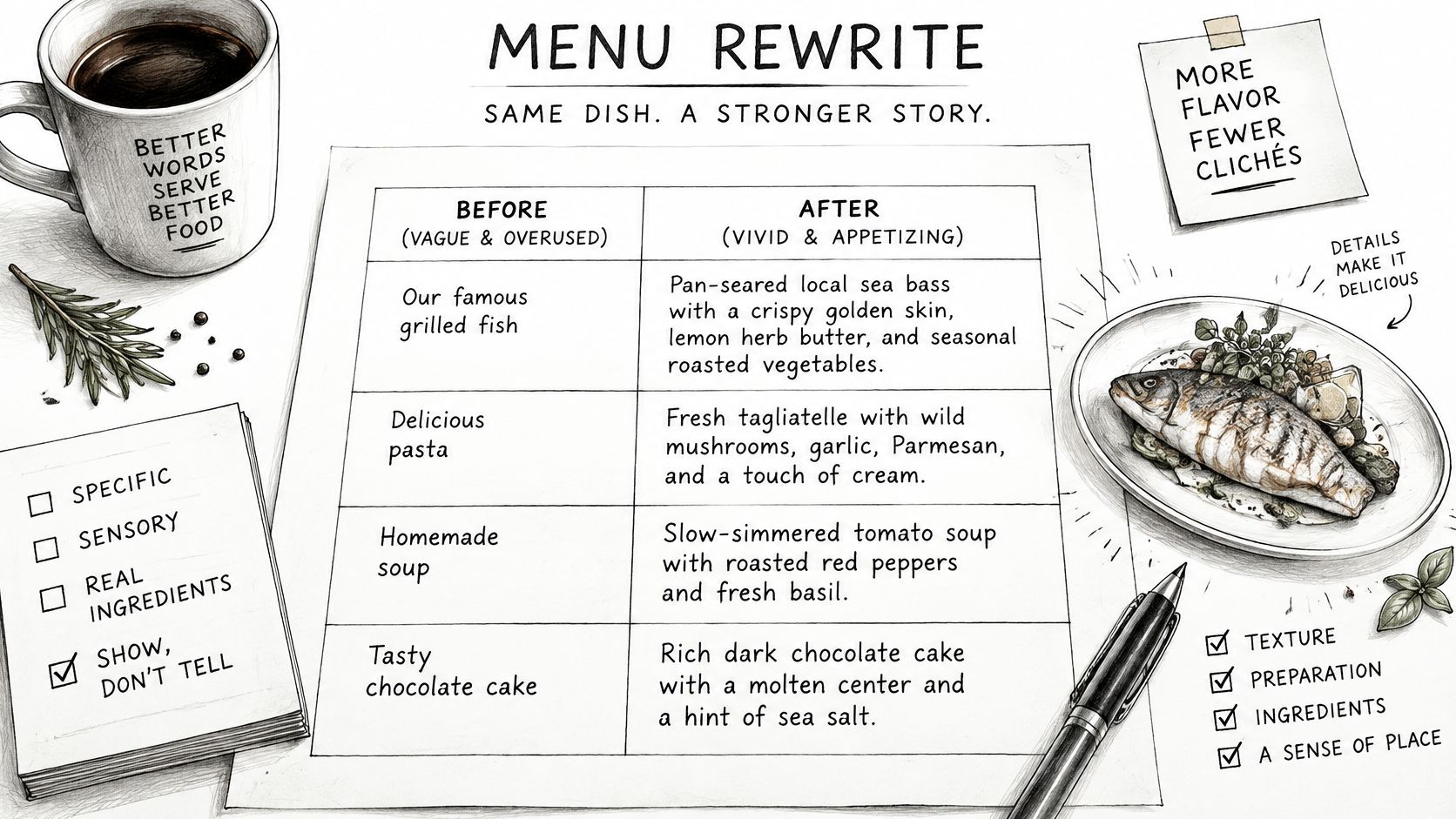
| Before | After | What changed |
|---|---|---|
| Delicious homemade fish with special sauce | Pan-seared sea bass, crushed potatoes, lemon-butter sauce, parsley | Subjective praise replaced by method, fish, side and sauce |
| Fresh salad with dressing | Grilled halloumi, tomatoes, cucumber, mint, pomegranate molasses | Vague salad named by its components |
| Our famous burger | Smashed beef patty, aged cheddar, pickles, brioche bun. Gluten, milk, egg | Claim replaced by components and allergens |
| Chocolate dessert | Dark chocolate fondant, sea salt, crème fraîche. Egg, milk | Category replaced by the main ingredient and the allergens |
Look at what each rewrite does. The adjective becomes a method (pan-seared, smashed, grilled). The unnamed ingredient becomes a named one (sea bass, halloumi, aged cheddar, dark chocolate). The allergen moves into the line itself, where a guest is already reading, instead of a footnote or a symbol nobody decodes at the table. Notice what none of the after versions does: none of them says the food is good.
Study the fish line first. In eight words it names the cooking method, the fish, the side, the sauce and the garnish, and it drops the praise "delicious" was making on the dish's behalf. One sensory cue, crisp or smoky, gives the line texture. A second cue starts to read as noise, and noise is what you were deleting.
The burger and the fondant take the same approach for allergens. Food Standards Scotland's allergen management guidance_CookSafe_-_Allergen_Management_Insert_Update_September_2021.docx) states that menu names and descriptions should reflect the allergenic ingredients a dish contains. If an ingredient can harm someone, it belongs in the words, not in a key at the bottom of the page.
Run the audit before anything goes to print. Delete every "best," "authentic" and "healthy" you cannot prove, then replace each one with the ingredient or method that earns it. Check the word count on every line. Then hand the lines to the kitchen, because a description has to survive a busy Friday service. If the pass cannot plate what the words promise, the words are wrong.
A description sends the guest to the right question. The kitchen still has to answer it.
Allergens and Hidden Ingredients Guests Ask About
In the European Union, allergen information for non-prepacked food is mandatory, not optional. The EU food safety guidance on food allergies identifies 14 allergens that must be declared when used as ingredients, and it recommends making allergen names visually distinguishable through bold type, a different style or a contrasting background.
Put the allergen in the description line itself. Keep the allergen line in the same place on every dish so a guest can find it without reading the whole page. Then use the table below as a check against your recipes, because the allergen usually isn't in the main ingredient.
| Allergen | Where it hides on menus | Example wording |
|---|---|---|
| Cereals containing gluten | Batter, breadcrumbs, soy sauce, roux | Breaded in wheat flour |
| Crustaceans | Bisque, stocks, shrimp paste | Prawn bisque |
| Eggs | Mayonnaise, pasta, glazes, batter | Egg yolk mayonnaise |
| Fish | Caesar dressing, Worcestershire, fish stock | Anchovy dressing |
| Peanuts | Satay sauce, curries, nougat | Satay sauce made with peanuts |
| Soybeans | Soy sauce, tofu, miso | Tofu and miso glaze |
| Milk | Butter, cream, cheese, buttermilk marinade | Buttermilk marinade |
| Nuts | Pesto, praline, marzipan, nut oils | Almond shortbread |
| Celery | Stock, spice mixes, celeriac | Celery salt |
| Mustard | Dressings, marinades, sauces | Dijon vinaigrette |
| Sesame | Bread, tahini, dukkah | Tahini dressing |
| Sulphur dioxide and sulphites | Wine, vinegar, dried fruit (above 10 mg/kg or 10 mg/L) | Sulphite-treated dried apricots |
| Lupin | Flour, pastry, plant-based alternatives | Lupin flour pastry |
| Molluscs | Squid, mussels, oysters, some sauces | Mussels in white wine |
The sauces carry it, not the protein
Read your own menu the way a nervous guest reads it. The thing they're worried about is rarely the chicken. It's the jus, the marinade, the garnish, the stock the vegetables were cooked in. List every sauce, dressing, garnish and stock on a per-dish checklist and mark it there, because that's where the declaration belongs.
Demand for this is growing. A 2025 survey of American diners found 68% prefer menus to list all ingredients, 58% consider nutritional value when choosing meals, and more than one in six have asked a restaurant for extra nutritional information when the menu didn't provide it, according to US Foods' menu research. That's a US sample, but the behaviour travels.
Three wording rules for modifications
Write what's in it, not what's missing. "Cooked in butter" beats implying a dish is dairy-free because the word butter didn't appear.
Name the anchovy and the shared grill. If the dressing contains anchovy, say so. If the steak is cooked on the same grill as the fish, write "cooked on a shared grill."
Offer substitutions only when the kitchen can deliver them every service. "Made without butter on request" is a promise, and a Saturday-night version of it that fails is worse than no offer.
Avoid "free from" claims entirely. An ingredient missing from a description does not make a dish safe, particularly in a small kitchen where recipes change weekly and a new commis is on the section. Publish consistently with a free allergen menu so the guest sees the same information in print and on their phone, and work through the restaurant allergen compliance checklist before a new menu goes live.
Provenance Claims You Can Verify
Guests are paying attention to where food comes from, and the spending follows it. Restaurant Business's menu trend report reports that 38% of diners were more likely to choose restaurants offering locally sourced products, while 30% favoured food grown or raised in environmentally friendly ways.
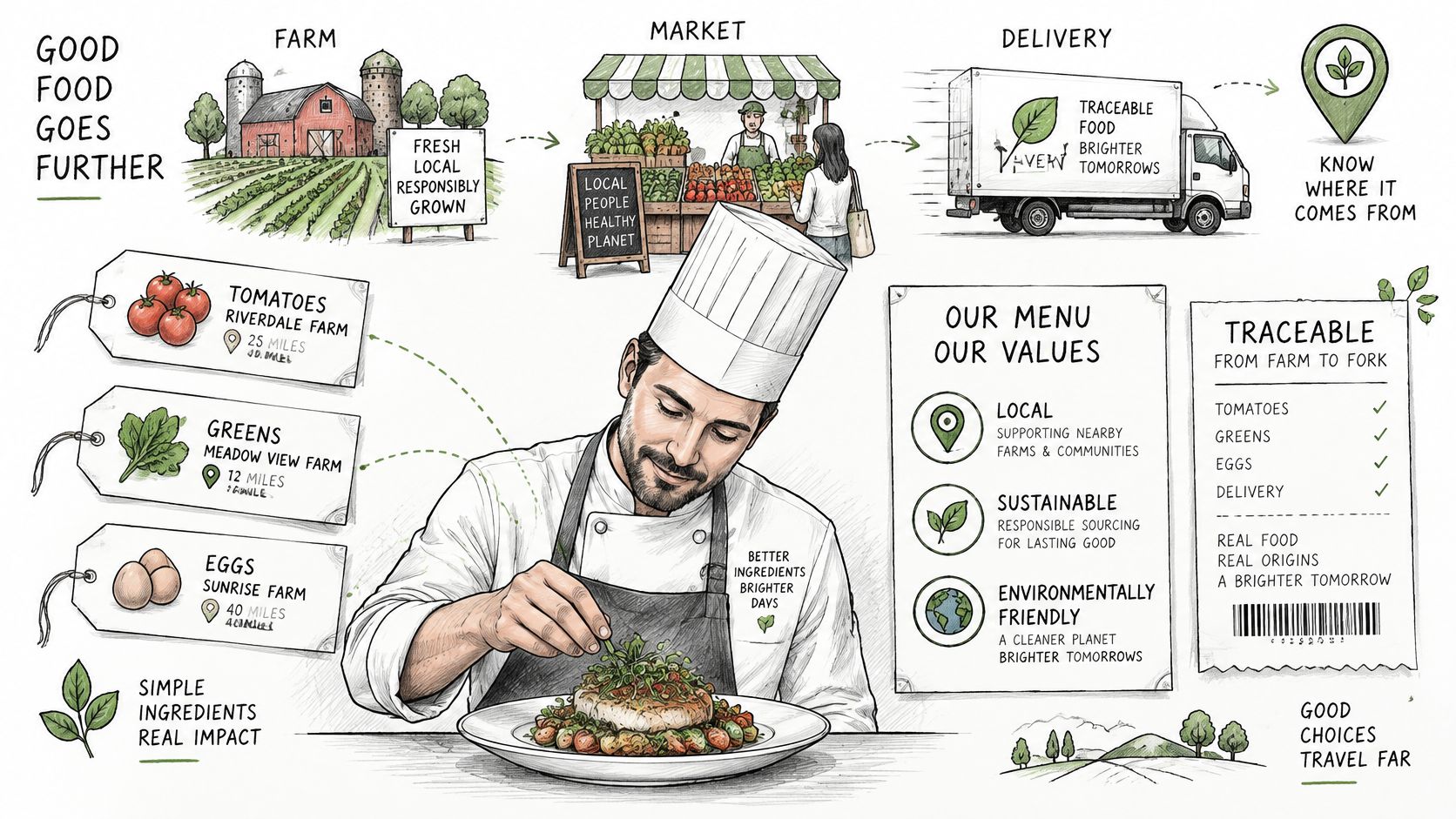
Menus get caught here. "Local," "organic," "seasonal," "responsibly sourced" and "low-waste" each point to a different standard, a different geography, or a different part of the dish. Produce that passed through a regional depot far from the farm can still be sold to you as local, and your guest can't tell which meaning you used. Your kitchen has to know.
| Term | What the description must specify | Example |
|---|---|---|
| Local | The region or distance, and the ingredient it applies to | Tomatoes from Kent |
| Organic | The certification and the specific ingredient certified | Soil Association certified organic flour |
| Seasonal | The season or availability window | Asparagus, spring season |
| Responsibly sourced | A named standard or supplier, never the phrase alone | Line-caught hake from a named fishery |
| Low-waste | The specific practice used in the dish | Made with surplus bread |
The format that survives menu changes names one ingredient and one verifiable fact: "Kent tomatoes, seasonal availability," "oyster mushrooms grown locally," "made with surplus bread." When the supplier changes, you edit one phrase rather than rewriting the whole page.
Keep a supplier sheet alongside the menu file. One row per item: what it is, where it comes from, which certification applies, and which months it's available. Check it before every print run and every digital publish, because the claim that was true in June is a liability in November.
The rule that settles arguments: if you can't name the source, the item or the practice, the claim comes out. One unsupported sustainability line taints every other dish on the page.
That same precision matters for religious and cultural diets, where "vegetarian" and "no pork" carry specific meanings and a loose description can put a guest off the whole menu. The guide to religious dietary needs on menus covers the wording for those cases.
What Descriptive Wording Does to Orders
The clearest field evidence on menu wording comes from a six-week experiment with 140 cafeteria customers, comparing six dishes presented with either ordinary labels or evocative ones such as "Grandma's zucchini cookies" and "succulent Italian seafood filet." About 56% of customers chose the descriptively labelled items against 44% for the conventionally labelled versions, and the descriptive versions produced a 27% increase in sales, according to the published account of the study. Diners also reported better attitudes toward the food and the restaurant, and stronger intentions to return.
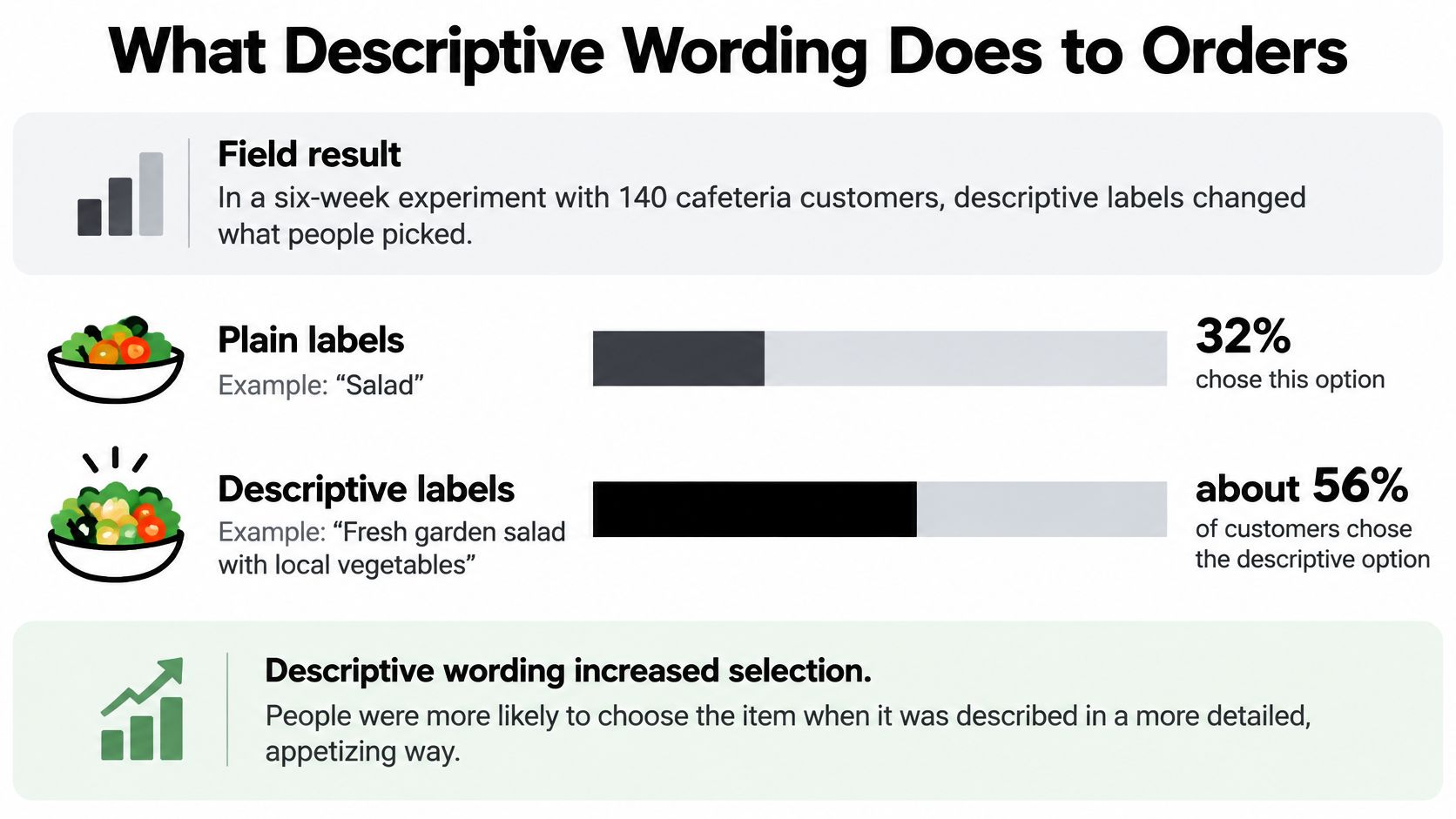
Now the limit, and it matters more than the headline. The same experiment found no direct increase in what customers were willing to pay for the descriptively labelled items. Descriptions help you sell the dish you want to sell. They don't buy you pricing power, so don't raise the price and credit the copy.
The lift also came from simple changes to names and descriptions, not from exaggeration. And it's one small study in one cafeteria. Treat 27% as a reason to test, not a number to forecast.
A test you can run this month
Pick two or three dishes, choosing high-margin items or slow movers. Write two versions of each using the formula, then rotate them across comparable services: same day of week, same daypart, similar covers.
Track orders per 100 menu views, not raw units, and note weather and any promotion running that week. Record modification requests and complaints alongside sales, because a vivid description that oversells will lift orders and harm satisfaction at the same time.
Change one variable per rotation. When a version wins and stays accurate, move it into a versioned copy library so the next print run starts from something tested rather than something remembered.
Menus are written once and read a thousand times. A copy library is how you stop rewriting from scratch every season.
The same discipline applies to the rest of your web presence, where vague claims cost you the same way they cost you on the page: Carlos Alba Media's web copy guidance for UK SMEs covers the broader job of replacing adjectives with information. On guest trust specifically, the guide to building customer trust connects accurate descriptions to repeat visits. And to see whether a vivid line is causing disappointment rather than delight, collect private feedback through the free restaurant feedback form and read the comments next to the sales figures.
Publish Your Descriptions This Week
The decision is whether to rewrite your best-selling dishes now or wait for the next print run. Rewrite now. The ten dishes that carry your revenue are the ten whose descriptions earn the most per word changed, and you can have them done before service on Thursday.
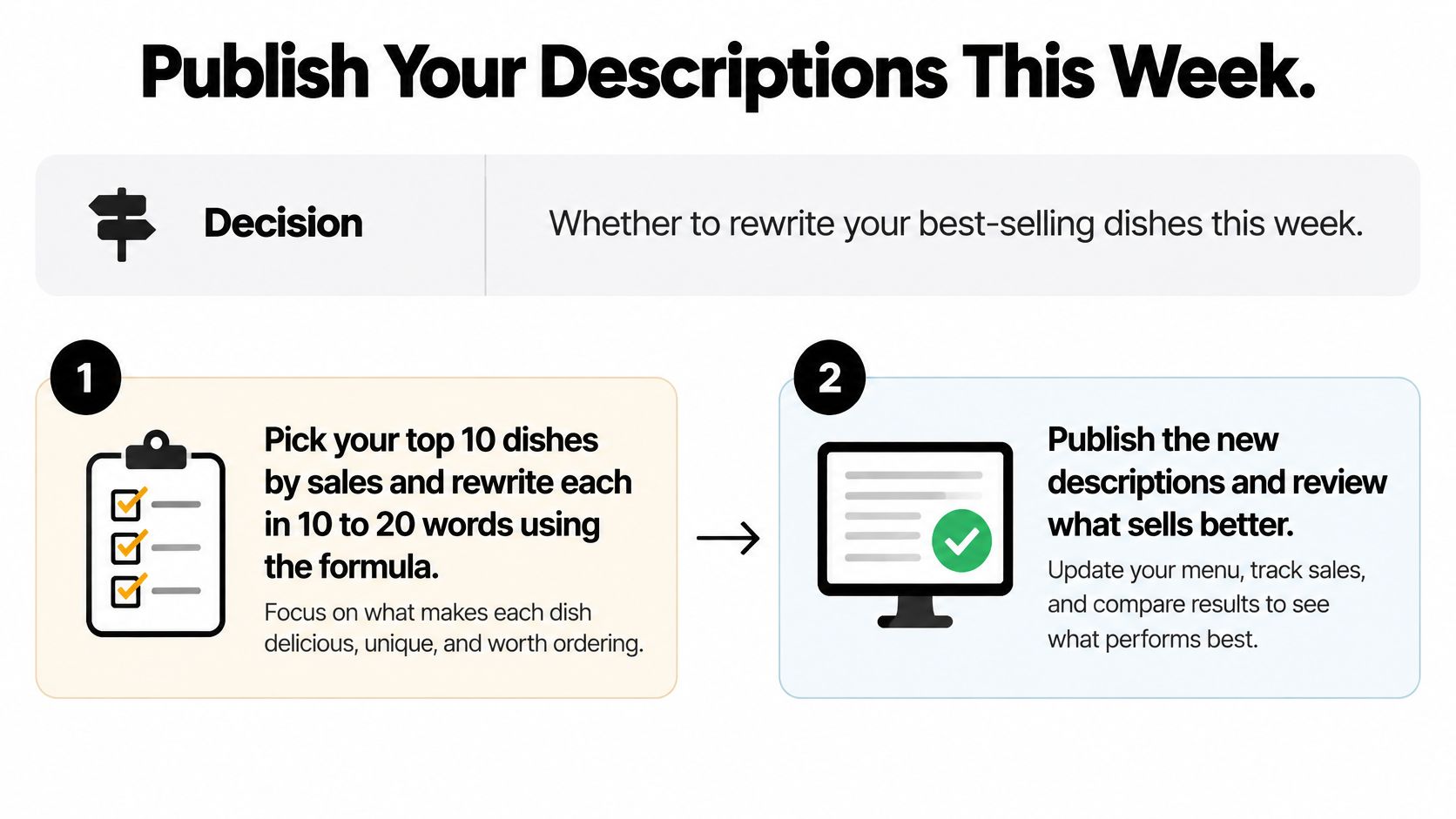
- Pull your top 10 dishes by sales and rewrite each in 10 to 20 words using the six-element formula.
- Check every ingredient, method and allergen with the head chef against your allergen list, not against memory.
- Mark allergens clearly and check every provenance claim against the supplier sheet before it goes anywhere near a guest.
- Publish in the menu editor, where each change goes live for guests immediately and the QR code they already have keeps working.
- Track orders and modification requests for two weeks, then keep the wording that sells and survives the kitchen check.
The practical setup is what makes this a week's work rather than a month's. A free menu creator lets you start from a blank menu or pull in your existing one, tag the 14 EU allergens per dish, and edit any line in seconds. One QR code covers all your menus, so a price change or a sold-out dish doesn't mean a reprint, and seasonal or daily items can be hidden without disturbing the main menu.
Guests can search the menu by dish name or description, which turns precise wording into a navigation tool as well as a sales one. And because the descriptions can be translated by AI into the guest's own language through AI menu translation, a tourist reads the allergen line in their own language rather than guessing at it.
If you still hand out a printed or PDF menu for events, sharing a PDF menu by link keeps a downloadable version consistent with the digital one. For teams managing several sites or frequent specials, the guide to menu management software covers how to keep one source of truth. The core of TopFoodApp is free, with an optional Pro plan that adds full AI translation and branding options.
None of that replaces the final check. The kitchen verifies every description before it's published, because the menu is a promise and the pass is where it gets kept.
TopFoodApp gives independent restaurants a free digital menu they can edit in minutes, with allergen tags, AI translation for guests reading in another language, and one QR code that never needs reprinting. If your descriptions are due a rewrite, build the menu here, run each line past your head chef, and publish the version that sells without overpromising. Start at TopFoodApp and have your ten best dishes rewritten this week.