What Is a Kitchen Brigade and How It Runs Today
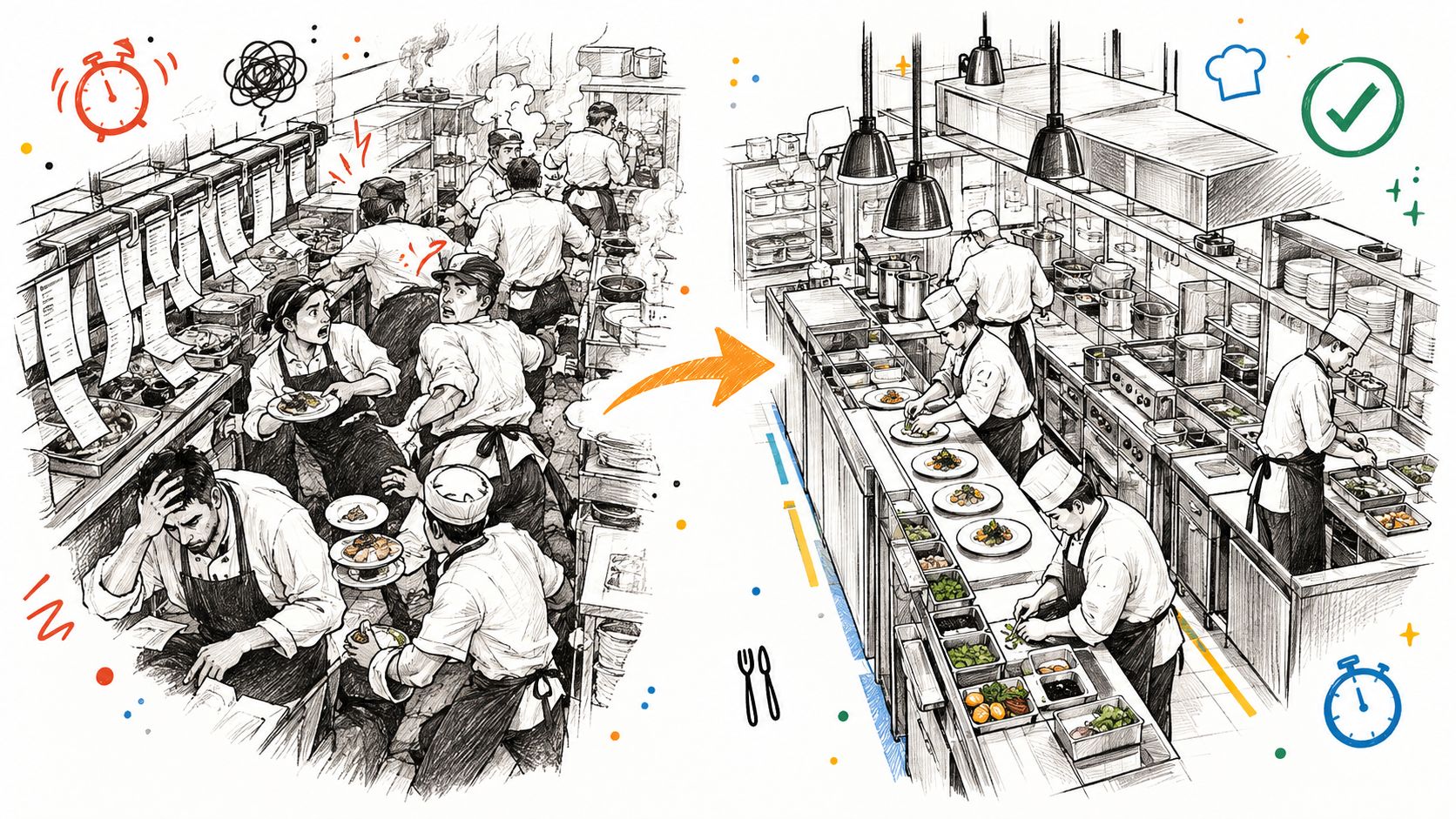
A Friday dinner rush has a familiar sound: printers chatter, pans hiss, and tickets collect faster than anyone can read them. One cook starts a sauce, another reaches across the same counter for fish, and the person responsible for dessert is suddenly helping with vegetables. The problem usually isn't effort. It's that nobody knows exactly who owns each task.
That's where the kitchen brigade system earns its place. A brigade gives the kitchen stations, reporting lines, and clear responsibility for production. It turns a group of cooks into a coordinated team without requiring every person to perform every task.
Table of Contents
- Introduction to the Kitchen Brigade System
- What the Kitchen Brigade Means in Modern Kitchens
- History of the Brigade System and Escoffier Influence
- Kitchen Brigade Hierarchy and Key Roles Explained
- Classic Stations Versus Modern Merged Roles
- Benefits of the Brigade System for Restaurant Operations
- How to Adapt the Brigade for Small Teams
Introduction to the Kitchen Brigade System
The phrase brigade de cuisine describes the organized system used to divide professional kitchen work. Each cook has a defined station or level of responsibility, and the team follows a chain of command during preparation and service. The classic model was designed for large, complicated operations, but its underlying principle works in a hotel, a neighborhood bistro, a café, or a food truck.
Think of a small service. The chef decides what needs to leave the pass, the grill cook handles proteins, another cook manages cold starters and garnishes, and a pastry-trained team member finishes desserts. If someone needs help, the request travels through an understood structure instead of becoming a shouted question to the whole room.
The brigade isn't valuable because French titles sound impressive. It's valuable because station ownership reduces hesitation. A cook can prepare mise en place with confidence, spot a shortage before service, and communicate with the person who can solve the problem. The system also makes training clearer. A new commis learns one area properly before taking on broader responsibilities.
This guide is useful if you're studying culinary arts, hiring for an independent restaurant, or trying to bring order to a busy hotel kitchen. You'll learn where the system came from, how the classic hierarchy works, which stations are commonly combined today, and how a 10-person team can use the structure without pretending it has a historical brigade.
By the end, you should be able to sketch a practical kitchen organization, assign ownership to every major task, and decide which titles matter in your operation and which can be left in the history books.
What the Kitchen Brigade Means in Modern Kitchens
A useful way to understand a brigade is to compare it with an orchestra. The violinist, percussionist, and conductor don't perform the same work, but the audience experiences one piece of music. A kitchen works in much the same way. The guest sees one plate, while several stations may have prepared, cooked, seasoned, garnished, and timed it.
The brigade also resembles a sports team. A goalkeeper doesn't abandon the goal every time another player needs support, and a line cook shouldn't leave an active station without a plan. Clear positions make cooperation possible because everyone knows both their primary duty and the boundaries of their responsibility.
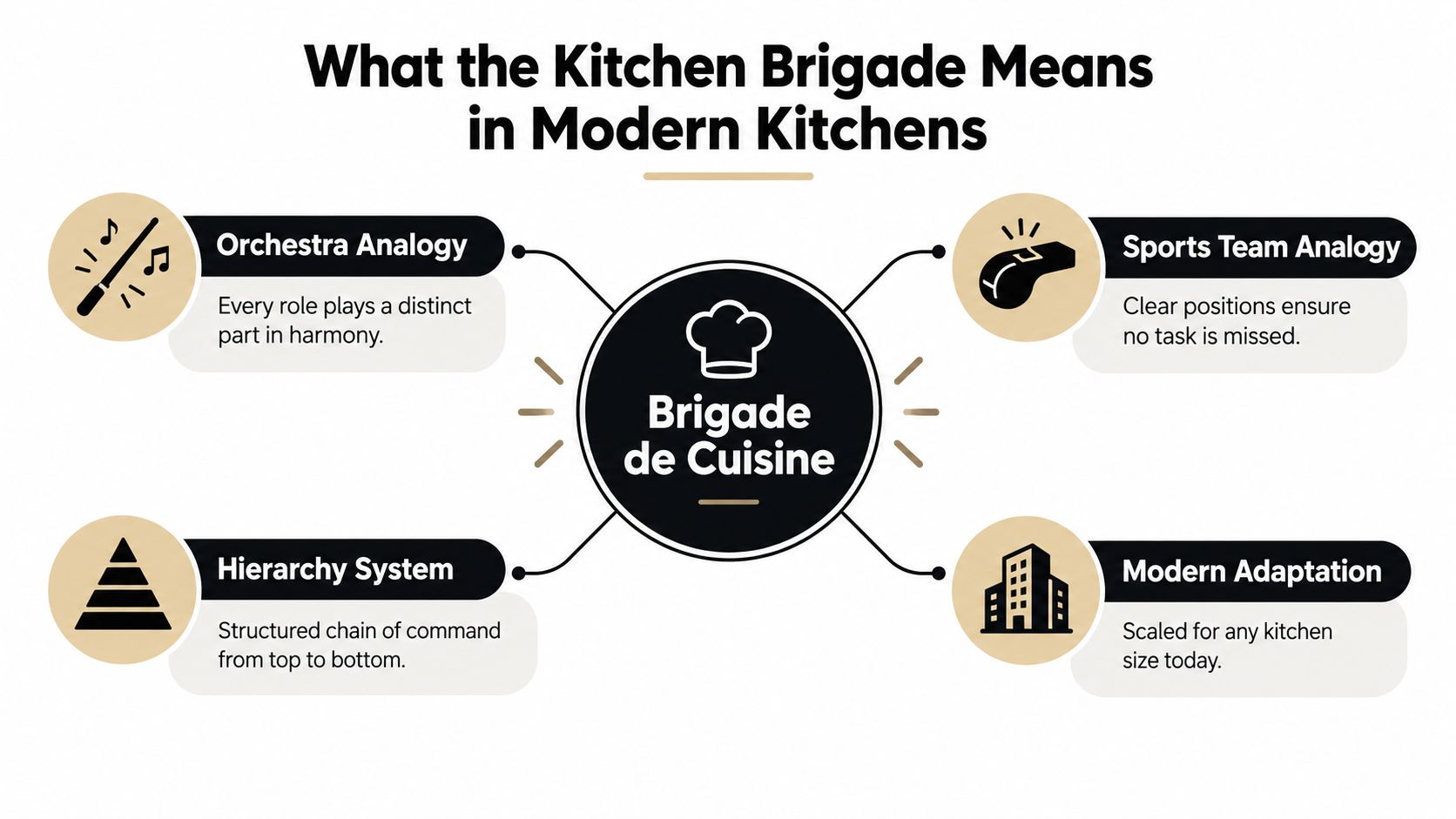
The four operating principles
Division of labor: The kitchen breaks a large workload into stations such as sauce, grill, pastry, cold preparation, and dishwashing.
Station ownership: One person or a small team is accountable for preparation, cleanliness, replenishment, and execution at each station.
Chain of command: The chef de cuisine leads the kitchen, the sous chef coordinates daily work, and station chefs report upward when service needs a decision.
Standardized output: Recipes, portions, plating instructions, and service calls help different cooks produce the same dish consistently.
An unstructured kitchen can appear flexible at first. Everyone helps with everything, so no title seems necessary. During a quiet prep period, that may work. During a rush, it creates duplicated work, neglected tasks, and conflicting decisions. Two cooks may prepare the same garnish while nobody checks the fish order, or several people may wait for the chef to decide who should fire a table.
A brigade doesn't mean people refuse to help outside their station. It means help is coordinated around a clear home base. A grill cook can support another station, but the team still knows who is watching the grill, who reports a shortage, and who has authority to change the plan.
Practical rule: Give every recurring task one clear owner, even when more than one person can perform it.
The same logic applies beyond the line. A restaurant can pair station responsibility with tools such as a real-time QR menu update workflow, so front-of-house and kitchen teams work from the same current menu information. The technology doesn't replace communication, but it supports the brigade's central promise: fewer surprises and clearer handoffs.
History of the Brigade System and Escoffier Influence
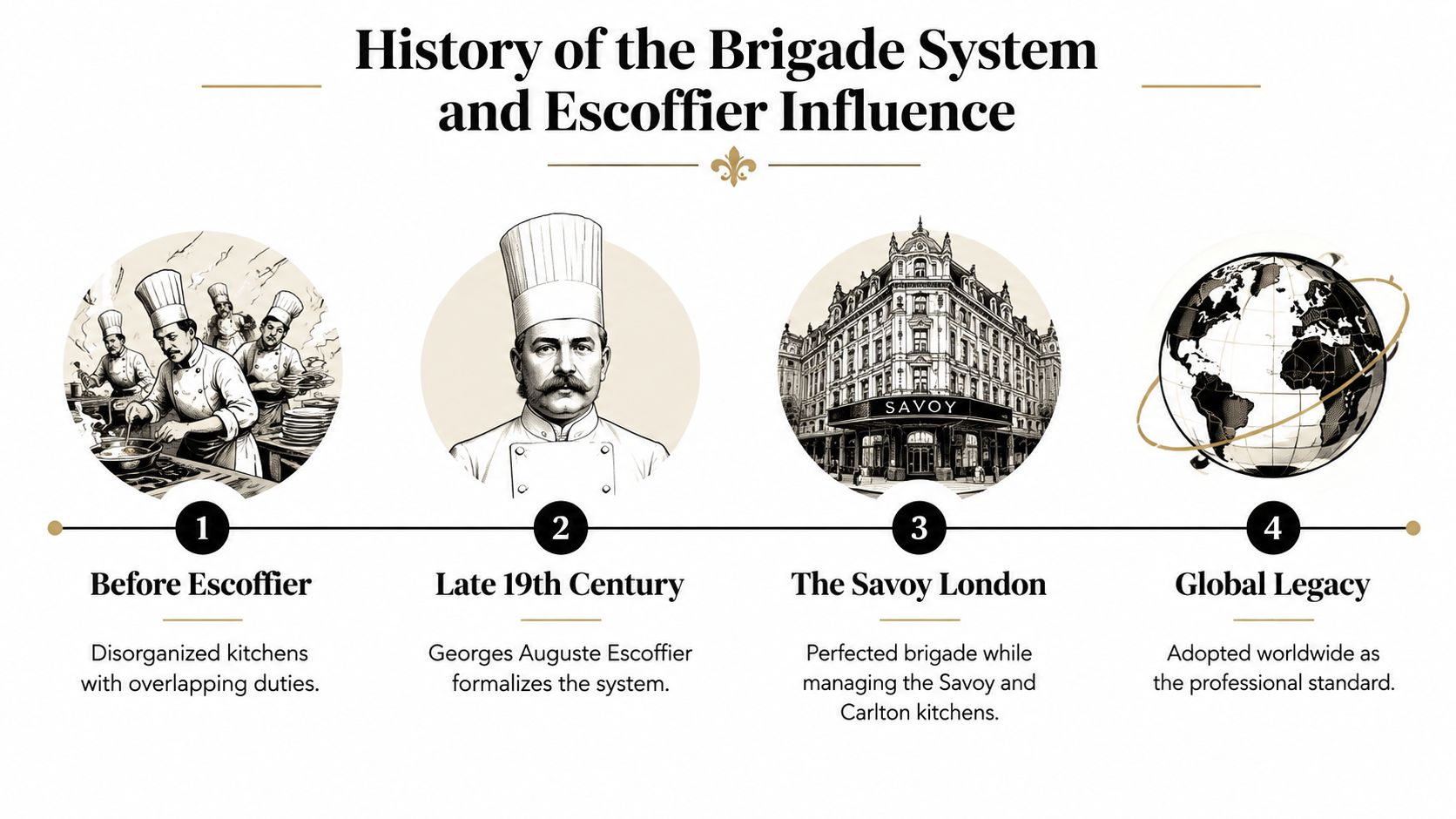
Before the modern brigade became recognizable, large kitchens faced a simple operational problem. Many cooks had to produce a wide range of dishes in a confined workplace, often for hotels serving substantial numbers of guests. Without defined responsibilities, preparation overlapped, instructions became inconsistent, and the chef had to personally control too many decisions.
French chef Georges Auguste Escoffier formalized the kitchen brigade in the late 19th century. Sources place its development in the 1890s, during his work at London's Savoy Hotel, and describe the structure as clearly defined by the publication of his foundational cookbook, Le Guide Culinaire, in 1903. You can read the historical account in this overview of the kitchen brigade system.
Why military organization influenced the kitchen
Escoffier's model drew directly from military organization. That influence explains the strict hierarchy, the emphasis on orders, and the separation of duties. The kitchen wasn't divided into stations to create ceremony. It was divided so a large operation could assign specialized work to specific cooks and coordinate the final result.
The structure placed a chef de cuisine at the top, supported by a sous chef and several station leaders. Each station handled a defined category of production. One cook focused on sauces, another on fish, another on roasting, and another on pastry. Support roles handled order calling, food preparation, and dishwashing.
That arrangement created a repeatable management framework. A chef could inspect a station, identify the person responsible, and correct a process rather than searching through an undifferentiated team. A hotel could also maintain standards across a complex menu because the work had been separated into teachable, inspectable functions.
From historical model to professional standard
The brigade spread because it solved a practical problem that many professional kitchens shared. It gave cooks a vocabulary for responsibility and gave managers a way to organize production at scale. Culinary schools and hospitality references continue to teach the structure, especially when introducing students to professional kitchen operations.
Its legacy isn't limited to French restaurants. The titles may be adapted, translated, or dropped entirely, but the core pattern remains familiar: a leader directs the operation, a service manager coordinates the pass, station owners execute defined work, and support staff keep production moving.
Kitchen Brigade Hierarchy and Key Roles Explained
The classic brigade is easiest to understand as a pyramid. Authority moves downward, while information about shortages, timing, and quality moves both ways. The chef sets direction, station leaders execute specialized work, and the expeditor keeps the separate pieces synchronized at the pass.
Leadership above the stations
Chef de cuisine: This is the head of the kitchen. The chef de cuisine establishes the menu direction, sets standards, organizes the brigade, and carries final responsibility for what leaves the kitchen.
Sous chef: The sous chef is the second-in-command and the operational link between leadership and the line. During service, this person may coordinate the stations, monitor timing, solve problems, and take control when the chef is occupied or absent.
Chef de partie: A chef de partie leads a station or “partie.” This person owns the mise en place, equipment, cleanliness, cooking, and plating associated with that area.
A station isn't just a place beside the range. It's a promise that someone has checked the ingredients, understands the method, and is watching the final result.
The classic station specialists
The traditional titles describe the work in more detail:
- Saucier: Prepares sauces and often handles related hot preparations.
- Poissonnier: Manages fish and seafood cookery.
- Rôtisseur: Oversees roasted and, in some kitchens, grilled meats.
- Entremetier: Prepares vegetables, soups, and other side dishes.
- Pâtissier: Produces pastries, desserts, and sometimes bread.
- Garde manger: Handles cold foods, salads, starters, terrines, and related preparation.
- Aboyeur: Calls orders and coordinates communication at the pass.
- Plongeur: Washes dishes and supports the sanitation flow that allows the kitchen to keep operating.
The hierarchy can include more than 10 named positions in modern explanations. One culinary reference describes Escoffier's system as containing over 20 specific cook positions, while a contemporary guide catalogs 24 positions associated with the brigade system. The Cordon Bleu explanation of the kitchen brigade provides that historical detail.
How an order moves through the system
A ticket begins with communication from the pass or order caller. Each station reads the items it owns, confirms timing, and starts the appropriate preparation. The chef de partie controls execution within that station, while the sous chef or chef de cuisine watches the full table so dishes arrive together.
If you're building a hiring plan, it helps to separate leadership, production, and support rather than treating every kitchen employee as interchangeable. This guide to back-of-the-house jobs can help clarify how kitchen positions fit within the broader restaurant team.
A brigade also supports food safety. Clear ownership makes it easier to assign storage checks, allergen communication, cleaning duties, and recipe controls. Operators building those procedures can use this restaurant allergen compliance checklist as a practical reference.
Classic Stations Versus Modern Merged Roles
The historical brigade was highly granular. One authority describes Escoffier as assigning over 20 specific cook positions, while another modern guide explicitly identifies 24 positions associated with the system. Those figures show how much the original model relied on specialization, but they don't mean a contemporary operator should reproduce every title.
The more useful question is functional: which responsibilities must be covered during service, and can one trained person safely cover more than one of them? In a small kitchen, a chef de partie might handle fish, meat, and vegetables across the same service. A pastry cook might prepare desserts and bread. A garde manger role may include salads, cold starters, prep, and plating support.
| Classic Station | Traditional Responsibility | Modern Adaptation |
|---|---|---|
| Saucier | Sauces, stocks, and hot preparations | Combined with a hot-line or senior chef de partie role |
| Poissonnier | Fish and seafood | Folded into a general protein or hot-line station |
| Rôtisseur | Roasted meats and related cooking | Combined with grill, sauté, or protein coverage |
| Entremetier | Vegetables, soups, and garnishes | Assigned to a garnish cook or shared across the hot line |
| Garde manger | Cold starters, salads, and cold preparation | Combined with prep, pantry, or general chef de partie duties |
| Pâtissier | Desserts, pastry, and sometimes bread | Retained when dessert requires dedicated skill, otherwise combined with bakery or prep |
| Aboyeur | Calls orders and coordinates the pass | Usually covered by the sous chef, chef, or designated expediter |
| Plongeur | Dishwashing and kitchen sanitation support | Retained as a support function, sometimes shared during quieter periods |
What has become a historical label
Titles such as saucier, poissonnier, and garde manger still communicate useful skills, especially in large hotels and classical fine-dining kitchens. In smaller operations, however, they often describe a responsibility rather than a separate job. The cook may perform the station's work without using the French title on the schedule.
Recent restaurant coverage describes modern kitchens as flatter, with combined roles and cross-trained staff. It also reports that most Michelin-starred kitchens use a slimmed-down brigade instead of maintaining the full historical structure. The modern kitchen brigade guide from TILIT discusses that adaptation.
The brigade survives because its coordination logic remains useful. The old job titles are optional. Station ownership, clear escalation, and consistent methods are not.
Benefits of the Brigade System for Restaurant Operations
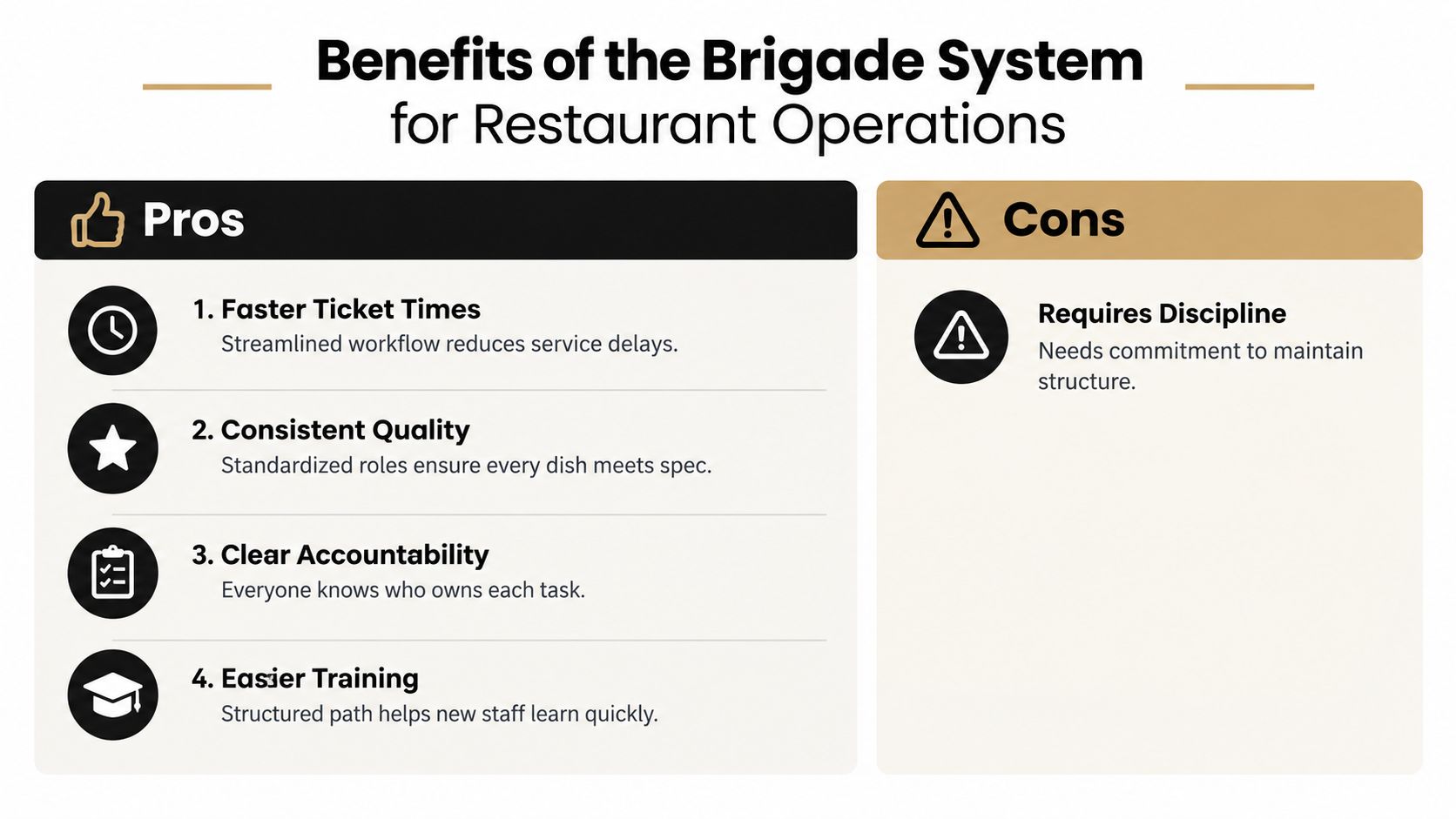
A brigade improves operations by making responsibility visible. When a dish is late, the team can identify whether the delay began with prep, cooking, plating, or communication. That diagnosis is far more useful than blaming “the kitchen” as a single unit.
The system also creates a common rhythm. Cooks prepare their stations before service, monitor their own stock, and understand when to call for help. The result is a calmer handoff between preparation, cooking, and the pass.
Where operators feel the difference
- Faster decisions: Staff know who can approve a substitution, adjust a firing time, or respond to a shortage.
- More consistent plates: Station ownership supports repeatable recipes, portions, and presentation.
- Clearer training: A new cook can learn one station's standards before moving into more complex work.
- Simpler problem-solving: Managers can trace a recurring error to a process, station, or handoff.
- Better guest communication: Front-of-house staff receive clearer answers when the kitchen has defined ownership of ingredients and preparation.
The structure can help an independent restaurant as much as a hotel. A café may assign one person to cold food and prep, another to hot breakfast production, and a shift lead to coordinate orders. A food truck may give one cook responsibility for the griddle, another for assembly, and a third for stock, sauces, and sanitation.
The downside is rigidity. If every employee protects a title instead of protecting service, the brigade becomes a barrier. Small teams need people who can step across stations while preserving accountability.
The best brigade creates flexible specialists, not isolated employees.
A current digital menu can reinforce that flexibility by reducing confusion when dishes, ingredients, or availability change. Operators exploring that workflow can review how to make a digital menu, then connect the menu information to their prep meetings and allergen checks.
How to Adapt the Brigade for Small Teams
A 10-person restaurant doesn't need 10 classical titles. It needs a clear answer to a more practical set of questions: who leads service, who owns each station, who covers breaks, and who takes over when demand changes?
Start with functions, not names. Assign one person to lead the kitchen and coordinate the pass. Give the remaining team primary ownership of hot proteins, vegetables and garnishes, cold preparation, pastry or dessert, prep, and dishwashing. Combine stations when the menu and service pattern allow it, but write the combination down so nobody assumes someone else is responsible.
A workable 10-person structure
| Team function | Primary responsibility | Useful cross-coverage |
|---|---|---|
| Kitchen lead | Menu standards, service decisions, final quality | Senior hot-line cook |
| Service coordinator | Pass communication and ticket flow | Kitchen lead |
| Hot-line cook | Proteins, sauces, and finishing | Garnish cook |
| Garnish cook | Vegetables, starches, and plating support | Hot-line cook |
| Cold and prep cook | Salads, starters, sauces, and mise en place | Pastry or support cook |
| Dessert lead | Desserts and pastry preparation | Cold and prep cook |
| Prep coverage | Batch preparation and replenishment | Any trained station cook |
| Utility support | Dishwashing, cleaning, and stock movement | Rotating team member |
| Flexible cooks | Relief, peak coverage, and station rotation | Assigned according to service needs |
| Float or shift support | Breaks, replenishment, and urgent tasks | Service coordinator |
The titles can change. The ownership can't disappear. Each person should know the station's opening checklist, par levels, recipes, plating standard, cleaning responsibilities, and escalation path.
Modern restaurants commonly flatten the hierarchy, combine roles, and cross-train staff so one person covers multiple classic stations. Coverage describing modern operations also notes that Michelin-starred kitchens generally use slimmed-down brigades rather than the complete historical model. That approach makes sense when staffing is constrained, but it works only when training and handoffs are deliberate.
Keep the chain of command short
A small kitchen may need only a kitchen lead and a service coordinator above station owners. That isn't a failure to implement the brigade. It's a sensible reduction of layers.
Use a simple pre-service meeting to confirm the menu, shortages, reservations, special requests, and station assignments. During service, let station owners make routine decisions and escalate only issues that affect timing, safety, quality, or the guest promise.
For scheduling and team coverage, operators may also benefit from reviewing this core team management guide. The same principle applies in the kitchen: define responsibilities, make coverage visible, and avoid building the entire operation around one indispensable person.
A modern brigade should be treated as a flexible staffing framework, not a museum display. Keep the discipline that prevents missed work, remove titles that add no clarity, and train every cook to support at least one neighboring station.
If your kitchen needs clearer coordination outside service as well, TopFoodApp lets you create and update QR-based digital menus, manage allergens, and organize menus for cafés, hotels, food trucks, and restaurants without per-item limits. Visit TopFoodApp to give your team one current menu reference while your adapted brigade focuses on accurate, consistent service.