Soft Opening vs Grand Opening: A Restaurant Guide
More than 20% of businesses close after their first year, according to Metrobi's restaurant soft-opening guidance. That makes the difference between a soft opening and a grand opening more than a question of terminology. It's a question of whether the restaurant discovers its operational weaknesses with a controlled group or in front of the entire market.
A grand opening creates attention, but attention magnifies every delay, missing menu item, payment error, and confused staff interaction. A soft opening gives the team a narrower, more forgiving environment in which to test the menu, service rhythm, digital systems, and guest communication before the public debut.
Table of Contents
- Why Staged Restaurant Launches Matter
- Defining Soft Openings and Grand Openings
- Core Differences in Goals and Experience
- Step-by-Step Launch Timelines
- Measuring Success and Key Performance Indicators
- Simplifying Launches with Digital Menus
- Navigating Pitfalls and Legal Requirements
- Strategic Recommendations for Restaurant Owners
Why Staged Restaurant Launches Matter
A restaurant launch rarely fails because the dining room lacks a memorable opening-night speech. It fails when several small problems arrive together. The kitchen has too many menu variations, servers can't find the right modifiers in the ordering system, the payment terminal behaves unpredictably, and guests receive different answers about allergens. During a quiet rehearsal, each issue is fixable. During a heavily promoted public debut, the same issues become reviews, refunds, and lost trust.
That's why staged launches work. The operator separates learning from promotion. The soft opening is where the restaurant tests whether its promises can be delivered consistently. The grand opening is where the restaurant presents that refined operation to a larger audience.
Practical rule: Don't use a grand opening to find out whether the restaurant is ready to operate.
The distinction also protects the team. A new kitchen needs time to establish communication between prep, line, expo, and front of house. New servers need to learn table positions, pacing, substitutions, payment procedures, and how to answer questions without guessing. A controlled service gives managers the chance to observe those interactions and correct them while staff are still building habits.
The soft opening isn't a free pass for poor hospitality. Guests should still receive a respectful, organized experience, and the restaurant should explain the event clearly. But expectations can be set transparently. An invited guest who understands that the team is testing service will usually offer more useful feedback than a public customer who believes every process is already final.
The strategic payoff is simple. A soft opening converts uncertainty into observations, and observations into changes. By the time the grand opening arrives, the restaurant should be selling a version of its operation that has already been challenged under real service conditions.
Defining Soft Openings and Grand Openings
A soft opening is a limited-capacity trial run held before the official grand opening. Restaurant guides commonly describe it as lasting about one to five days, with many operators placing it one to two weeks before the grand opening so there's time for fixes and training, as explained in GoFoodservice's restaurant-opening guide.
A grand opening is the restaurant's public debut. It often carries promotions, local publicity, community invitations, and a stronger expectation that the operation is ready for normal demand. The two events may use the same dining room, menu platform, staff, and payment system, but they serve different business purposes.
| Area | Soft opening | Grand opening |
|---|---|---|
| Primary purpose | Test operations and collect feedback | Announce the restaurant publicly |
| Guest access | Often invited or restricted, though practice varies | Usually open to the broader public |
| Menu scope | Frequently reduced or selectively offered | Normally the intended public menu |
| Service conditions | Controlled hours, capacity, or seating flow | Higher visibility and broader demand |
| Management focus | Diagnose bottlenecks and train staff | Deliver a polished guest experience |
| Marketing role | Generate informed early interest | Create public awareness and customer acquisition |
| Success signal | Actionable operational learning | Reliable service at public scale |
The soft opening is therefore not just a smaller grand opening. It's a different phase. A reduced menu may be deliberate because the team needs to test core dishes without creating unnecessary production complexity. Restricted hours may help managers isolate lunch, dinner, bar, or payment workflows rather than exposing every operating period at once.
The timing isn't fixed by a universal rule. A 2026 restaurant-opening guide cited by GoFoodservice describes most soft openings as lasting two to five days, while other restaurant-operations guidance favors a longer testing period when the operator needs more service data. Those recommendations aren't contradictory. A short event may suit a nearly finished operation, while a longer controlled period may be justified when pricing, throughput, or menu scope remains uncertain.
The grand opening begins when the operator is prepared to accept the reputational consequences of normal public exposure. That doesn't mean every detail will be perfect. It means the team has tested the systems that matter most and has a documented response for problems that may still arise.
Core Differences in Goals and Experience
A soft opening and a grand opening serve different business decisions. The soft opening tests operational reliability under controlled pressure. The grand opening tests public visibility, demand, and the restaurant's ability to deliver a credible first impression at scale.
Charge real money during a soft opening when the goal is to test the complete commercial experience. Payment exposes problems that a complimentary event can hide, including split bills, refunds, card failures, modifier errors, and confusion about pricing. Discounts also affect how guests judge value, so record the offer attached to each transaction rather than treating every sale as equivalent.
A restaurant-operations source recommends a soft-opening period of roughly one to three weeks when the team needs enough real service data to recalibrate pricing, kitchen throughput, and menu scope, as outlined by Katalystos' guidance on soft openings and pricing.
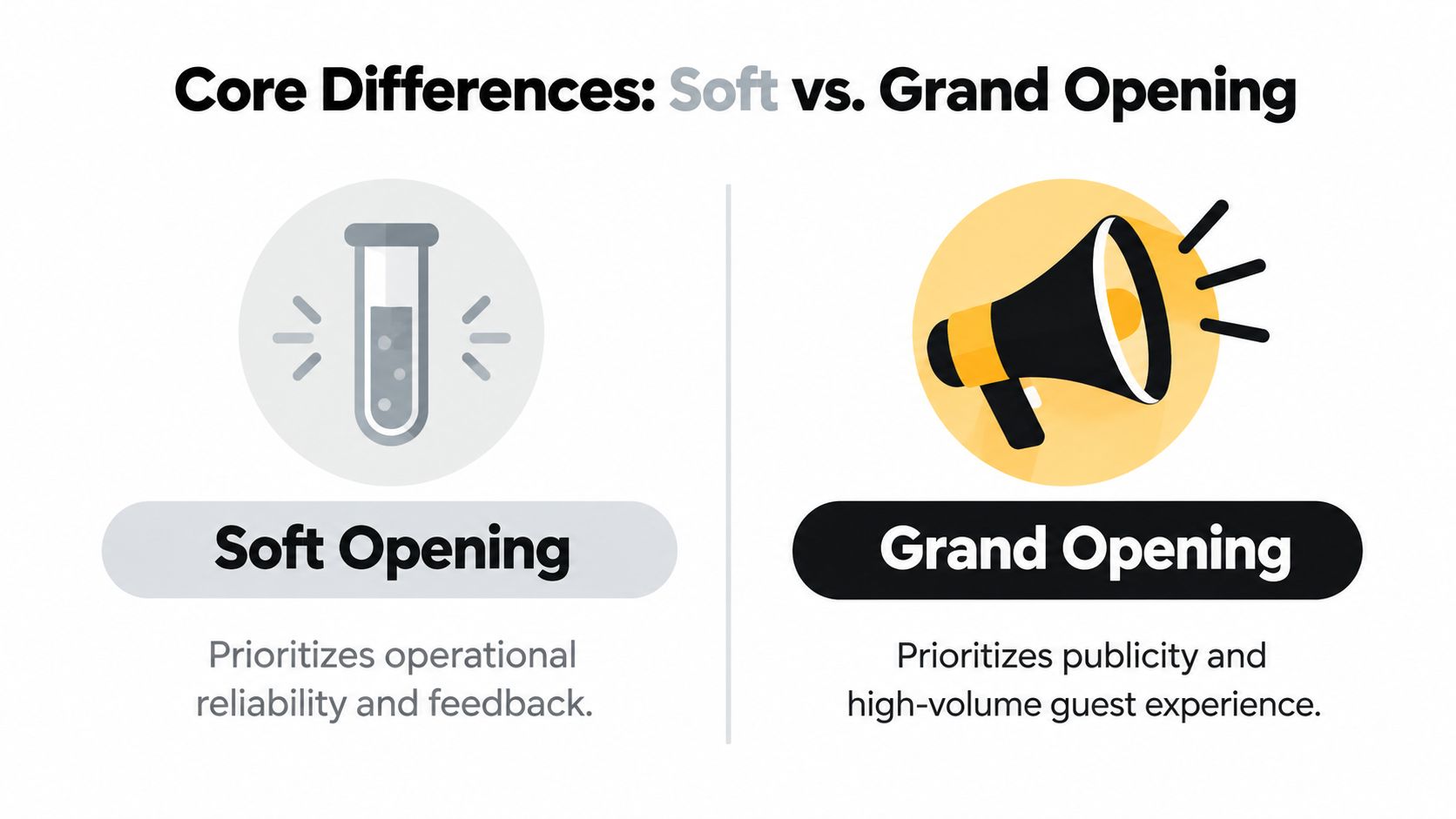
The operational contrast
| Decision | Soft opening | Grand opening |
|---|---|---|
| Guest mix | Friends, family, local contacts, selected strangers, or industry peers | General public, invited community, media, and promotional guests |
| Feedback quality | Direct, detailed, and deliberately collected | More public, less controlled, and often expressed through reviews |
| Menu design | Narrow enough to test without overwhelming the line | Broad enough to represent the intended offer |
| Staffing priority | Coaching, role clarity, and observation | Full deployment, speed, consistency, and guest recovery |
| Marketing spend | Limited communication and targeted invitations | Public promotion, launch content, partnerships, and media activity |
| Management behavior | Watch, record, diagnose, and adjust | Coordinate, protect the guest experience, and maintain momentum |
The guest mix determines the quality of the evidence. Friends and family can identify obvious problems and provide useful encouragement, but selected strangers often reveal unclear menu language, awkward ordering steps, and service friction that personal contacts overlook. Record feedback by service period, table, dish, and point of failure so managers can separate isolated opinions from repeatable operational issues.
TopFoodApp can reduce digital complexity in both phases by keeping menu information, ordering workflows, promotions, and guest signals organized in one operating process. During the soft opening, that structure helps managers compare what guests saw online with what the kitchen and front-of-house teams could deliver. During the grand opening, it helps protect consistency when traffic, inquiries, and promotional demand increase together.
The grand-opening guest arrives with a different assumption. They may have seen a promotion, followed a creator, searched for the restaurant, or received a recommendation. They expect the advertised offer to be available and the service to work without being told that the restaurant is still practicing.
Marketing can support a soft opening, but it should not displace measurement. If creators are invited, define the purpose, offer, timing, and disclosure expectations before the visit. Guidance on promotional tactics for creators can help operators plan visibility without confusing publicity with operational readiness.
Step-by-Step Launch Timelines
A launch timeline should create a feedback loop, not a single event followed by hope. Begin with the smallest service format that exposes the systems requiring a real test. Expand only after the team has reviewed the evidence and corrected the failures.
Phase one prepares the test
Before inviting guests, simplify the menu where needed, confirm recipes and portions, and train every role against the actual service sequence. Servers should rehearse modifier entry, course timing, guest questions, and check closing. Kitchen staff should identify dishes competing for the same equipment, prep station, or cooking time.
Write the soft-opening rules down. Set guest capacity, hours, menu availability, pricing, payment expectations, and the feedback process. Clear conditions matter because confused guests produce feedback about the event setup, not necessarily about the operation itself.
Phase two collects usable evidence
A short soft opening may last one to five days, while a longer window of one to three weeks is recommended when the team needs enough service data for meaningful recalibration. Choose the duration based on what remains untested, how quickly managers can implement changes, and whether each service produces new evidence.
The goal is controlled variation. Test a different service period, staffing mix, or demand level when the operation is ready, then compare the results. A short launch that repeats the same quiet shift may provide less useful information than a longer schedule that exposes bottlenecks under different conditions.
After each service, hold a focused debrief. Record the failure, assign an owner, set the next test, and define what improvement should look like. Avoid changing the full menu, staffing model, and table layout together. Targeted adjustments make cause and effect easier to assess.
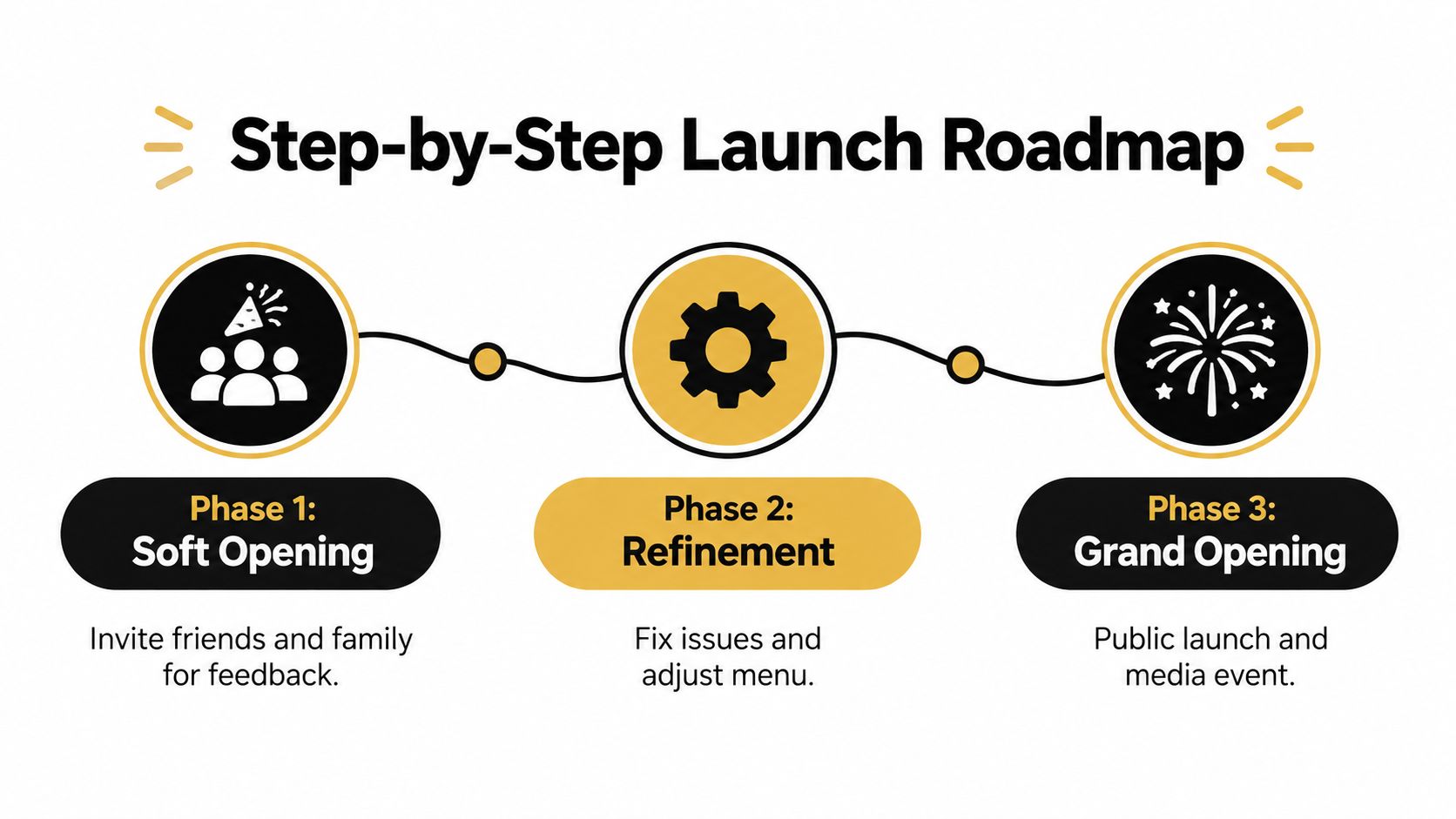
Phase three scales the public event
Once the main bottlenecks are resolved, build the grand opening around the proven operation. Increase capacity carefully, activate the public campaign, confirm supplier and staffing coverage, and check that the published menu matches what the kitchen can deliver.
TopFoodApp helps manage the digital workload across both phases by keeping menus, ordering details, promotions, and guest-facing information aligned. For local discovery, operators can use this guide to adding a restaurant to Google Business Profile, then verify that opening details, hours, location, and customer-facing information match across channels.
That final check protects the public launch from a preventable mismatch between the promise online and the service delivered in the restaurant.
Measuring Success and Key Performance Indicators
A soft opening without measurement is just an early dinner service. The manager may leave with impressions, but impressions are difficult to prioritize and even harder to translate into training or menu decisions.
The right KPIs depend on the phase. During the soft opening, measure reliability and failure points. During the grand opening, measure whether that reliable operation can support public demand while producing a healthy commercial result.
Soft-opening measures
An industry guide recommends recording the following during each service:
- Per-dish ticket times: Track individual dishes instead of relying only on a broad average. A single slow item can create a kitchen bottleneck even when overall service appears acceptable.
- Payment performance: Test split-bill handling and card-payment success so front-of-house staff aren't discovering transaction problems during the busiest public service.
- Allergen handling: Record whether staff can provide accurate allergen information and whether the menu communicates it consistently.
- Course gaps: Note the time and coordination between courses. Guests may tolerate a longer meal, but unexplained gaps feel like forgotten orders.
- Repeat requests: Count how often guests ask for the same clarification, such as ingredients, side options, or payment instructions. Repeated questions often indicate a menu or training problem.
These benchmarks come from Local Brand Hub's restaurant soft-opening guidance, which frames the soft opening as a systems stress test rather than a marketing contest.
Grand-opening measures
The public launch requires a different dashboard. Monitor covers, average check size, table turnover, booking or walk-in flow, item availability, complaints, refunds, and the speed of issue recovery. Social engagement can show whether the event is reaching people, but attention doesn't compensate for a dining room that can't deliver the advertised experience.
Use the two dashboards together without confusing their purposes. A soft opening succeeds when it produces clear decisions. A grand opening succeeds when the restaurant delivers those decisions consistently under greater visibility.
A practical debrief should answer three questions:
- What failed repeatedly?
- What did guests ask for or misunderstand?
- Which change will the team make before the next service?
That last question is essential. Data only helps when someone owns the response and verifies whether the adjustment worked.
Simplifying Launches with Digital Menus
Menu changes create unnecessary risk when every correction requires new printed materials. During a soft opening, the chef may remove a slow dish, revise an ingredient description, change a price, or clarify an allergen. If the grand opening uses a different printed menu from the version tested during the rehearsal, staff may end up selling information that no longer matches the kitchen.
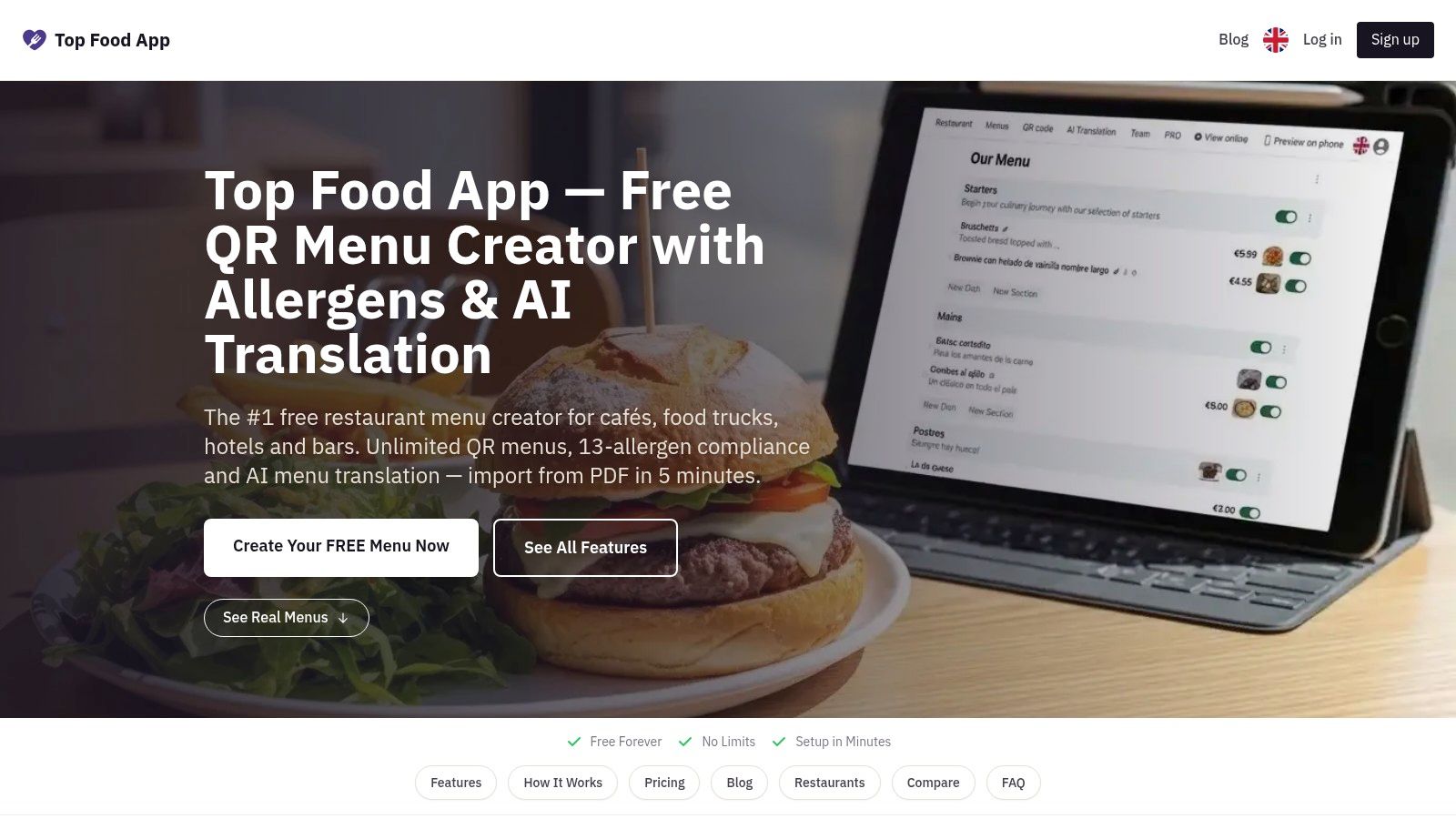
A digital menu creates a more controlled handoff between phases. Operators can update dishes, sections, pricing options, visibility, and descriptions without replacing every physical copy. The same QR code can continue to point guests to the current menu, which reduces the chance that an old version remains in circulation.
What the system needs to handle
A launch menu isn't just a list of dishes. It carries operational and safety information that staff and guests use under pressure.
- Fast edits: Managers need to remove unavailable items and revise descriptions immediately.
- Allergen clarity: The system should support the 13 EU regulated allergens and give guests a practical way to filter menu items.
- Multiple service periods: Breakfast, lunch, cocktails, room service, and seasonal offers shouldn't require disconnected guest journeys.
- Language access: Multi-language menus help staff avoid repeating basic explanations and give visitors a clearer way to review dishes.
- Structured setup: An AI menu digitizer can turn an existing PDF or photo into an editable menu structure, reducing manual entry during a busy opening period.
- Team control: Multiple staff members should be able to maintain the menu without creating conflicting versions.
The operational advantage isn't decoration. It's consistency. A universal QR code, searchable mobile menu, and centralized update process help ensure that the menu tested during the soft opening is the menu guests see at the grand opening. For a broader explanation of the operational case, review why restaurants use digital QR menus.
Navigating Pitfalls and Legal Requirements
The most damaging launch mistakes often begin with an unclear definition of the event. A restaurant may call a service a private soft opening, then allow public bookings through an active reservation page. Guests arrive expecting a normal opening, encounter a reduced menu, and interpret the limitations as poor preparation rather than deliberate testing.
There are no consistent rules governing whether a soft opening must be private. Some events are invitation-only, while others are open to the public, and the term grand opening may describe the first operating day or an event held later. Recent coverage of public and private soft openings highlights why the restaurant must define its own terms clearly.
Prevent avoidable confusion
Write the event status into every guest-facing channel. State whether reservations are required, whether the menu is limited, whether normal pricing applies, and whether feedback is requested. Keep the digital menu, QR code, social posts, booking page, and staff script aligned.
Legal readiness deserves the same attention. Confirm that local health, fire, occupancy, food-service, alcohol, accessibility, and business requirements are satisfied before serving guests. Requirements vary by jurisdiction, so the operator should verify them with the relevant local authorities rather than treating a soft opening as exempt from normal obligations.
Allergen communication is another area where informal promises create risk. Staff need a reliable process for checking ingredients, communicating uncertainty, preventing cross-contact where applicable, and escalating questions. This restaurant allergen compliance checklist can help structure the review, but it doesn't replace local legal advice or documented kitchen procedures.
For a candid reminder that one missed inspection detail can threaten an opening schedule, operators can study these lessons from a near-failed restaurant opening. The broader lesson is practical: regulatory preparation belongs before the rehearsal, not after the first complaint.
Strategic Recommendations for Restaurant Owners
Treat the soft opening as a diagnostic service, not a cheaper party. If the team isn't recording ticket times, payment issues, allergen questions, course pacing, and repeat requests, it isn't using the phase for its highest-value purpose.
Resource allocation should follow that priority. Put experienced managers on the floor, give the kitchen a menu it can execute, and leave enough time between the test and public debut to make targeted corrections. A short event may be sufficient for a prepared operation, while a longer window is more useful when pricing, throughput, menu scope, or staff coordination still need evidence.
Make the transition deliberate
Use a written readiness decision rather than relying on excitement. Before announcing the grand opening, confirm that:
- The menu is operationally honest: Published dishes, modifiers, prices, and availability match what the kitchen can deliver.
- The team can explain the offer: Servers know ingredients, allergens, substitutions, pacing, and payment procedures.
- The technology is stable: Ordering, payment, reservations, and digital menu access have been tested in service conditions.
- The guest promise is clear: Invitations and public promotions accurately describe what guests will experience.
- The feedback has produced action: Each significant issue has an owner, a correction, and a follow-up check.
Don't let marketing pressure force the public launch before the operation is ready. A restaurant can create momentum through thoughtful communication, local partnerships, and creator outreach, but those activities should support a credible service rather than conceal weak execution. For broader planning across promotion, customer acquisition, and retention, this complete guide to restaurant success offers useful context.
The best soft opening is not the one that looks most polished in photographs. It's the one that reveals the problems the team can still fix. The best grand opening is not the loudest event. It's the first public proof that the restaurant learned from its rehearsal.
TopFoodApp helps restaurants create free QR-based digital menus with unlimited items, instant updates, multilingual tools, AI Menu Digitizer features, and allergen management for the 13 EU regulated allergens. Visit TopFoodApp to build a menu that stays accurate as you refine the soft opening and prepare for the grand opening.