Pricing Restaurant Menus Without Guesswork
You're at the pass on a Tuesday, and the menu board from the place two streets over is still in your head. You priced your lunch plate a little above theirs, because that felt like the market. Then the invoices land on the desk and the dish you were proudest of turns out to be the one funding the neighbourhood's price war.
Almost every independent menu gets priced this way at some point. A glance at the competition, a feel for the room, a number that sounds about right on a Friday night. The instinct isn't the problem. The problem is that the instinct never gets tested against an invoice.
What follows is a working method rather than a philosophy. Price from the cash each dish leaves behind, move only the dishes whose costs changed, and get the new number in front of guests the same day in every channel you sell through.
Table of Contents
- Calculate Food Cost and Price a Dish
- Sort Dishes into Stars Plowhorses Puzzles and Dogs
- Endings Anchors and Bundles That Sell
- When to Raise Prices Without a Backlash
- Price Seasonal Specials and Drinks Separately
- Reprice Three Dishes This Week
Calculate Food Cost and Price a Dish
A lunch café prices a plate at 12 because a nearby restaurant charges the same. Then the invoice reveals 5.20 in ingredients per serving, a 43% food cost. The price looked competitive, but the dish leaves less cash for wages, rent and profit than the owner expected.
Food-cost percentage is the ingredient cost of one serving divided by its selling price, multiplied by 100. Use it to audit a current price. To set a price, work backward from your costs and the contribution each sale needs to make.
A worked example from Restaurant365 shows a plate costing 6 priced at 20 to meet a 30% food-cost target. Your target should reflect projected sales, labour, occupancy and operating costs, plus the profit you intend to take. Recost a dish when its supplier price, yield or portion changes. Price only the dishes whose costs have moved.
| Measure | How to calculate | Example or range |
|---|---|---|
| Food-cost percentage | Ingredient cost of one serving ÷ selling price × 100 | A plate costing 6 at a price of 20 is 30% |
| Backward price | Plate cost ÷ target food-cost percentage | 6 ÷ 0.30 = 20 |
| Contribution margin | Menu price minus standard food cost | A 28 item at 30% food cost contributes 19.60 |
| Food-cost band | Share of menu sales, set from your own costs | Often 28% to 35%, not a universal rule |
| Prime cost | Food plus labour as a share of sales | Commonly near 55% to 65% |
Six steps from invoice to a tested price
- List every ingredient at its current invoice price. Include oil, seasoning, garnish, pickles, aioli and bread. Account for trim, cooking loss and the portion served. If a kilo of bone-in protein yields 700 grams of usable product, cost the full kilo against those 700 grams.
- Cost one serving accurately. Use a spreadsheet or recipe costing tool that handles unit conversions and yields. Enter the quantities for a single serving so the result reflects what leaves the kitchen.
- Calculate a starting price. Divide plate cost by your target. A plate costing 6 at a 30% target starts at 20.
- Check the contribution margin. Subtract standard food cost from the proposed price, then compare the result with other dishes in the same category using till counts.
- Use competitors as a reference, not your formula. Their rent, wages and supplier terms differ from yours. If your price sits well above theirs, review the portion, garnish or recipe before accepting a thinner margin.
- Test the change on one or two dishes. Review two weeks of till data before changing prices across the menu.
Contribution margin is the amount left from a sale after standard food cost, available for labour, rent, utilities and profit. A 28 entrée at a 30% food cost has 8.40 in ingredients and contributes 19.60 per cover. A 14 side at a 25% food cost contributes 10.50. The side has the lower food-cost percentage, but the entrée leaves more cash.
The test that matters: A high food-cost percentage can still leave more cash behind if the selling price is high enough. Judge the dish by its contribution, not by the percentage alone.
Treat published ranges as checks, not targets. Food cost often falls between 28% and 35% of menu sales, while prime cost commonly sits near 55% to 65%. Those ranges can flag a dish that has drifted, but your own costs determine whether its price works.
Check the cost side before you touch the price
A higher selling price is one way to improve contribution. Reviewing operational costs that restaurants can control is another. Check whether avoidable waste or a costly process is adding pressure before passing every increase on to guests.
The same arithmetic applies at the bar. Keg and bottle costs affect what each drink leaves behind. Use the Carbon 6 Brewing guide for venues to review wholesale tiers and minimum order quantities before resetting pour prices.
If you change an ingredient, check its effect on allergen information in the same review. Update the allergen menu before the revised dish goes live.
Once you settle a price, publish it the same day across the channels where guests see your menu. TopFoodApp lets restaurants publish digital menus online and generate QR codes for instant sharing. With one QR code covering all of a restaurant's menus, the dining room, delivery and social channels can point guests to the same current prices.
Sort Dishes into Stars Plowhorses Puzzles and Dogs
Once the plate costs are real, the menu stops being a list of equal decisions. Menu engineering is the discipline that sorts them, introduced around 1982 by Michael L. Kasavana and Donald I. Smith at Michigan State University's School of Hospitality Business, who adapted the Boston Consulting Group's portfolio framework to foodservice, as a history of menu engineering sets out.
Its central measurement is contribution margin: menu price minus an item's direct variable cost. Popularity alone tells you what the room likes. Margin alone tells you what pays. Put the two together and every dish lands in one of four boxes, whether or not anyone on your team has ever heard the term.
Split the menu at your own midpoint
Pull two to four typical weeks of till counts and divide the menu at your own median, not a borrowed benchmark. A dish selling 90 covers a week in a room where the median is 40 is a different animal from one selling 90 where the median is 200.
| Class | Popularity | Contribution margin | What to do |
|---|---|---|---|
| Star | High | High | Feature it and protect the recipe |
| Plowhorse | High | Low | Reprice, tighten the portion or swap one costly ingredient |
| Puzzle | Low | High | Move it up, rewrite the description and have staff offer it |
| Dog | Low | Low | Remove it or rebuild it before the next menu change |
A modest move is worth more than it looks. Take a 20 dish with 7 of ingredient cost: contribution is 13. Push the price to 21 and it becomes 14 at the same cost, a 7.7% gain. Leave the price alone through a 5% ingredient rise and contribution falls to 12.65. Neither shift is dramatic on its own. Six months of both together is how a menu stops working.
A plowhorse isn't a bad dish. It's a popular dish carrying a price built for someone else's cost structure.
Run this only after the plate costs are current, and give it an hour a month rather than a weekend a year. The sorting doesn't decide anything on its own. It tells you where to spend your next hour: repricing, rewriting, repositioning, or removing.
Endings Anchors and Bundles That Sell
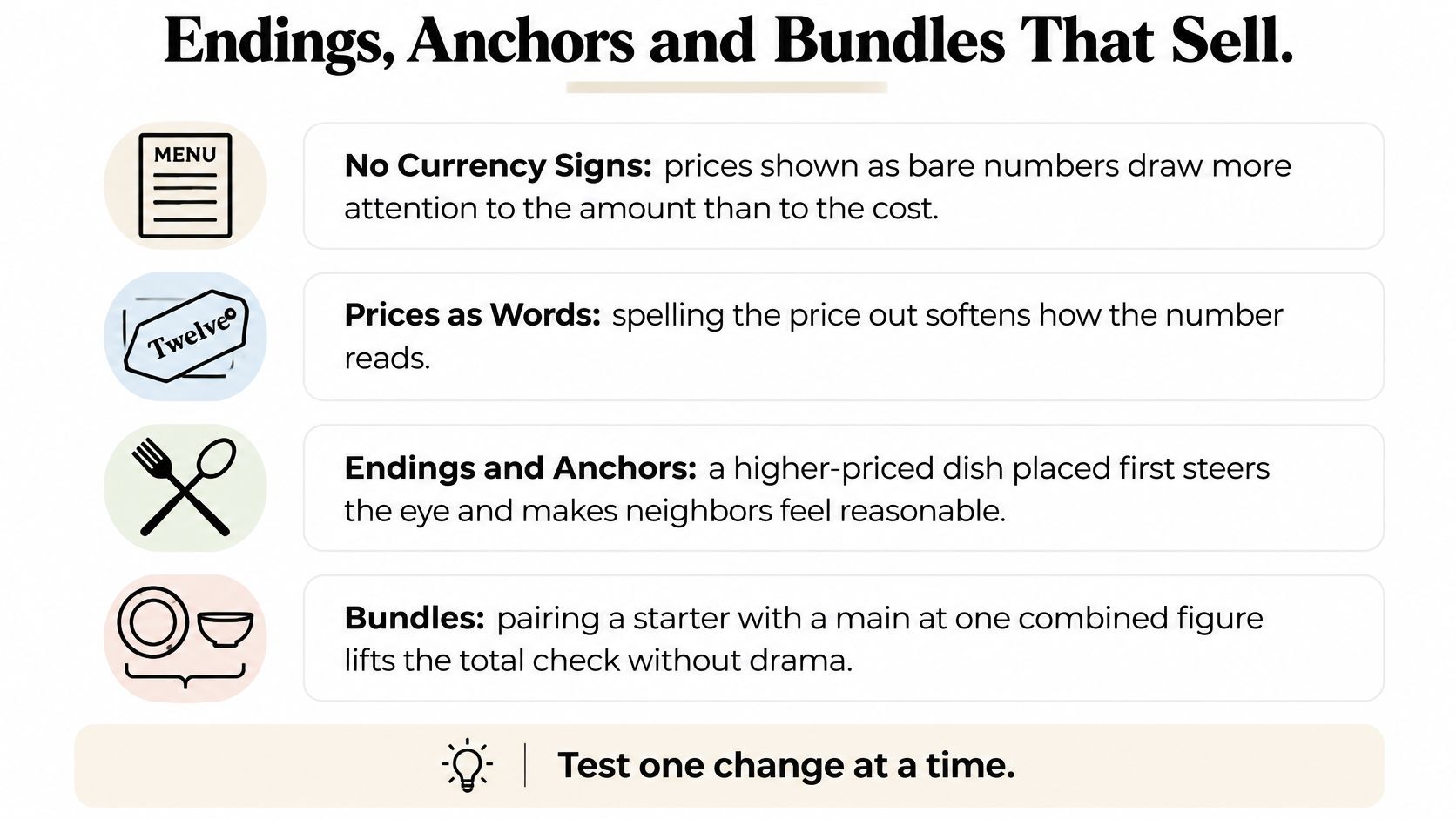
A dish can earn more attention from its placement and wording, but design cannot fix a price that leaves too little contribution. Test presentation after you have priced the plate correctly, and change one element at a time so you can see what affects orders.
Three changes you can make this week
Test how prices appear on the page. Try figures without currency symbols, keep each price close to its dish description, and use legible type. Dotted leader lines that draw the eye straight to a price can make the menu feel like a price list. Respect local habits: some markets expect a currency word or symbol.
Use a genuine anchor. Place a properly premium dish near the top of a section, one you are proud to serve at its listed price. It can make nearby dishes feel like reasonable choices. A decoy dish that nobody orders wastes menu space and does little to build trust.
If the layout needs work, these restaurant menu design examples show how placement and typography shape a menu.
Bundles that don't give away the margin
Bundle a main, side and drink only when their combined contribution meets or beats what they earn sold separately. Name exactly what the bundle includes. If the price depends on a smaller portion, say so clearly.
Treat charm endings as a test, not a rule. A price ending in .90 or .95 may suit a casual room and feel out of place in a finer one. Choose a convention that fits your concept, then apply it consistently.
Ask diners how the prices and presentation feel. A private guest feedback form gives customers a direct way to share their response. Use that feedback alongside average spend and item mix, then keep only changes that support both the guest experience and contribution margin.
Design can influence what guests order. It cannot rescue a dish that contributes too little.
When to Raise Prices Without a Backlash
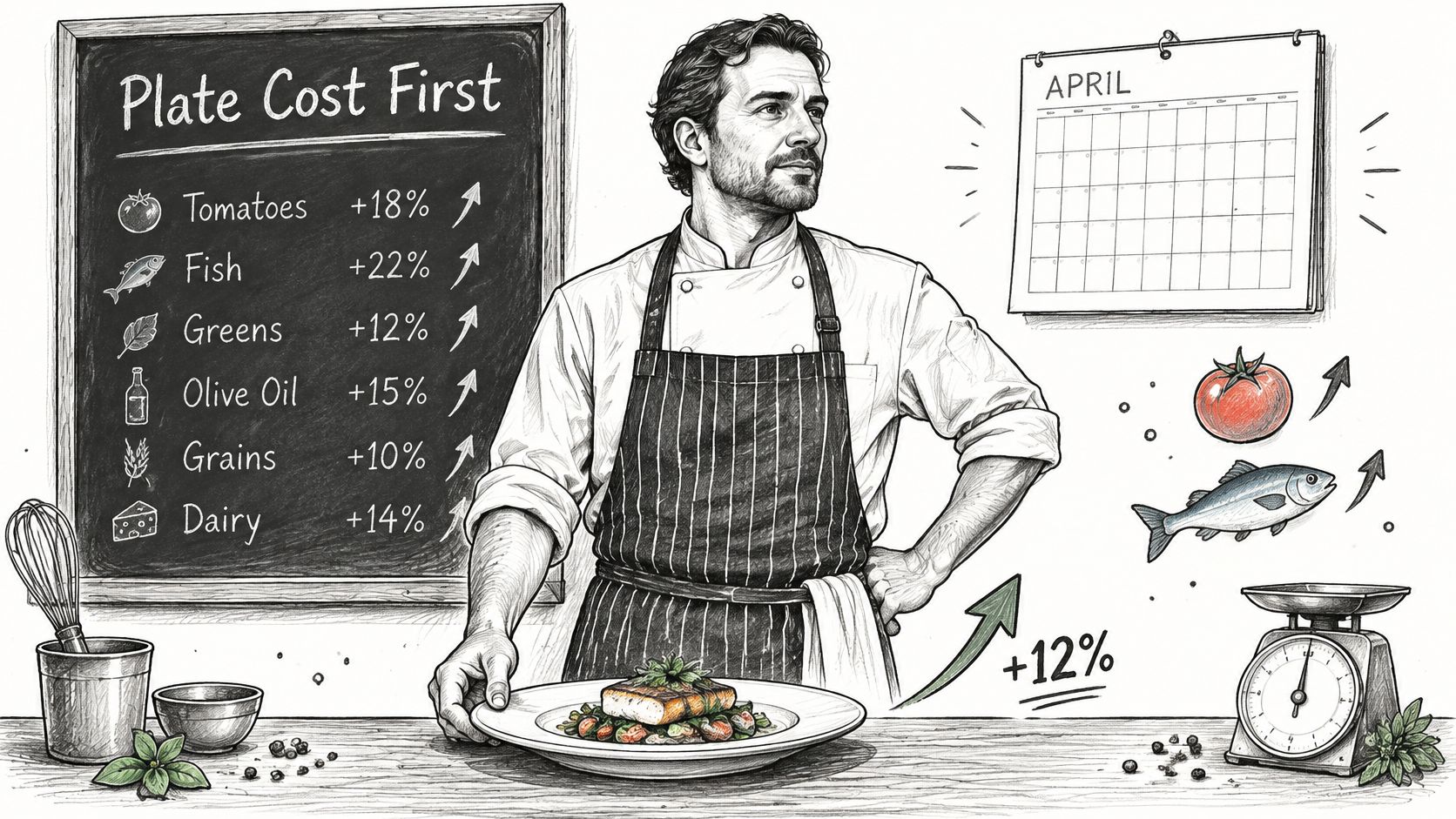
Raise a price when the cost of that dish moved, not when the calendar feels heavy or the bank balance looks thin on a Monday. Waiting for one large correction is the more damaging habit: it produces a single shocking jump across the whole menu instead of several small, explainable ones on the dishes that changed.
In the US, the James Beard Foundation's 2025 independent restaurant industry report found that 55% of surveyed operators raised prices across their entire menu in 2024 while another 36% raised prices on selected items. The second group is the one to copy.
The trigger list
- A supplier invoice has moved beyond the threshold you set for yourself, not just wobbled a few percent.
- The yield changed. A new supplier trims differently and your usable weight drops without the invoice changing at all.
- Portions have crept. The line is over-scooping and your calculated cost no longer matches the plate.
- A whole-menu cost has risen. Wages, energy or packaging hit every dish at once, so the response belongs on the whole menu.
- A bundle or add-on stopped adding up after one of its components moved.
Before you publish
Recost the recipe from current invoices. Recheck the food-cost percentage and the contribution margin. Confirm the tax and service-charge wording for your jurisdiction. Decide whether the change hits one dish, one section or everything. Then write the one sentence you'll give the floor.
Publish the same number everywhere, the same day
A digital menu earns its keep. Build the menu in the TopFoodApp menu creator, generate the code once with the QR code generator and leave it in place. Every change is live for guests instantly and the same QR code keeps working, so nothing gets reprinted: prices update, sold-out dishes hide, specials swap in seconds. One code covers all of a restaurant's menus, from lunch to the wine list, and a seasonal section can be hidden when it ends without disturbing anything else.
If you publish in more than one language, update the translated version in the same sitting with AI menu translation, or you'll be running two prices in two languages and one confused floor team. Give the team one sentence to say and a consistent question to ask, and borrow comment card ideas so the wording doesn't change with whoever is on shift. Record the effective date and any regional difference in a single line of notes, because someone will ask in three weeks why the terrace menu shows a different number.
Price Seasonal Specials and Drinks Separately
Seasonal dishes need their own rule, and it's a short one: cost the special with this season's invoice, not last season's, and give it an end date before it goes on the board. A special costed at last year's price is a discount you never advertised.
Drinks need a stricter rule still.
Cost the pour, not the bottle
A coffee carrying 0.60 of beans and milk at a 25% target prices at 2.40. A 30 ml spirit serve has to be costed on the measured pour rather than the bottle price, because the bottle is a purchase and the pour is the product, and the gap between them is where the waste, the spillage and the free round live.
Check the whole list adds up once it's on one page. Guests compare a beer, a cocktail and a plate side by side, so a bar price built on a different target to the kitchen's will look arbitrary even when both were calculated with care.
Wine is where the test gets hardest. If you're building a by-the-glass programme around a producer or a club, browsing Calistoga winery club tiers shows how allocation and club pricing work on the supply side, which is the cost your pour has to survive. For the list itself, this guide to building a restaurant wine list covers structure, by-the-glass pricing and how many lines you need.
When the season ends, hide the special rather than leaving a stale price up or deleting the section. Then review it: what sold, what it contributed, whether it earned a return. Keep that log short and keep it somewhere you'll find it next year.
A seasonal special without an end date becomes a permanent dish with a stale cost.
Reprice Three Dishes This Week
Pick three dishes tonight and leave the rest of the menu where it is.
The first is a plowhorse, the popular item contributing less than its neighbours in the same section. The second is a puzzle, the dish that earns well and gets ordered twice a night because nobody notices it. The third is whichever dish had its main ingredient jump on the last invoice you opened.
Pick three, not thirty
Recalculate each plate from current invoices and real yields, set the price from your own target, and check the resulting contribution against the other dishes in its category. Then publish those three prices and nothing else. A digital menu sitting behind one QR code changes what guests see the moment you edit the source, without reprinting a page or replacing the code, which is exactly the mechanic you want when only three figures move.
Tell the floor the new price and the one-line reason before service starts on the day it goes live. Keep the three changes in the same sheet you use for menu management, so the next revision starts from a record instead of a guess.
What the next fortnight looks like
Watch item mix and contribution margin, not sales alone. Revenue can rise while margin falls if the shift pushes guests toward the wrong dishes, and that's the failure this whole method exists to catch.
If guests push back, read the private comments from every diner rather than guessing from one table, and keep inviting all of them to give feedback. Asking only the happy ones for a public review breaks Google's policy and tells you nothing useful.
If a seasonal special replaces one of your three, hide the old dish rather than deleting the section. Note the effective date, the tax wording you checked and whether a translated version needed the same number. Then stop. The rest of the menu waits until these three have proved the price still sells and still contributes.
TopFoodApp gives independent restaurants a free digital menu that updates the moment you change a price, one QR code that keeps working, a commission-free booking page and a private guest feedback form in the same place. Change three dishes this week, publish them from one editor, and let two weeks of till data tell you whether you were right. Start at TopFoodApp and put your next price change live today.