Religious Dietary Needs for Independent Restaurants
81% of Indian adults limit meat consumption in at least one way, according to Pew Research Center's nationally representative survey published in 2021. For a restaurant owner, that reframes religious dietary needs: the question isn't whether you offer a vegetarian dish. It's whether you can explain what went into it, what touched it, and what you can verify when it reaches the table.
Table of Contents
- Why Religious Dietary Needs Reach the Pass
- Major Faith Rules Your Menu Must Distinguish
- Three Claim Levels a Kitchen Can Stand Behind
- Halal and Kosher Controls Beyond the Ingredient List
- Hindu Jain Buddhist and Fasting Requests
- Staff Answers That Do Not Overpromise
- Ramadan Yom Kippur and Passover Service Timing
- Publish One Stance Through Labels and Tools
Why Religious Dietary Needs Reach the Pass
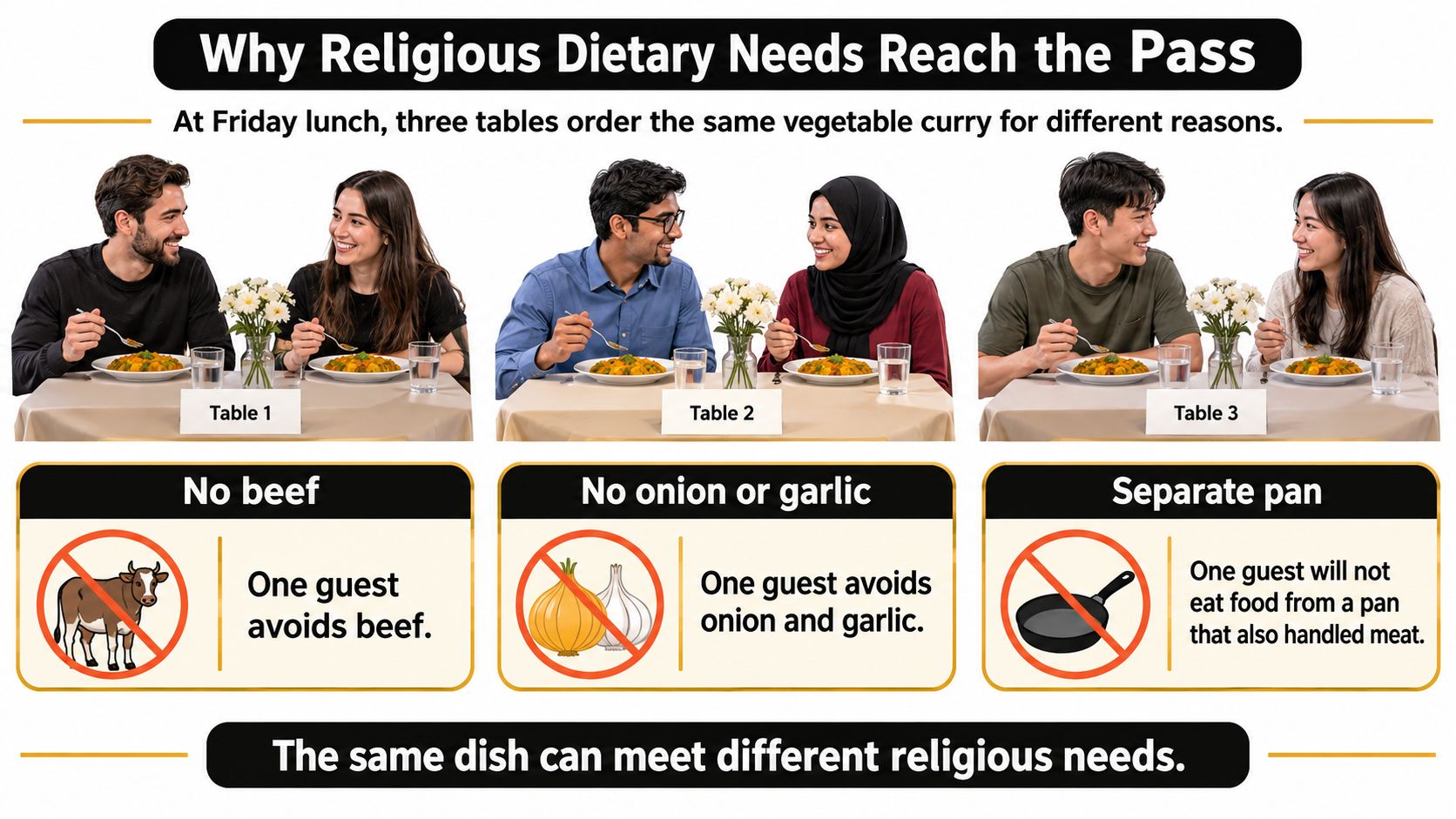
At Friday lunch, three tables order the same vegetable curry. One guest avoids beef, another avoids onion and garlic, and another won't eat food from a pan that also cooked meat. The order looks identical on the sales report, but the kitchen has received different requests.
The curry might meet the first guest's requirement without modification. The second needs a different base if onions were cooked into the sauce. The third needs an answer about equipment before the chef starts cooking, not reassurance after the plate arrives.
These are different requirements hiding behind the same dish name.
Vegetarian identity doesn't tell the whole story
In that Pew survey of Indian adults, 39% identified as vegetarian, while another 42% didn't identify as vegetarian but avoided certain meats, avoided meat on particular days, or followed both practices. A diner can therefore order meat regularly and still have a firm religious exclusion.
The vegetarian share also differed across communities: 92% of Jains, 44% of Hindus, 25% of Buddhists, 10% of Christians, and 8% of Muslims identified as vegetarian. Among Hindus, 83% either followed a vegetarian diet or restricted meat types or the days on which they ate meat. Those are findings about Indian adults, not a forecast of your restaurant's customer mix, but they show why a vegetarian-versus-nonvegetarian split misses important distinctions.
Operating principle: One faith is never one filter. Confirm the dish-level requirement instead of deciding what a guest must eat from their religion.
Translate the request into a kitchen instruction
Religious dietary needs can concern permitted animals, slaughter, alcohol, separation of foods, preparation equipment, or calendar fasting. Some requirements apply every day; others apply to a particular meal or observance.
For a small restaurant, the useful starting point is a short conversation:
- Ingredients: What must the dish exclude, including stocks, sauces, and garnishes?
- Handling: Does the guest require separate cookware, oil, utensils, or storage?
- Assurance: Do they need recognized certification, or are they asking for specific exclusions?
Don't ask a server to interpret theology during lunch service. Give them a dish record they can read and a manager they can call when the record doesn't answer the question. A clear limitation is more useful than an accommodating answer the kitchen can't support.
Major Faith Rules Your Menu Must Distinguish
Religious dietary rules a small menu must keep separate
| Tradition | Foods commonly avoided | Separation or timing rule | Honest small-kitchen claim |
|---|---|---|---|
| Halal | Pork and derivatives, blood, alcohol, carrion, meat not slaughtered to Islamic rules | Prevent contact with non-halal food, utensils, fryers, boards, and storage | Certified only when a named, in-date certificate covers the product or site; otherwise describe the limits |
| Kosher | Pork, shellfish, meat and dairy together, non-shechita meat, uncertified additives | Meat, dairy, and pareve require controlled utensils, surfaces, and service | Name the certifier and scope; don't present kosher-style food as certified kosher |
| Hindu | Beef for many diners; meat, eggs, onion, or garlic for some households | Household practice and particular days can require vegetarian meals | Label no beef, vegetarian, or no onion and garlic per dish |
| Jain | Meat, fish, eggs, and often honey and root vegetables, including onion, garlic, potato, and carrot | Avoidance of harm includes excluding many foods grown underground | Use a Jain claim only after checking the relevant exclusions; otherwise list them |
| Buddhist | From no general meat exclusion to vegetarian food; some traditions exclude onion and garlic | Some accept meat not killed for them; others require vegetarian meals | Identify ingredients and ask about handling rather than using a universal Buddhist icon |
| Seventh-day Adventist | Often meat; commonly pork, shellfish, and alcohol; some avoid caffeine | Many follow lacto-ovo vegetarian habits rather than a slaughter certification | Offer clearly vegetarian dishes and disclose alcohol or pork |
| Orthodox Christian fasting | Often meat, dairy, and eggs; sometimes fish, wine, and oil | Many Wednesdays, Fridays, and Great Lent, with jurisdiction and dispensation differences | State the exclusions available today and ask which fast the guest is keeping |
Halal and kosher aren't interchangeable
For halal service, a pork-free recipe is only part of the assessment. The Islamic Foundation of Ireland's published halal standards address prohibited ingredients, slaughter requirements, and contact with non-halal materials. A restaurant shouldn't convert a supplier's meat claim into a promise about an entire finished meal.
Kosher service has a different architecture. The US Foods kosher foodservice guide distinguishes fleishig, meaning meat, milchig, meaning dairy, and pareve, meaning neither meat nor dairy, alongside permitted species and slaughter through shechita.
That distinction affects utensils, dishes, cookware, surfaces, and even towels. A dairy-free recipe isn't automatically kosher, and a vegetable dish isn't automatically pareve just because the visible ingredients are vegetables. Kosher-style describes a style of food, not certified kosher service.
Vegetarian patterns still need separate questions
Hindu diners may avoid beef while accepting other meats, follow vegetarian diets, or exclude eggs and alliums according to household practice. Don't label an entire menu Hindu when you can make a more useful statement about each dish.
Many Jains follow a lacto-vegetarian pattern, but a standard vegetarian icon doesn't address root vegetables or honey. A potato filling, carrot garnish, or garlic paste can make the proposed alternative unsuitable.
Buddhist practice also spans different approaches to meat and alliums. Some diners accept meat when the animal wasn't killed specifically for them; some vegetarian traditions exclude onion and garlic. Ask what the guest requires rather than treating either pattern as universal.
Fasting isn't a permanent ingredient category
Many Seventh-day Adventists accept eggs and dairy within a vegetarian diet. An alcohol-free drinks selection and clearly described meat-free plates are more practical than an invented faith certification.
Orthodox Christian fasting requires attention to the date and the individual's observance. Fish, wine, and oil need their own disclosures rather than being hidden beneath a vegan or fasting badge.
The operational distinction is straightforward: a tradition helps you anticipate questions; the guest's requirements determine the order. Your menu claim must then reflect what your kitchen can verify.
Three Claim Levels a Kitchen Can Stand Behind
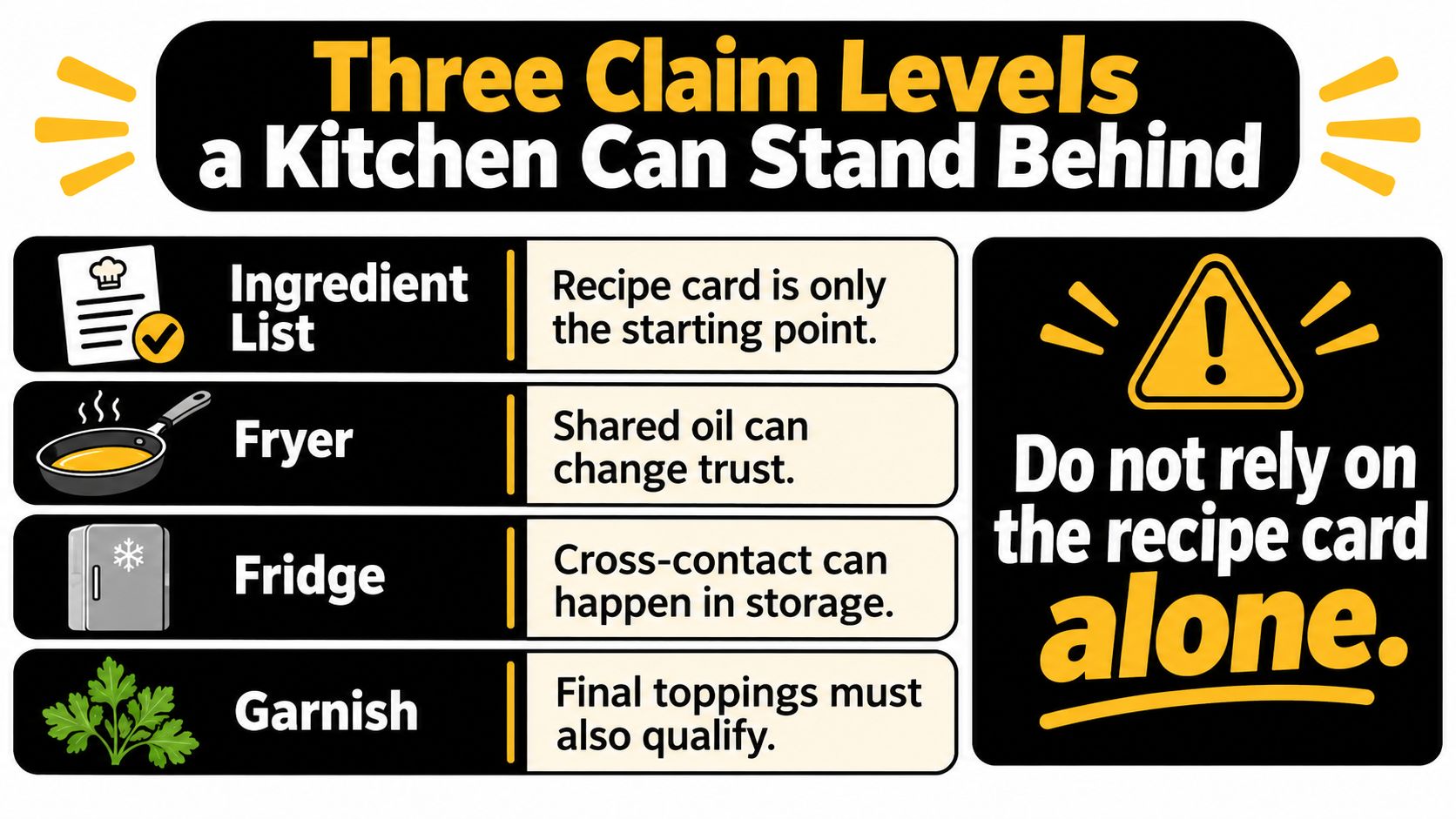
Can the guest trust the meal after the fryer, the fridge, and the garnish? That's a harder question than whether the recipe card mentions pork, and it's the question your disclosure system needs to answer.
The US Foods halal guide for foodservice professionals provides useful context for treating sourcing and preparation as part of the claim. Use the following decision tool to separate evidence from hospitality.
What a restaurant can say about a dish
| Claim level | Evidence required | Say this to the guest | Do not imply |
|---|---|---|---|
| Certified | Named authority, current certificate, and scope matching the site or products sold | Certified by the authority named on our certificate, covering the listed items | That unrelated dishes or the whole kitchen are certified |
| Ingredients appear compliant, shared equipment | Recipe and relevant specifications checked; shared equipment identified | No pork or alcohol in the checked recipe; cooked in a shared fryer | A binary halal or kosher guarantee |
| Unable to verify | Missing specifications for sauces, gelatin, enzymes, extracts, or slaughter | We cannot confirm halal or kosher status | Certainty based on visible ingredients |
| Preference or calendar exclusion | Guest names exclusions and kitchen confirms them | This dish has no beef and no onion; please tell us the fast you're keeping | That everyone of that faith wants the same plate |
The first three rows are claim levels. The final row is a guest-selected exclusion, not another certification category. Staff must never upgrade a row because the guest sounds disappointed.
A recipe card is the starting point, not the finished assurance.
Keep the evidence behind the sentence
Build a dish record containing the certification body, certificate scope, expiry, supplier, animal-protein status, alcohol-derived ingredients, and shared-equipment status. Attach the relevant product specifications rather than relying on a purchasing manager's memory.
When a supplier changes, nominate who reviews the replacement and who changes the guest-facing description. Until that review happens, the old assurance shouldn't remain live.
A single halal-friendly or kosher filter can conceal too much uncertainty. If the meat is certified but the sauce isn't verified, record those facts separately; don't average them into a reassuring badge.
Borrow documentation discipline, not medical assumptions
Religious compliance and food allergy management aren't the same thing. However, a restaurant allergen compliance checklist can help you organize ingredient records, substitution controls, and clear responsibility.
For the separate medical-safety side, TP Training's guidance relevant to handling allergy incidents in hospitality is a useful resource when reviewing supervisor responsibilities. Never suggest that a religious disclosure replaces an allergy procedure.
Use this video as a discussion prompt alongside your own dish records.
Before anyone draws an icon, assign every current dish a claim level. Add confirmed guest exclusions separately, so a modified order doesn't accidentally acquire a certification it never had.
Halal and Kosher Controls Beyond the Ingredient List
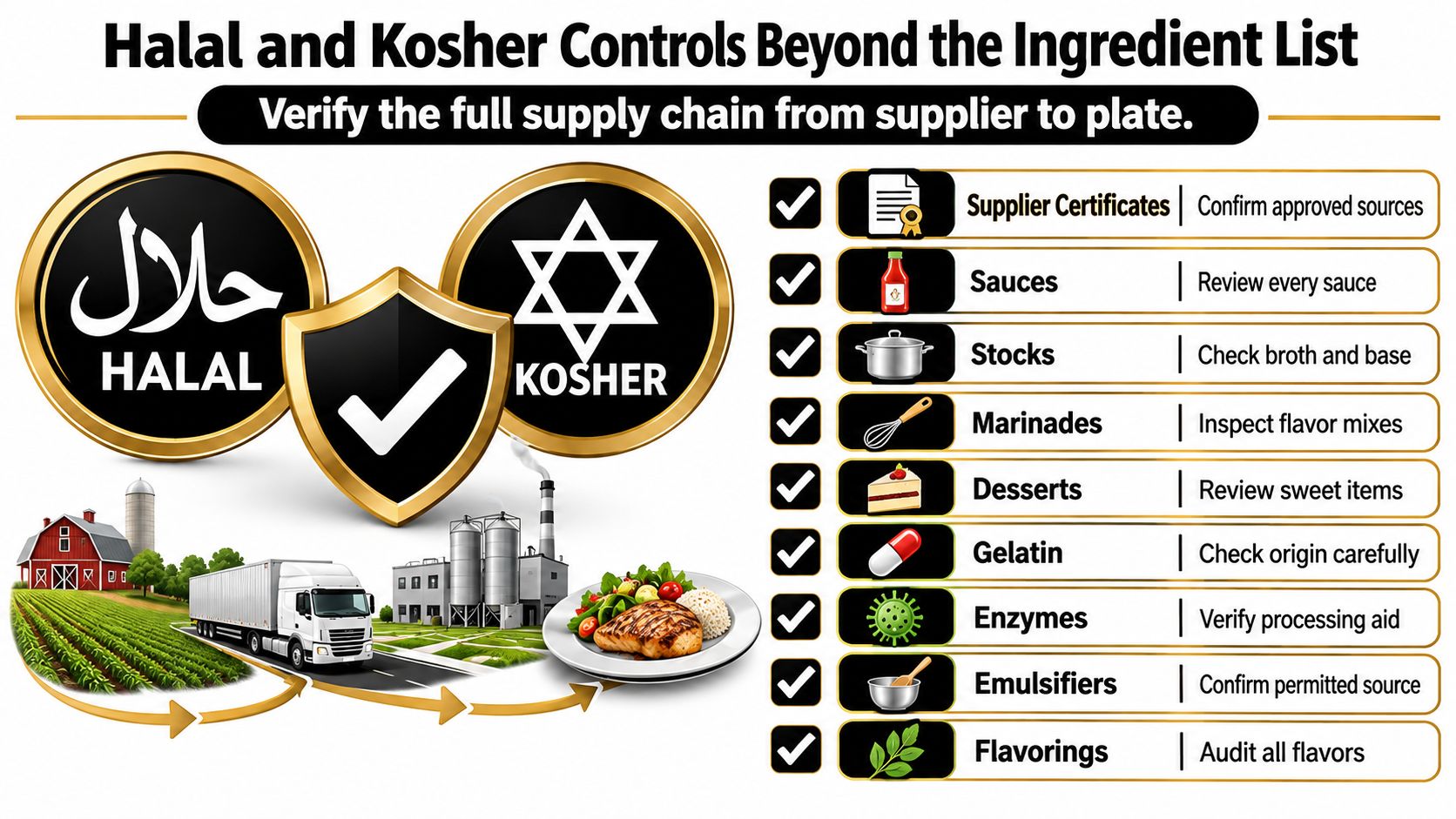
Treat halal as a supplier-to-plate chain, not a pork-free recipe. Start with the certificate, continue through processed components, and finish with the equipment and packaging used for the actual order.
Before listing a certified product, ask the supplier for the current certificate rather than a logo. Match the certifier's name, covered product or site, and expiry to what you purchase.
The checkpoints below belong in the purchasing folder and the kitchen's working records.
Check what the guest can't see
Keep a specification register for sauces, stocks, marinades, desserts, gelatin, enzymes, emulsifiers, flavorings, and preservatives. The chef's handwritten recipe won't reveal the origin of an enzyme inside a bought-in ingredient.
The American Halal Foundation's cross-contamination guidance states that drinks containing at least 1% ethanol are categorized as khamr, while fermented drinks below that level may avoid the category but can still be haram to consume. That isn't a universal permission threshold for restaurant drinks.
Vanilla extract, mirin, wine reductions, confectionery, and cooking extracts need specifications, not taste tests. Don't let staff decide religious status from whether they can taste alcohol.
For bars and cafés, maintain a separate alcohol-free drinks selection and check coffee syrups, vanilla, mixers, and cooking wine through the same register. An alcohol-free description doesn't by itself settle questions about alcohol-derived ingredients.
Match cleaning to the applicable standard
The American Halal Foundation standards require segregation across handling, storage, processing, and distribution. Where stunning is used, requirements differ by jurisdiction and certifier; a common expectation is a reversible method that doesn't kill the animal before religious slaughter, with appropriate supervision.
Don't try to verify slaughter from a delivery driver's verbal answer. Obtain the documentation through the supplier and check that the certifier's scope matches the product.
In the kitchen, identify dedicated boards, knives, pans, fryers, grills, containers, and delivery packaging where required. A general wash-down isn't automatically sufficient for religious compliance; follow the applicable certifier's cleaning or restoration requirements.
For kosher operations, the OK Kosher introductory guidance explains why equipment history and separation matter alongside ingredients. Record meat, dairy, pareve, and certification status for every component, with designated storage, utensils, cookware, surfaces, and towels.
A swapped wine, cheese, gelatin, or sauce can undermine an otherwise controlled dish. If your site can't maintain the required separation, disclose the limitation instead of promising certified service.
Close down with a verification check
- Match proteins to certificates. Confirm that the actual delivered product is covered.
- Scan additives. Check specifications for alcohol, gelatin, enzymes, and other animal-derived components.
- Mark shared equipment. Put fryer and grill limitations on the dish record.
- Separate and label containers. Keep the agreed storage controls visible to the next shift.
- Stop and recheck substitutions. Pause the affected claim when a supplier or formulation changes.
A small kitchen may not have room for every dedicated station. It can still maintain accurate records and refuse to promise separation it doesn't have.
Hindu Jain Buddhist and Fasting Requests
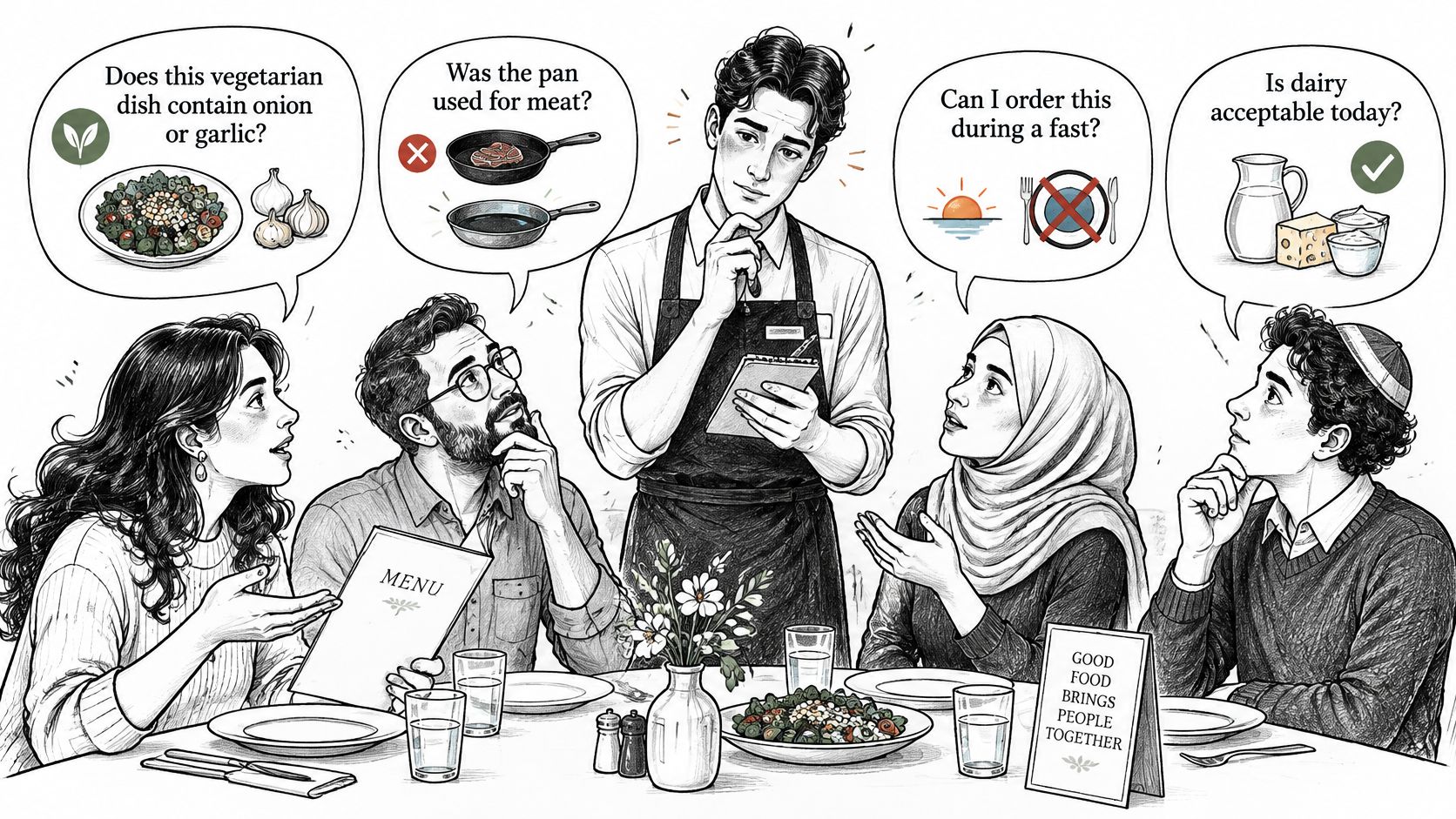
Does this vegetarian dish contain onion or garlic? Was the pan used for meat? Can I order this during a fast? Is dairy acceptable today?
Those questions don't fit neatly into standard vegan, vegetarian, halal, or kosher filters. Restaurantware's guidance on dietary restrictions and preferences recognizes that Hindu and Buddhist requirements can include distinctions such as beef avoidance and onion or garlic exclusions.
The useful conversation happens around ingredients and preparation, not a compulsory religion dropdown.
Build the answer around the actual plate
Say a café offers a South Indian thali. The menu identifies a version made without onion or garlic, names ghee in the preparation, and states that the griddle also cooks eggs.
That description gives different guests different useful answers. A Hindu diner can assess their household exclusions, a fasting guest can refuse dairy, and someone who won't accept egg-contact equipment can decline before ordering.
It doesn't make the entire thali universally suitable. Check each chutney, pickle, bread, and garnish rather than treating the central curry as the whole meal.
For a Jain request, a vegetable stir-fry containing onion, potato, or garlic isn't solved by removing the meat. If those ingredients are already in the batch, offer a separate preparation or explain that you can't accommodate the request.
Buddhist guests may ask for vegetarian food without alliums, including some Mahayana diners. Other guests may accept meat under their own tradition's conditions; the kitchen should establish the requirement without challenging the guest's practice.
Ask what must stay out of the meal and what equipment is acceptable. Don't ask the guest to defend why their practice differs from someone else's.
Make temporary choices visible
For Orthodox fasting, a short rotating selection is easier to control than a permanent fasting badge. Identify dishes without meat, dairy, and eggs, then state explicitly when fish, oil, or wine is included.
Seventh-day Adventist guests may be better served by a clearly meat-free plate and transparent drinks descriptions than a religious symbol. Eggs and dairy need separate ingredient information rather than an assumption that vegetarian means vegan.
Use menu-section visibility controls to remove a temporary selection when it's no longer available. Keep the main menu intact rather than leaving an expired offer visible with a handwritten exception.
Let guests select exclusions
A useful request row lets diners specify:
- Animal ingredients: Beef, pork, meat, eggs, or dairy.
- Recipe components: Alcohol, onion, garlic, or other named ingredients.
- Preparation limits: Shared cookware, frying oil, or cooking surfaces.
- Temporary observance: The fast being kept and the exclusions relevant today.
Some less-observant diners may associate religious certification with cleanliness or health, but certification isn't a substitute for food-safety controls. Nor is that association a reason to display an unsupported religious mark.
Confirm what the kitchen can do, then leave the decision with the guest. Their acceptance of one limitation doesn't authorize a different undisclosed limitation elsewhere on the plate.
Staff Answers That Do Not Overpromise
It should be fine is the sentence to remove from service. It gives the guest confidence without explaining what anyone checked.
During staff training and feedback review, teach servers to read the claim level and stop at its limits. A welcoming tone should never become an improvised certification.
Give servers an answer they can repeat
| Situation | Allowed answer |
|---|---|
| Certified item | The certificate names the certifying authority and covers these listed products. I can show you the scope. |
| Checked recipe with shared equipment | The checked recipe contains no pork or alcohol, but we cook it in a fryer also used for other dishes. |
| Missing evidence | We can't confirm halal or kosher status because we don't have the specification for that ingredient. I can explain the exclusions we have verified on another dish. |
Don't accept answers such as no pork, so it's halal, or the chef can make it kosher with a clean plate. Neither addresses the evidence the guest needs.
For a Jain or fasting request, repeat the agreed exclusions plainly: no onion, no potato, no egg, with dairy served separately if that's what the guest requested. Then put the same instruction on the kitchen ticket.
Ban silent substitutions. Wine, stock, cheese, gelatin, and replacement sauces require a check before they enter a meal sold under a specific assurance.
Handle a challenged claim as an operational fault
If a guest says the meal violated a stated claim, apologize without debating their beliefs. Record the dish, supplier, preparation station, and what staff told them; pull the affected item or claim until a manager checks the record.
Offer a private feedback route through the menu or a receipt code created with a QR code generator. A translated inbox and low-rating alert can help managers identify a problem promptly, but the immediate conversation at the table still matters.
If you offer a Google review button, show it to every diner. Don't send only happy guests toward public reviews, because review gating breaks Google's policy.
Keep religious-claim procedures alongside, but distinct from, your allergen-labeling compliance procedures. A complaint involving a suspected allergic reaction needs the appropriate medical-safety response, not just a menu correction.
Rehearse the awkward moments
- Shared fryer: The guest asks for certainty that the kitchen can't provide.
- Missing gelatin specification: The dessert looks vegetarian, but the record is incomplete.
- Friday fast: This particular guest accepts fish, so the server must not impose a stricter assumption.
The test is consistency: a new server and the chef should give the same factual answer.
Ramadan Yom Kippur and Passover Service Timing
Time-based observances affect when you serve, not just what you cook. During Ramadan, a Muslim guest observing the fast abstains from dawn until sunset, so a useful offer may include suhoor before dawn and iftar around sunset.
Only offer a service window your team can deliver. A modest pre-arranged meal is better than advertising an elaborate set that arrives after everyone expected to break their fast.
Plan the meal and the clock together
For an iftar service, confirm the local sunset time for the relevant date before printing it on the menu. Check the halal status of every included dish through the normal claim process; a seasonal heading doesn't strengthen the evidence.
A free, commission-free booking page helps guests reserve the relevant service slot and leave dietary notes in advance. Managers should review those notes before confirming an accommodation, rather than treating submission as acceptance.
Passover requires a different check. Jewish guests observing it avoid chametz, and a regular kosher certificate doesn't automatically establish that a product or meal is kosher for Passover.
Yom Kippur involves a full fast of about 25 hours. Discuss pre-fast meals and any requested post-fast arrangements with the guest rather than assuming they want a conventional late dinner or your usual service schedule.
Use a short observance workflow
- Ask during the booking conversation. Establish the observance, exclusions, and requested meal time.
- Publish the date and window. Make the special service's availability explicit.
- Check every included component. Include drinks, bread, condiments, and desserts in the review.
- Remove the offer afterward. Hide the special section when the observance or service period ends.
Use real-time menu updates for availability changes, with the same wording available to the front-of-house team. Don't leave yesterday's timing or an unavailable certified option visible because the main menu still works.
Publish One Stance Through Labels and Tools
Put the claim level beside the dish, not in a distant footer. Name the certifier where applicable, and place any shared-equipment limitation beside the ingredient statement.
Keep dish details specific: vegetarian, no beef, no onion or garlic, no egg, no alcohol, meat, dairy, or pareve. Dairy-free does not establish kosher status, and a guest-selected exclusion does not change the dish's underlying assurance level.
Keep religious disclosures separate from allergen filters
Allergen labels answer a different question. Dishes can be tagged with the 14 EU-regulated allergens under Regulation 1169/2011, the same list as German LMZDV §5. Guests can filter the public menu to hide dishes containing a selected allergen.
That filter does not establish halal or kosher status. An allergen-free result says nothing by itself about slaughter, certification, alcohol-derived components, or equipment history.
Use each tool for its specific job:
- Publish the claim: Build dish descriptions in the free menu creator, using this practical guide to make a digital menu.
- Keep allergy information distinct: Use the Free Allergen Menu to tag allergens and let guests filter dishes.
- Make limitations understandable: Translate menu content for guests, then review religious terms and preparation notes for accuracy.
- Keep wording consistent across menus: Unlimited menus can be created for daily specials, seasonal menus, private events, or different locations, and one QR code covers all of a restaurant's menus.
The core tools are free, with no per-item limits. An optional Pro plan adds full AI translation and branding options.
Choose the promise you can maintain
For the next menu cycle, choose an operating stance your kitchen can support: sell certified items within their documented scope, state the limitations of a mixed kitchen, or say that religious status cannot be verified while listing specific confirmed exclusions.
Different dishes can carry different records, but one plate must have one coherent claim. A certified protein does not certify an unverified sauce, garnish, or preparation process.
Start with your ten best-selling dishes. Assign each a claim level, check supplier records for gelatin, enzymes, and alcohol-derived ingredients, and identify shared fryers and grills. Then publish the exact sentence your team can stand behind.
TopFoodApp offers digital menus, booking tools, and private guest feedback to help restaurants publish clear dietary information and collect specific requests before service. Visit TopFoodApp to update dish descriptions with confirmed exclusions, certification scope, and preparation limits.