Line Cook vs Prep Cook: Roles, Pay, and Career Paths
A Friday dinner rush exposes the difference immediately. The prep list looked complete, but the sauté station is missing portioned protein, the sauce base is thin, and the expediter is calling for plates that can't leave together. The line cook is working at full speed, yet the service is still late because the work behind the station wasn't reliable.
That's why line cook vs prep cook isn't just a job-title comparison. It's an operating decision that affects ticket flow, station coverage, schedule stability, training, and the pressure each person carries. A cook choosing a career path needs a realistic picture of the work. A manager hiring for service needs to know which gap is really slowing the kitchen.
The useful comparison comes down to five questions: what each role owns during a shift, which skills matter, how stamina and temperament affect performance, how schedules and pay are benchmarked, and how labor realities in 2025–2026 are changing kitchen staffing. The old shortcut, prep happens before service and line cooking happens during service, is accurate but incomplete. The core difference appears in handoffs, station systems, cross-training, and the consequences of a weak mise en place.
Table of Contents
- What the Line Cook vs Prep Cook Question Really Hinges On
- What Each Role Actually Does During a Shift
- Skills, Stamina, and Personality Fit
- Schedules, Pay, and How the Roles Are Benchmarked
- Training Pathways and Career Progression
- Stability, Automation, and 2025–2026 Labor Realities
- Hiring and Staffing Decisions for Operators
- Which Role Fits You and Quick Answers to Common Questions
What the Line Cook vs Prep Cook Question Really Hinges On
The first question isn't which role sounds more advanced. Ask instead, where is the kitchen losing control?
If tickets are piling up because nobody can fire proteins, manage pans, or coordinate pickups, the immediate need is line coverage. If the line has enough people but keeps running out of sliced vegetables, sauces, garnishes, or portioned ingredients, another line cook won't solve the root problem. The kitchen needs dependable prep.
That distinction matters because the two roles absorb different kinds of pressure. A line cook works inside a live production system. Orders arrive unpredictably, several dishes must finish together, and a small error becomes visible at the pass. A prep cook works ahead of that pressure, converting deliveries and recipes into labeled, usable mise en place. Their mistakes may stay invisible until service starts, which makes accurate prep control just as important as fast firing.
Practical rule: Hire for the bottleneck you can observe, not for the role that seems more prestigious.
Use five criteria when comparing candidates or jobs:
- Shift responsibility: Does the position prepare inputs or execute finished plates?
- Skill profile: Does success depend more on knife consistency and batch control, or timing and station discipline?
- Physical demand: Is the work defined by heat and sprint intervals, or repetition and steady volume?
- Schedule and pay: Does the role follow morning production or evening service peaks?
- Labor reality: Can the kitchen cross-train the person, and which tasks are most exposed to standardization or automation?
This approach removes hierarchy folklore from the decision. Prep isn't lesser line work, and line cooking isn't prep with more drama. One role protects readiness. The other protects execution. A well-run kitchen needs both responsibilities to connect cleanly.
What Each Role Actually Does During a Shift
A prep cook's shift starts with the question, what must be ready before the first serious order arrives? The cook reads the par sheet, checks available product, prioritizes items with the longest production time, and works through washing, cutting, portioning, sauces, stocks, dressings, or other assigned batches. Finished items are labeled, stored correctly, and placed where the line can find them without interrupting production.
A line cook begins by turning that preparation into a station that can survive service. The cook checks quantities, tests sauces, verifies portions, arranges tools, confirms temperatures, and flags missing product before the first ticket. During service, the job changes from preparation to controlled reaction. The cook fires food in sequence, watches doneness, communicates with neighboring stations, and sends plates that match the menu specification.
| Time Block | Line Cook Focus | Prep Cook Focus |
|---|---|---|
| Opening production | Review station needs and confirm available mise en place | Read the prep list, inspect ingredients, and prioritize production |
| Pre-service setup | Arrange pans, tools, sauces, proteins, garnishes, and backups | Wash, cut, portion, batch-cook, label, and store ingredients |
| Service handoff | Identify shortages and request replenishment before the rush | Deliver clean, usable mise en place and explain quantities or substitutions |
| Active service | Fire orders, manage timing, plate to specification, and communicate with the expediter | Replenish where assigned, continue urgent prep, and protect food-safety standards |
| Closing | Break down the station, record shortages, clean equipment, and store product | Finish storage, rotate product, reset prep areas, and sanitize work surfaces |
The handoff between these roles is where many kitchens fail. A container may be technically full but unusable because the cut is inconsistent, the label is unclear, the portion is wrong, or the product is stored in the wrong place. Conversely, a prep cook can complete a strong list and still leave the line exposed if the station cook doesn't check the delivery early enough.
Digital ordering and inventory tools can make that handoff more visible. A restaurant evaluating a broader operating system may find a resource such as POS for Singapore restaurants useful when connecting sales information with planning and front-of-house workflows. The tool doesn't replace a prep list or a station check, but better information can help managers see which items repeatedly create pressure.
The line cook owns what leaves the pass. The prep cook owns what reaches the line in a usable condition. Food-safety details also need a consistent process, especially where ingredients and allergens move between prep areas and stations. A documented restaurant allergen compliance checklist can support that process, but staff still have to follow the labels, storage rules, and communication standards in practice.
Skills, Stamina, and Personality Fit
The strongest candidate isn't always the person with the longest résumé. Fit depends on the type of pressure the kitchen needs that person to handle repeatedly.
| Attribute | Line Cook | Prep Cook |
|---|---|---|
| Core technical skill | Timing, heat control, sauce judgment, station setup, and plating | Knife consistency, accurate measuring, batch production, labeling, and rotation |
| Pace | Reactive bursts during service, with several tasks competing for attention | Sustained output across a defined production list |
| Physical environment | Heat, noise, tight movement, and frequent interruptions | Repetition, lifting, standing, cold storage, and extended concentration |
| Quality test | Dishes leave together, correctly cooked and plated | Ingredients arrive at the line in the right quantity and condition |
| Communication | Constant calls with the expediter and neighboring stations | Clear handoffs, shortage reports, labels, and production notes |
| Temperament | Composed under visible, immediate pressure | Methodical, consistent, and comfortable with quieter accountability |
Line cooking rewards cooks who can make decisions without losing station discipline. A grill cook may need to track different cooking stages while listening for a call from sauté and watching the expediter. Speed helps, but uncontrolled speed creates waste, missed modifiers, and uneven plates.
Prep work demands a different kind of intelligence. A prep cook has to understand yields, recognize when an ingredient is deteriorating, adjust production to actual demand, and keep a clean sequence through repetitive work. The cook who rushes through knife work may finish sooner but create inconsistent pieces that cook unevenly or force the line to remake portions.
The line exposes hesitation. Prep exposes inconsistency.
Personality fit matters because neither role is easy in the same way. Some cooks gain energy from immediate feedback, chef calls, and the visible result of a plate. Others produce better work when they can follow a clear list, control their workspace, and build accuracy without a crowd watching every move.
Cross-training can connect the two paths, but it shouldn't be treated as automatic. Moving a dependable prep cook into pantry, salads, or another lower-complexity station is often a practical bridge. Moving a sauté cook into a long prep block can be harder because station intensity doesn't automatically build patience, yield awareness, or batch discipline.
Schedules, Pay, and How the Roles Are Benchmarked
Prep cooks often work earlier, steadier shifts because their output must be ready before guests arrive. Line cooks are more likely to absorb dinner service, weekends, closing work, and the uneven demand that comes with peak periods. That schedule difference can matter as much as the hourly offer for someone balancing family commitments, transportation, or a second job.
The available wage benchmarks show a clear distinction in the United States. The cited national average salary is $41,170 per year for line cooks and $30,335 per year for prep cooks, a difference of $10,835, or about 35.7%, according to Indeed's line cook versus prep cook comparison. These figures are benchmarks, not guarantees. Actual offers vary with kitchen type, experience, location, schedule, responsibilities, and whether the cook is expected to cover multiple stations.
| Metric | Line Cook | Prep Cook |
|---|---|---|
| Main labor output | Completed dishes during active service | Ready ingredients and batches before service |
| Primary productivity measure | Throughput, timing, station coverage, and plates to specification | Par-list accuracy, usable yield, replenishment, and inventory control |
| Typical shift pattern | Service-focused, often later and more variable | Production-focused, often earlier and more predictable |
| U.S. cited annual benchmark | $41,170 average salary | $30,335 average salary |
| Why pay can differ | Real-time execution, station ownership, and peak-service pressure | Foundational production, consistency, and inventory support |
Operators should avoid comparing the roles only by hours scheduled. A prep cook who prevents repeated shortages may protect service more effectively than an additional line cook. A line cook who can cover multiple stations may create flexibility that a narrow specialist can't provide. The right benchmark combines labor cost with the work produced and the problems prevented.
Cross-market comparisons also need care. One industry source cites average hourly pay of about $13 for line cooks in the United States and about $16 in Canada, illustrating that the same job title is benchmarked differently between major markets. That figure appears in the Culinary Institute of America's discussion of cook and chef roles, and it shouldn't be treated as a universal rate.
Training Pathways and Career Progression
A new prep cook can enter through supervised kitchen work, a food-safety course, or a culinary program, but formal school isn't the only route. The first priority is dependable knife work, followed by recipe accuracy, labeling, storage, rotation, and the ability to finish a production list without constant reminders.
Line cooks often learn through station progression. They begin by observing setup and basic tasks, then take responsibility for parts of a station, timing, and quality checks. The useful milestone isn't just learning recipes. It's learning how to keep a station organized while orders, modifications, shortages, and neighboring stations compete for attention.
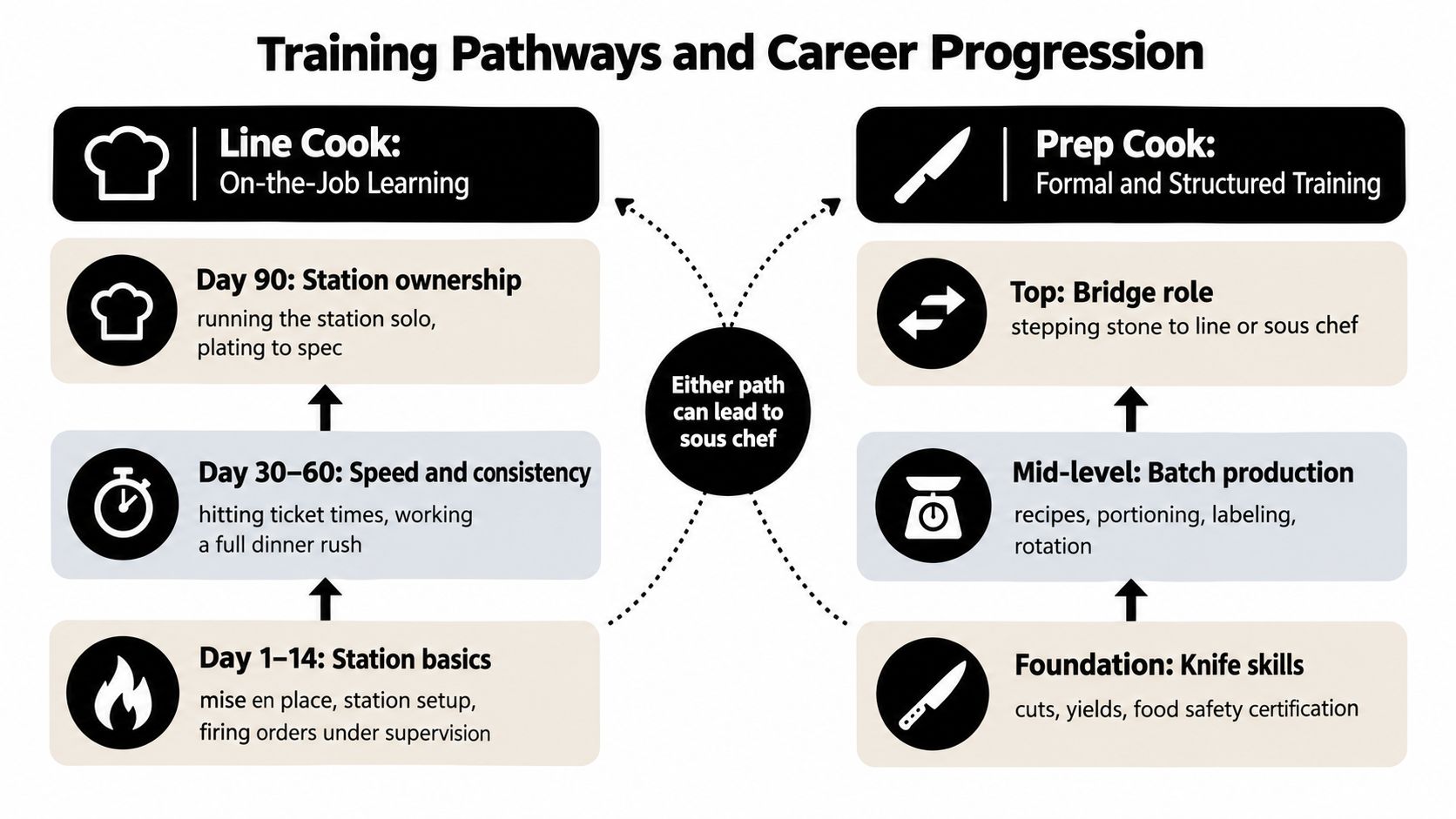
A realistic progression for either role has three parts:
- Build control first: Learn the kitchen's recipes, storage rules, cleaning standards, and communication habits before chasing speed.
- Add range next: Prep cooks can learn pantry or cold-station work. Line cooks can improve bulk production, ordering awareness, and yield control.
- Take ownership last: A senior cook should be able to anticipate shortages, train another person, and protect quality without waiting for a chef to intervene.
Culinary school can be useful when it provides strong fundamentals, reliable placements, and access to a specific specialty. It makes less sense when the cost creates pressure without improving the candidate's target role. Many kitchens can teach menu execution directly, while a formal program may be more valuable for someone pursuing pastry, classical technique, hospitality management, or a credential-based career path.
Candidates should document more than dish names when applying. A useful cook resume writing guide can help frame station ownership, batch production, food-safety practices, and cross-training as evidence of responsibility. A cook who has moved between prep and line often has a stronger operational story than someone who has only performed one narrow task.
Both paths can lead toward lead cook, sous chef, chef de partie, catering production, purchasing, or specialist work. The route isn't a ladder with only one correct first step. It's a widening set of responsibilities.
Stability, Automation, and 2025–2026 Labor Realities
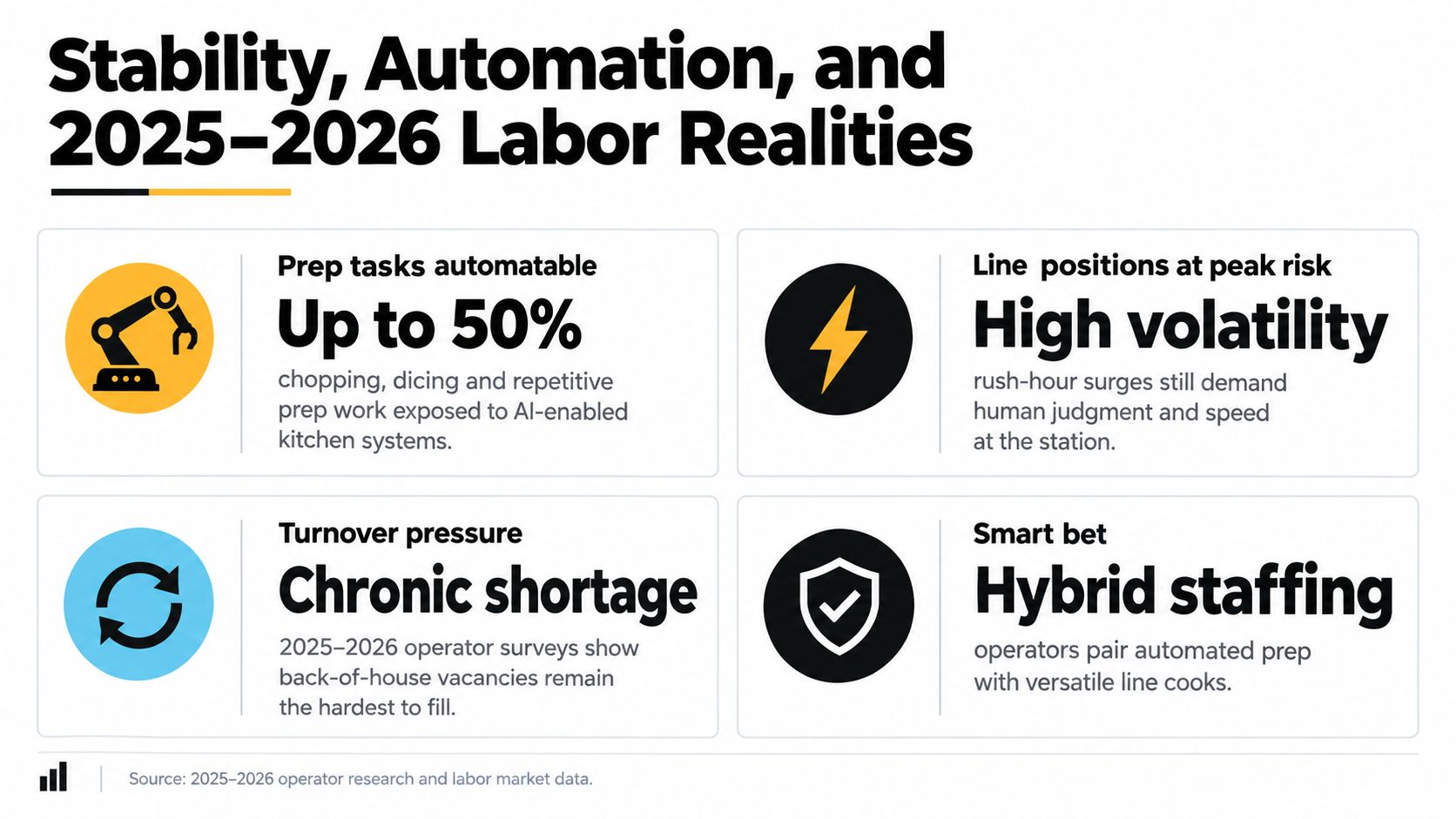
The more stable role depends on the kitchen's production model. Prep work can offer a steadier rhythm, especially where the menu relies on planned batch production and predictable opening preparation. It can also face more pressure from centralized commissaries, forecasting software, portioning systems, and equipment that standardizes repetitive tasks.
Line work faces a different risk. Automation may support ticket displays, timers, inventory prompts, or cooking consistency, but the station still has to interpret the order, manage exceptions, coordinate with other cooks, and respond when demand changes suddenly. The line is therefore more exposed to peak-hour volatility, even when the work is harder to standardize.
Restaurant operators report serious staffing pressure. Research from the National Restaurant Association on workforce and technology states that 77% of restaurant operators say recruiting and retaining employees is a significant challenge. That pressure encourages operators to redesign jobs around flexibility instead of preserving a strict prep-to-line hierarchy.
The practical reading is straightforward:
- Prep cooks need broader value: Knife work alone is vulnerable when a kitchen standardizes production. Inventory judgment, food safety, recipe control, and the ability to support a station make the role more durable.
- Line cooks need more than speed: A cook who can run one station is useful. A cook who can set up, cover adjacent stations, coach a new hire, and communicate shortages is harder to replace.
- Operators need hybrid staffing: Pairing reliable prep coverage with versatile line cooks can reduce the damage from callouts, menu changes, and uneven demand.
Technology won't remove the need for people, but it can change which tasks employers pay to keep in-house. A manager should ask whether a system is reducing repetitive prep, improving forecasting, or adding another screen for cooks to maintain.
Language and menu clarity also affect execution across a mixed team. For restaurants serving multilingual staff or guests, AI translation for restaurant menus can be part of a broader communication workflow, provided the kitchen still verifies ingredients, modifiers, and allergen information.
Service pressure remains human and immediate. This video offers another visual perspective on the relationship between kitchen roles and live production:
Hiring and Staffing Decisions for Operators
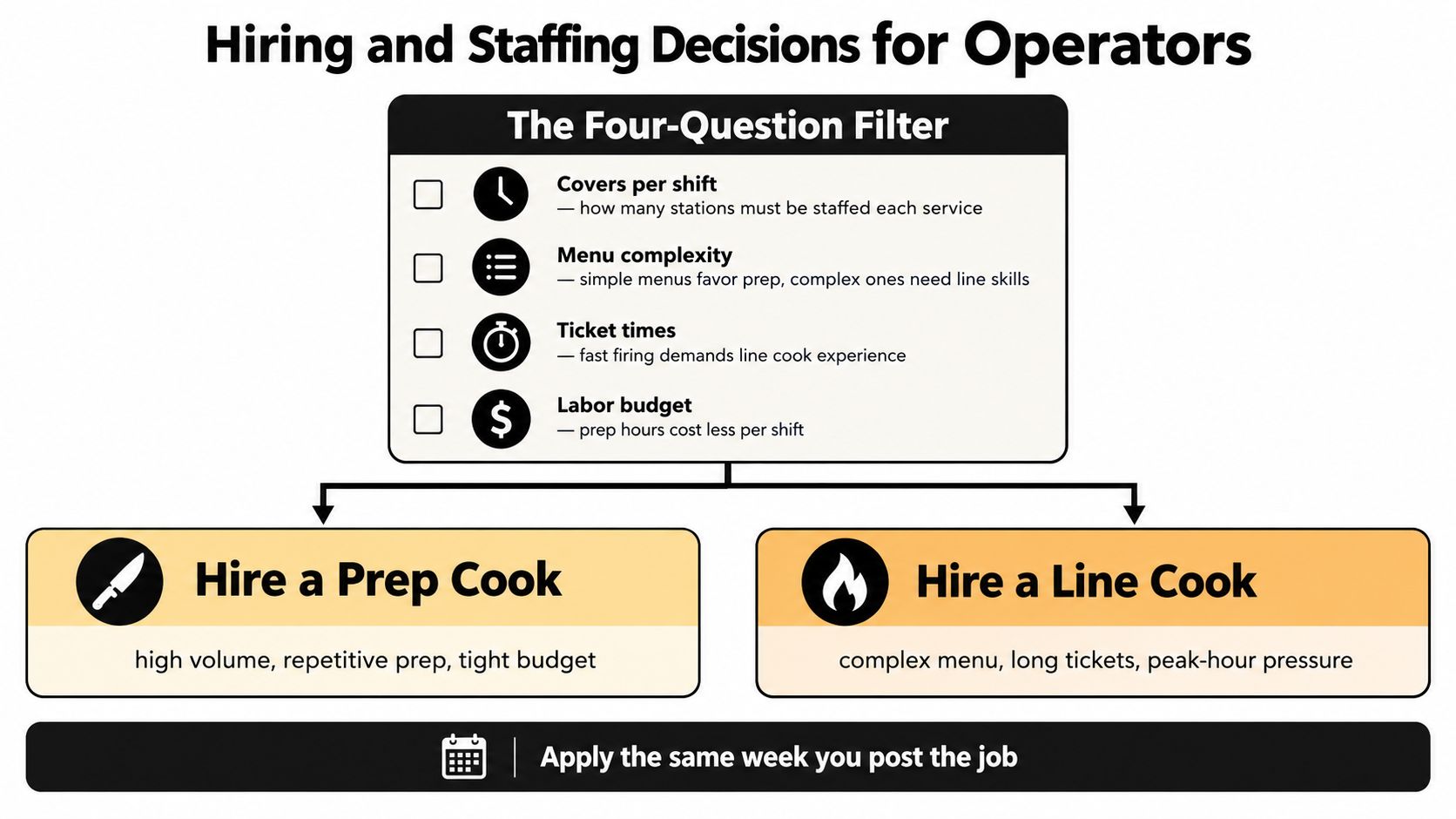
Start with four questions before writing the job post:
- How many stations need coverage? Count the positions that must remain active during service, not just the total number of cooks.
- How complex is the menu? A menu with extensive sauces, proteins, garnishes, and modifiers creates more line pressure.
- Where do tickets slow down? If cooks wait for ingredients, hire for prep. If mise en place is ready but plates stall, hire for the line.
- What can the labor budget support? Compare the cost of scheduled hours with the revenue and service risk attached to the bottleneck.
A neighborhood bistro may need prep coverage first when one person currently chops, portions, and restocks before service. A larger high-volume operation may need line depth first because a single uncovered station can disrupt the whole pass. A multi-unit ghost-kitchen operator may benefit from centralized prep and a flexible pool of station cooks, but only if product reaches each location consistently and on time.
Screen candidates with work samples that resemble the job. For prep applicants, review knife consistency, labeling habits, sanitation, batch accuracy, and whether they can explain how they prioritize a production list. For line applicants, run a supervised station exercise that tests setup, timing, communication, recovery from a mistake, and adherence to plating standards.
The hiring decision is only half the solution. Keep people by making expectations visible:
- Publish station standards: Show pars, setup diagrams, cleaning duties, and escalation rules.
- Rotate deliberately: Cross-train compatible stations without moving people so often that nobody develops ownership.
- Explain compensation clearly: Employees need to understand base pay, overtime practices, tip-pool treatment where applicable, and schedule expectations.
- Track the bottleneck: Review shortages, remakes, late pickups, and unfinished prep instead of judging performance by speed alone.
Food safety should be part of the hiring and training system, not a separate document that sits in an office. A manager can use a restaurant allergen labeling compliance guide to reinforce the connection between prep labels, menu information, and service communication.
Which Role Fits You and Quick Answers to Common Questions
Choose prep if you prefer clear production goals, controlled repetition, and the satisfaction of making the next shift possible. Choose the line if you want immediate feedback, enjoy coordinated pressure, and are ready to own a station when several orders compete for attention. If you're unsure, a paid trial period in prep can let you learn the kitchen's standards before deciding whether live service suits you.
The most useful career choice is the one that builds a missing capability. A prep cook who learns pantry service gains timing and guest-facing urgency. A line cook who learns production planning gains a better understanding of yield, waste, ordering, and why a station succeeds or fails before the first ticket prints.
Can a prep cook move into a line position without culinary school
Yes. A prep cook can move into a line role by demonstrating knife control, food-safety discipline, recipe accuracy, station organization, and calm communication. Start with a manageable station, then add responsibility as the cook proves they can maintain quality while orders are active.
Which role typically earns more in the United States
The cited national benchmark places line cooks above prep cooks, with the line-cook average at $41,170 per year and the prep-cook average at $30,335 per year in the comparison published by Indeed. Actual pay still depends on location, experience, menu complexity, schedule, and whether the cook covers multiple stations.
How are line and prep cooks classified for overtime
Job titles alone don't determine overtime treatment. Classification depends on the worker's duties, pay arrangement, schedule, and the applicable employment rules, so operators should review the role with qualified payroll or employment counsel rather than assuming every kitchen cook is treated the same way.
Can line and prep cooks share a tip pool
They may be able to share a tip pool depending on the restaurant's structure and the rules that apply in its jurisdiction. The operator should document eligibility, communicate the policy before hiring, and verify the arrangement with payroll or employment counsel.
A practical decision is to compare the shift you can sustain, not just the title you want. Prep favors reliable production and can form a strong foundation. Line work develops real-time judgment and station ownership. The best long-term cooks usually understand both sides of the handoff.
TopFoodApp helps restaurants create QR-based digital menus with instant updates, allergen management, multilingual menu options, and structured menus from PDFs or photos. Visit TopFoodApp to see how it can support clearer menu communication between operators, prep teams, line cooks, and guests.