Gratuity in Restaurants Explained for Owners and Staff
A guest studies the bill, points to a line marked “gratuity,” and asks, “Is this already the tip?” The server knows the restaurant has a policy, but isn't sure whether the charge goes directly to the team, belongs to the house, or can be removed. A small wording problem has suddenly become a table-side trust problem.
That moment is common because gratuity in restaurants can describe different payment arrangements. A voluntary tip, an automatic gratuity, and a service charge may appear close together on a receipt, yet they can carry different expectations for guests, different handling requirements for operators, and different answers from staff.
Clear communication matters as much as the percentage. Pew Research found that 92% of U.S. adults who dine at sit-down restaurants say they always or often tip, while 57% say they'd tip 15% or less for an average sit-down meal, including 2% who'd leave no tip (Pew Research Center's tipping culture analysis). Tipping remains established, but guests no longer share one uniform expectation.

Table of Contents
- Introduction to Gratuity in Modern Dining
- What Gratuity Really Means and How It Differs From Tips
- Legal and Tax Implications Every Operator Should Know
- How to Calculate and Distribute Gratuity Fairly
- Menu Wording and QR Menu Examples That Build Trust
- Record Keeping and Handling Guest Questions With Confidence
- Putting Your Gratuity Policy Into Practice
Introduction to Gratuity in Modern Dining
For a restaurant owner, an unclear gratuity policy creates several problems at once. Guests may feel surprised, servers may feel exposed when they have to defend a charge they didn't design, and managers may end up authorizing inconsistent adjustments. The same confusion can later appear in online reviews, staff conversations, and accounting records.
The practical issue isn't whether a restaurant uses a 15%, 18%, 20%, or another figure. The issue is whether the guest understands what the charge is, whether it's optional, who receives it, and when it appears. A percentage shown only at checkout feels different from the same percentage disclosed clearly on the menu before ordering.
Industry transaction data reflects a softer but still established tipping pattern. Toast reported average tips of 18.9% in Q1 2024, 18.8% in Q2 2024, and 18.8% in Q1 2026, with full-service tips around 19.3% to 19.4% and quick-service tips around 15.8% to 16.0% (Toast restaurant trends reported in MarketWatch). Those figures don't create a universal rule, but they show why operators should avoid treating every service format as identical.
Why the wording affects the experience
A guest at a full-service table may expect an optional tip after receiving personal service. A guest ordering at a counter may interpret the same prompt differently, especially if the screen presents several suggested amounts before payment. A hotel restaurant, brewery, food truck, and fine-dining room can all use different policies because the service model differs.
The safest approach is to design the policy from the guest's point of view. Put the explanation where the decision happens, use consistent terms across menus and receipts, and train employees to answer without sounding defensive. Clarity protects the relationship even when a guest doesn't like the policy.
What Gratuity Really Means and How It Differs From Tips
Start with the payment decision, not the label.
A voluntary tip is controlled by the guest. The guest decides whether to leave it, how much to leave, and generally who should receive it. A server might describe it as an optional thank-you after service. The restaurant can suggest an amount, but a suggestion must remain a suggestion.
An automatic gratuity is a preset amount added by the restaurant. The guest doesn't calculate or choose it at the end of the meal. In everyday operations, restaurants often use this arrangement for large parties, private events, or other service situations that require a predictable charge. Because legal treatment can vary by jurisdiction and policy design, operators should confirm the classification and disclosure requirements that apply locally.
A service charge is a fee imposed by the business. The house sets the amount or method, collects it, and distributes it according to its written policy. It may support wages, administration, kitchen operations, event service, or other stated purposes. It isn't automatically the same thing as a voluntary tip, even if the restaurant uses the word “gratuity” in casual conversation.
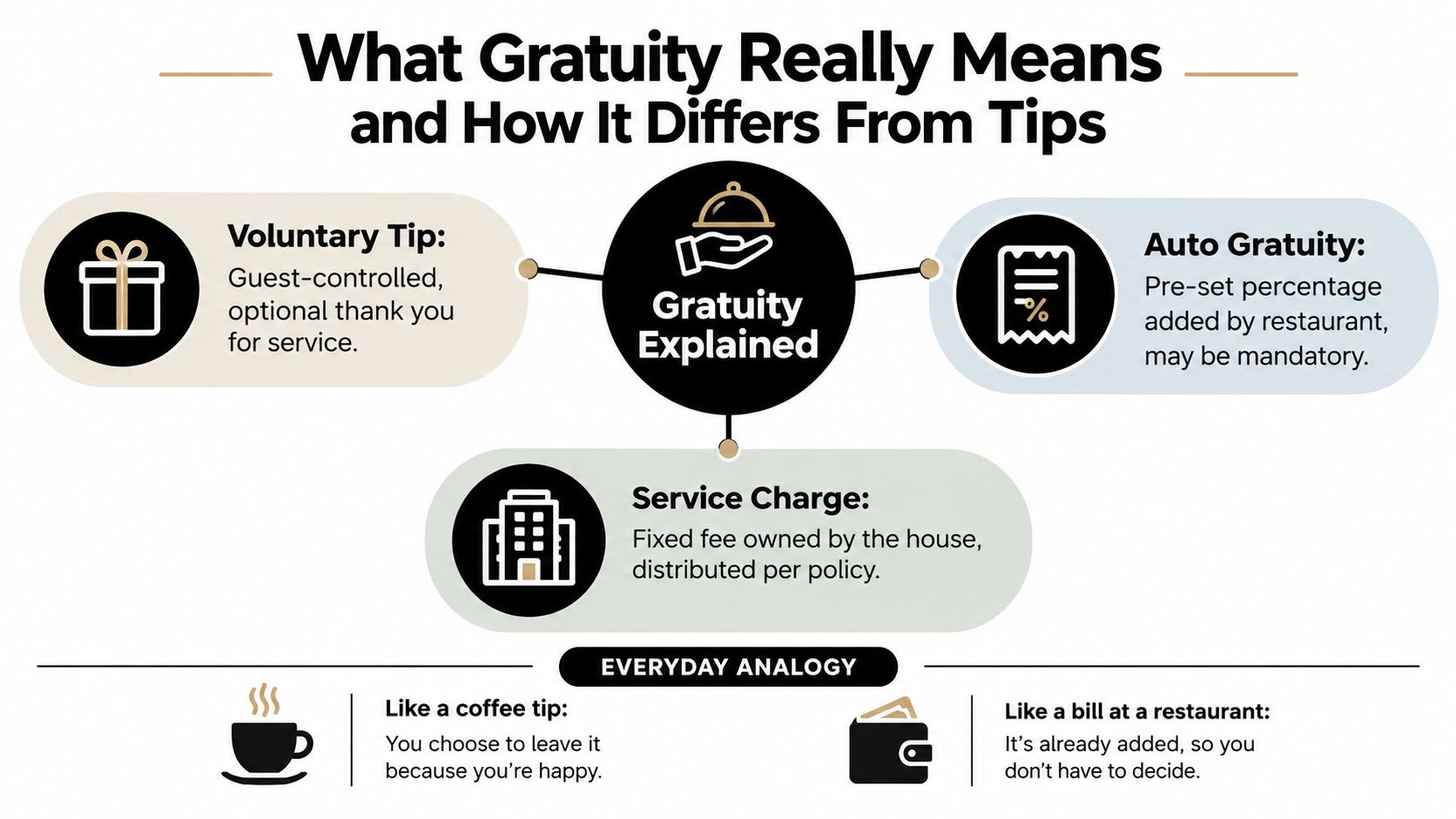
Core distinction: A tip is guest-controlled. An automatic gratuity or service charge is restaurant-controlled, so the guest needs advance notice and precise wording.
Use a simple staff explanation
Train employees to explain the difference with an everyday analogy. A voluntary tip is like leaving a thank-you note after someone helps you. An automatic gratuity is like a clearly announced reservation condition. A service charge is like a listed facility fee, the restaurant applies it because its policy says it applies.
The words “optional” and “included” carry important meaning. “Suggested gratuity” signals choice. “An 18% service charge will be added” signals a mandatory fee. “A 20% gratuity is included for parties of six or more” tells the guest that the bill already contains a preset charge, but it may still leave questions about distribution unless the restaurant explains that separately.
Watch the video below for another visual introduction to gratuity terminology and restaurant payment practices.
A receipt should never force a guest to infer the answer. If the charge is mandatory, call it a service charge or automatic gratuity and say so before ordering. If an additional tip is welcome, label that option separately as optional.
Legal and Tax Implications Every Operator Should Know
The classification changes the operator's responsibilities. A voluntary tip is controlled by the guest and is generally treated differently from a mandatory charge that the business imposes. A service charge usually enters the restaurant's funds first, then moves through payroll or another distribution process according to policy and applicable law.
That distinction affects ownership, distribution, wage treatment, withholding, and reporting. It also affects what staff members believe they're entitled to receive. An owner who calls a charge a “tip” on the menu but records it as a house-controlled fee may create confusion for employees and guests, even if the internal accounting process seems orderly.
The exact answer depends on federal requirements, state and local rules, employment arrangements, and the language used in the policy. Operators should ask their accountant, payroll provider, or employment counsel to review the arrangement rather than relying on a generic industry template. Restaurants working across regions should avoid assuming that one policy works everywhere.
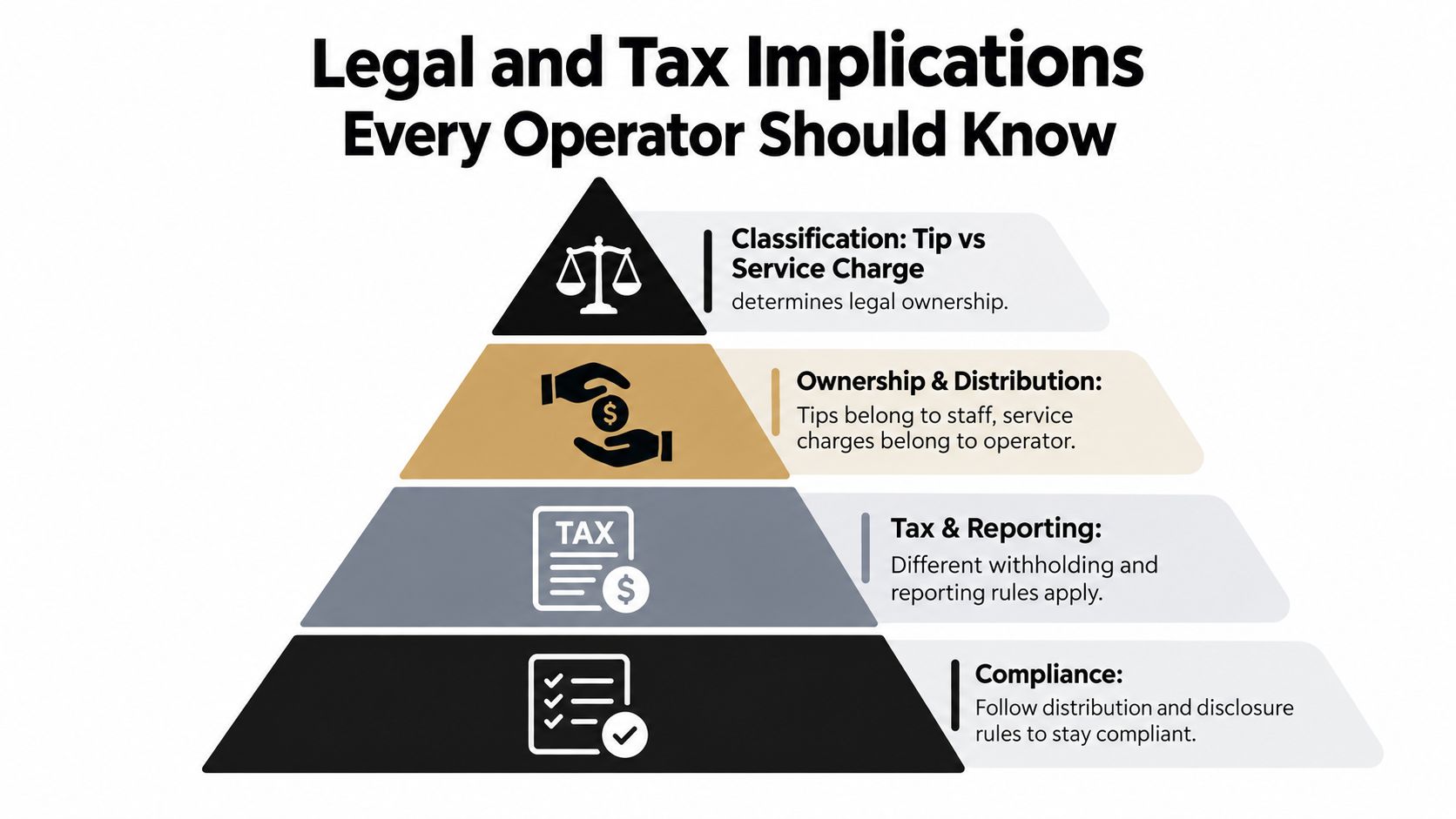
Four questions to ask before launch
Who controls the money? If the guest freely chooses the payment, it may be a tip. If the restaurant requires it, it may be a service charge or automatic gratuity.
Where does the money go? Write down whether the amount is paid to servers, pooled among eligible employees, used for wages, or allocated through another documented method.
How does payroll record it? Give your payroll specialist the exact policy language and POS configuration. Labels on reports should match the terms shown to guests.
Where do guests see the disclosure? Put the explanation on printed menus, QR menus, event agreements, receipts, and payment screens when relevant.
A restaurant should also consider related financial rules when setting menu prices and fees. For operators working in European markets, this practical guide to Benelux food VAT rates explained can help frame the separate VAT questions that arise alongside service-charge decisions. VAT treatment and gratuity classification aren't interchangeable, so review them as separate issues.
Why consistency matters
A policy can be legally sound on paper and still fail operationally if the menu says “service fee,” the POS says “gratuity,” and the server describes it as “the tip.” Use one approved vocabulary. Keep a dated copy of the policy, train managers on exceptions, and record any changes before updating guest-facing materials.
Don't promise employees that a charge belongs to them until the distribution and payroll treatment have been confirmed. Clear internal documentation supports compliance, but it also gives staff the confidence to answer guests.
How to Calculate and Distribute Gratuity Fairly
Calculation and distribution are separate decisions. First determine how the guest-facing amount is calculated. Then decide how the restaurant allocates the collected money internally.
Common calculation methods include a percentage of the meal total, a fixed amount connected to party size, and a tiered structure for different event or service conditions. Operators should define whether the calculation uses the pre-tax food and beverage total, excludes discounts, or treats delivery, private rooms, and other charges separately. The policy must state the basis in language a guest can understand.
A percentage can feel natural in full-service dining because it follows the value of the order. A per-person fee may be easier to explain for a hosted event with a defined service package. A tiered model can fit private dining, but it needs especially careful disclosure because guests may not expect the amount to change by condition.
Compare the models before choosing one
| Model | How It Works | Best For | Watch Out For |
|---|---|---|---|
| Percentage of eligible sales | Applies a stated percentage to a defined subtotal | Full-service restaurants with consistent table service | Guests may not know whether tax, discounts, or other fees are included |
| Per-person fee | Applies a stated amount to each covered guest | Large parties, banquets, and set service packages | The fee can feel disproportionate if party details change |
| Tiered calculation | Uses different rates or fees for defined service conditions | Events, private rooms, and hybrid packages | Complex rules create disputes unless staff can explain them |
| Shared pool | Combines eligible amounts and distributes them among a defined group | Teams that emphasize shared service | Employees need visibility into eligibility and timing |
| Point system | Assigns roles different points, then divides the pool by total points | Larger teams with varied responsibilities | Managers must explain how points reflect duties |
| Role-weighted split | Allocates shares by job category or documented contribution | Restaurants with clear front- and back-of-house roles | The model can damage morale if workers don't understand the rationale |
For a deeper look at allocation approaches, operators can review how do restaurants split tips and use the comparison to test their own policy against their service model.
Make the math visible internally
Suppose a restaurant applies a percentage to an eligible subtotal. The manager should be able to show the team the calculation path, the amount collected, permitted deductions, the distribution pool, and each person's share. Staff don't need a complicated spreadsheet, but they do need a repeatable explanation.
A written policy should answer practical questions:
- Eligibility: Which roles participate?
- Timing: When is the distribution calculated and paid?
- Inputs: Which sales or charges enter the calculation?
- Exceptions: How are voids, refunds, discounts, and walkouts handled?
- Review: Who checks the model and how can employees raise concerns?
Review the arrangement when the menu, staffing structure, or service format changes. A model that feels fair in a small café may not make sense after the restaurant adds events, table-side service, or a larger kitchen team.
Menu Wording and QR Menu Examples That Build Trust
Guests need the disclosure before they commit to the purchase. A note buried on the receipt comes too late because the guest has already ordered, eaten, and formed an expectation about the final price.
Use plain language and separate three ideas: what is charged, whether it's optional, and where the money goes. Place the notice near the menu footer, beside relevant event or large-party terms, and in the digital checkout path. On a QR menu, don't hide the policy behind several unrelated links. A guest scanning the menu should be able to find it before ordering.
Copy guests can understand
For a voluntary tip suggestion:
“A tip is optional and decided by you. Suggested tip amounts appear at checkout as a convenience. Your tip is separate from menu prices and any listed service charge.”
This wording protects the guest's choice. It also prevents a suggested amount from looking like a mandatory line item.
For an automatic gratuity on large parties:
“An automatic gratuity of [stated amount or percentage] applies to parties of [stated size or condition]. It will be added to your bill automatically. Please ask your server or manager if you have questions.”
The bracketed details must be completed before publication. Avoid saying “included” if the charge is added later, and avoid calling it optional if the restaurant requires payment.
For an inclusive service charge:
“A service charge of [stated amount or percentage] is included in your bill. This charge is retained and distributed by the restaurant according to its compensation policy. An additional tip is optional.”
Only use the final sentence if an additional tip is optional. If the restaurant doesn't accept extra tips, say that instead.
Design the digital disclosure as part of the ordering flow
A QR menu should show the policy in a readable size on a phone. Use a visible “Service and gratuity” label, an item-level badge for affected bookings, and a receipt line that uses the same wording as the menu. A digital menu can also support the broader guest experience, as explained in why use a digital QR menu, but the value depends on accurate, accessible information.
Test the menu with someone who doesn't know your policy. Ask them what they think the charge means, who receives it, and whether they can decline it. If their answer differs from your intended policy, rewrite the disclosure before training staff.
Record Keeping and Handling Guest Questions With Confidence
A transparent policy needs a reliable back office. Each day, the manager should compare the POS totals for voluntary tips, automatic gratuities, and service charges with the payment batch. Keep those categories separate. Combining them into one “gratuity” line makes reconciliation and employee explanations harder.
Maintain a distribution record that shows the covered shift or service period, the amount available, the method used, adjustments, and the recipients or role groups involved. Store the written policy beside the report instructions so a new manager doesn't have to reconstruct the rules from memory.
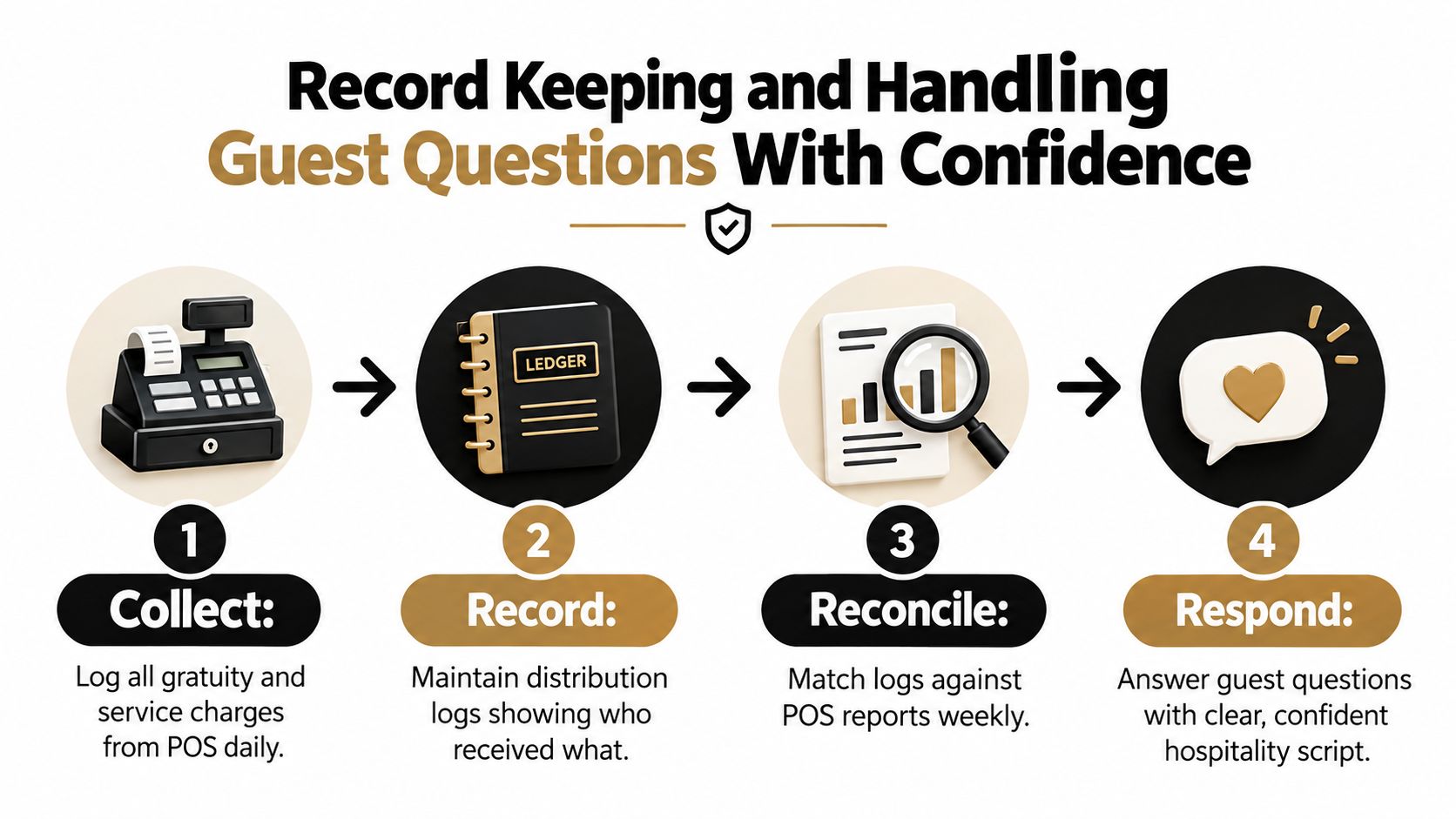
Build a simple daily rhythm
- Collect: Close the POS day and export each payment category separately.
- Record: Enter distributions in a controlled log with the date, service period, and responsible manager.
- Reconcile: Compare the log with POS reports and payroll records on a scheduled basis.
- Respond: Use the approved guest script and document unusual adjustments or disputes.
Restaurants that want broader financial discipline can use a practical resource on master restaurant bookkeeping to connect gratuity records with the rest of the books. A gratuity policy shouldn't live in a spreadsheet that payroll never sees. The same terminology should appear in the POS, accounting records, payroll instructions, and staff handbook.
Give staff calm, direct scripts
If a guest asks, “Is this optional?” the server can say:
“This line is an automatic charge under our restaurant policy, so it isn't the same as an optional tip. The policy is listed on the menu, and I can ask a manager to review the bill with you.”
If the guest asks, “Does this go to the server?” the employee shouldn't guess. A better response is:
“Our policy says this charge is distributed through the restaurant's compensation process. I can explain the published policy or bring the manager if you'd like more detail.”
If a guest says they didn't see the disclosure, the employee should acknowledge the concern before discussing the rule. A manager can review where the notice appeared, correct a genuine communication failure, and record the resolution consistently.
Staff training should also cover other guest-facing policy questions. A clear restaurant allergen compliance checklist offers a useful model for treating disclosures as an everyday service responsibility rather than an afterthought.
Putting Your Gratuity Policy Into Practice
A strong gratuity policy does three jobs. It gives guests a fair chance to understand the price, gives employees a dependable explanation, and gives the operator a consistent process for payroll and reconciliation.
Start with the label. Decide whether the restaurant uses voluntary tips, an automatic gratuity, a service charge, or a combination of clearly separated options. Then document the calculation basis, distribution method, and treatment of exceptions.
A practical implementation checklist
- Audit every guest touchpoint: Review printed menus, QR menus, booking pages, event agreements, POS prompts, and receipts.
- Use one vocabulary: Make sure “tip,” “automatic gratuity,” and “service charge” mean the same thing in every system.
- Test the guest view: Ask someone unfamiliar with the policy to explain the charge after reading the menu.
- Train the team: Give servers short scripts and a clear escalation path for disputes.
- Check the records: Reconcile collected amounts and distributions, then have your accountant review the tax and payroll treatment.
- Set a review date: Revisit the policy when the service model, menu, staffing structure, or local requirements change.
A digital menu makes wording changes easier to manage, but ease of editing isn't a substitute for careful review. Operators can use this guide on how to make a digital menu to improve the menu workflow, then apply the same discipline to gratuity disclosures.
Clarity today prevents disputes tomorrow. Guests may not agree with every fee, but they should never have to discover its meaning after payment.
If you want to make gratuity wording easier to manage, TopFoodApp lets you create and update QR menus with clear service-charge and tipping information in the same place guests view your menu. Visit TopFoodApp to build a mobile-friendly digital menu, keep policy language current, and give staff a reliable reference when questions arise.