Food Waste Reduction Strategies for Restaurants
In 2022, the world wasted 1.05 billion tonnes of food, equal to about 19% of all food available to consumers through retail, food service, and households, according to the UNEP Food Waste Index 2024 key messages. Food service accounted for 290 million tonnes, a figure that should make every restaurant operator look beyond sustainability posters and inspect the receiving dock, prep list, portion scoop, menu file, and waste log.
Food waste reduction is a margin project before it's an environmental slogan. Every discarded ingredient has already consumed purchasing budget, labor, storage capacity, preparation time, and often energy. The operators who make lasting progress don't rely on staff goodwill alone. They build systems that make the lower-waste decision easier, faster, and measurable during a busy service.
Table of Contents
- The True Cost of Food Waste in Hospitality
- Optimizing Procurement and Storage Workflows
- Engineering Agile Menus for Cross-Utilization
- Rethinking Service and Portion Control
- Tracking KPIs and Proving the ROI
- Building a Sustainable Kitchen Culture
The True Cost of Food Waste in Hospitality
A restaurant's waste bill starts long before food reaches the bin. Ingredients can arrive in volumes that exceed demand, deteriorate in an overcrowded walk-in, or be trimmed inconsistently during prep. A “just in case” batch can remain unsold after a quiet service. An oversized portion can return from the dining room as plate waste.
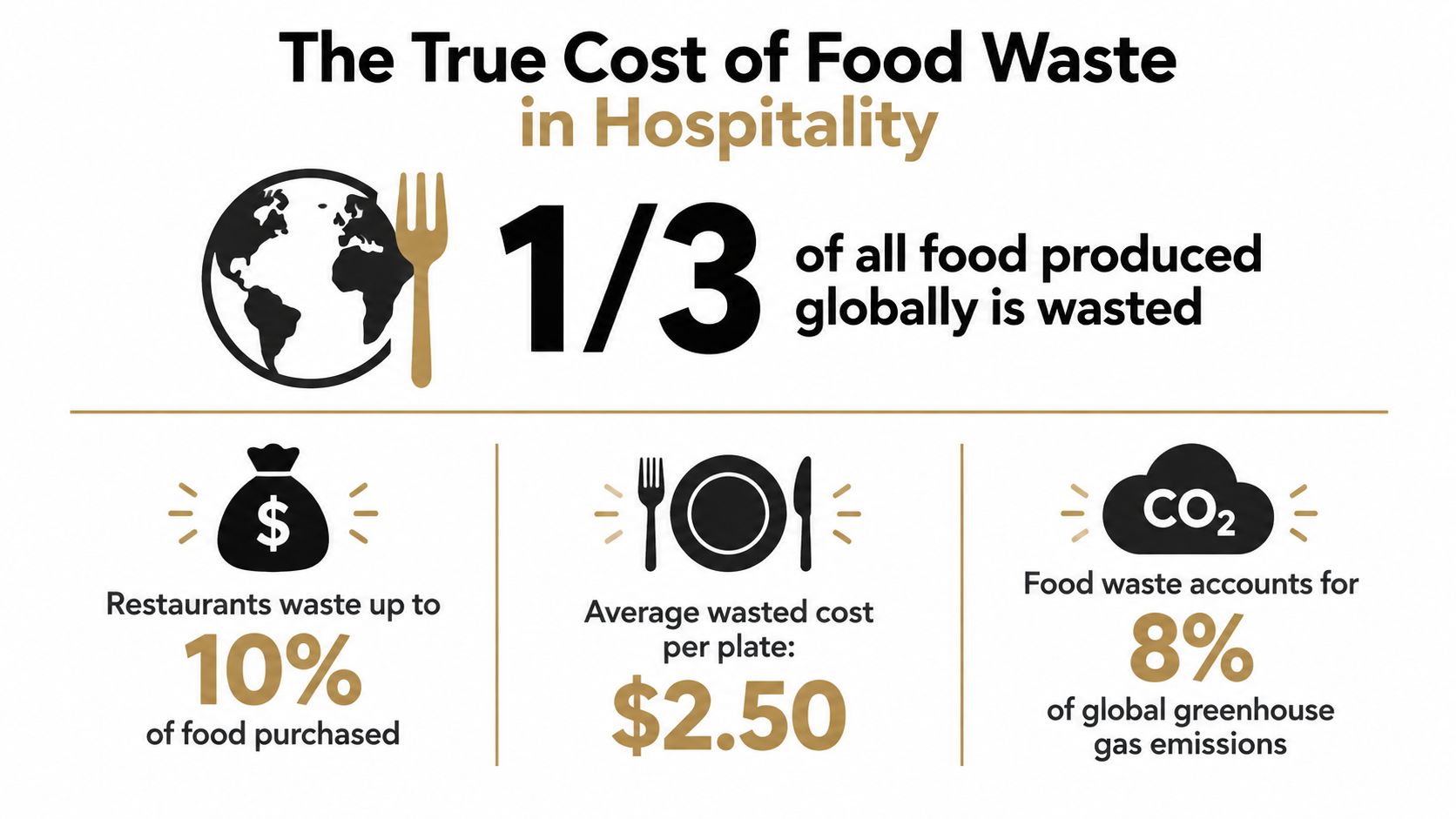
In 2022, households generated 631 million tonnes, or 60% of total consumer-facing food waste, followed by food service at 290 million tonnes and retail at 131 million tonnes, according to UNEP. Restaurants still have a distinct operating role. Food service connects purchasing, production, menu structure, service style, and customer behavior. A change in one workflow can therefore reduce waste at several points.
Waste reaches the P&L before it reaches the bin
The bin records the final event, not the decisions that caused it. Financial loss begins with an order that exceeds realistic demand or stock that is not rotated. It continues through the labor used to trim, prep, cook, plate, and clean up food that produces no sale. Once an ingredient passes its usable window, recovery becomes harder.
Managers should account for four cost layers:
- Purchase cost: The value of ingredients discarded through spoilage, overproduction, damage, or plate returns.
- Labor cost: Staff time spent handling food that never generates revenue.
- Capacity cost: Shelf, pan, container, and cooler space occupied by stock that does not move.
- Margin cost: The contribution lost when food cost rises without a matching increase in sales.
A waste log that never reaches purchasing, prep, and menu decisions is a record of loss, not a control system.
The wider policy target provides context. SDG 12.3 calls for halving per-capita food waste at retail and consumer levels by 2030, while the 2022 baseline is documented in the UNEP Food Waste Index 2024. For an individual restaurant, the useful response is practical: identify controllable waste streams, assign an owner, and connect each action to food cost and service performance.
Broad awareness rarely corrects a forecasting error, inconsistent trim, or an oversized ladle. An independent intervention review found that broad interventions delivered 5% to 20% reductions, while targeted portion and plate-size changes produced reductions of up to 57% in hospitality settings. The operational lesson is clear. Staff need a defined action, a visible result, and enough menu and workflow flexibility to apply it during a rush. Digital menu controls can support that flexibility, while frontline teams identify waste causes that reports alone miss.
Optimizing Procurement and Storage Workflows
Food waste reduction starts at the delivery dock. A restaurant can't recover shelf life that was lost through poor receiving, and it can't forecast accurately if the inventory record says ten cases are available when several are damaged, short-dated, or unusable.
Make receiving a quality-control checkpoint
The receiver should compare the delivery against the purchase order before anything enters storage. Check quantity, packaging integrity, temperature requirements, date information, ripeness, visible damage, and substitutions. Record discrepancies immediately, take photographs when supplier policy allows, and notify the person responsible for credits while the evidence is still clear.
A rushed receiving process creates hidden waste. A box of bruised tomatoes may look acceptable until prep begins. A short-dated dairy delivery may force the kitchen to change production plans. A missing case may trigger an emergency purchase later at a higher cost. Receiving isn't administrative work. It's the first inventory decision of the day.
Set par levels from movement, not habit
Par levels should reflect actual sales patterns, lead times, delivery schedules, storage capacity, and the ingredient's usable life. Review them when the menu changes, when a promotion ends, when seasonality shifts, or when the restaurant's trading pattern changes.
Avoid setting one permanent par for a volatile ingredient. A slower weekday and a high-volume weekend need different purchasing logic. The chef or manager should also separate ingredients by risk:
- Fast-moving staples can support tighter replenishment because demand is predictable.
- Short-life perishables need conservative ordering and frequent checks.
- Specialty items should be tied to a specific menu item, event, or confirmed demand.
- Shared ingredients deserve priority because several dishes can consume the same stock.
For menu planning outside the restaurant, structured meal prep ideas for fitness goals demonstrate the same principle: plan portions and ingredient use before buying. Restaurants apply that logic at a larger operational scale, matching purchasing to planned covers, recipes, and expected sales rather than ordering from memory.
Control the walk-in physically
FIFO, first in and first out, only works when the storage layout supports it. Put new deliveries behind existing stock, label opened containers with product name and date, and keep a clearly marked area for items that need priority use. A label should help a cook answer three questions quickly: what is it, when was it prepared or opened, and where should it be used?
Divide the cooler into practical zones according to product requirements and workflow. Keep raw proteins separated from ready-to-eat foods, protect prepared items from drips and cross-contamination, and avoid packing shelves so tightly that air can't circulate or staff can't see what they have.
A daily walk-in check should focus on exceptions, not a full inventory count. Look for items approaching their use window, duplicated open containers, products without labels, and ingredients that have no clear menu destination. Those findings should feed the next prep meeting and the next order.
Engineering Agile Menus for Cross-Utilization
A static menu turns each purchasing decision into a commitment. If one dish depends on an ingredient with uneven demand, the restaurant carries that stock whether guests order it or not. The practical answer is to build variety around a controlled group of ingredients that can move through several dishes without lowering quality.
Build menus around ingredient roles
List the core ingredients, then assign each one a defined role across the menu. A roasted vegetable might serve as a starter component, a grain-bowl topping, and a side. A prepared sauce could support a main course, sandwich, and daily special. Cross-utilization works only when recipes protect quality and the prep team knows approved substitutions, holding limits, and the point at which an ingredient should be discarded.
Reuse can also create work. An ingredient does not reduce waste if it adds extra prep, confusing storage, or inconsistent portions. Each menu item should justify its place through sales, intelligent use of shared stock, or a practical outlet for surplus. Items requiring a one-off purchase with uncertain demand need close review.
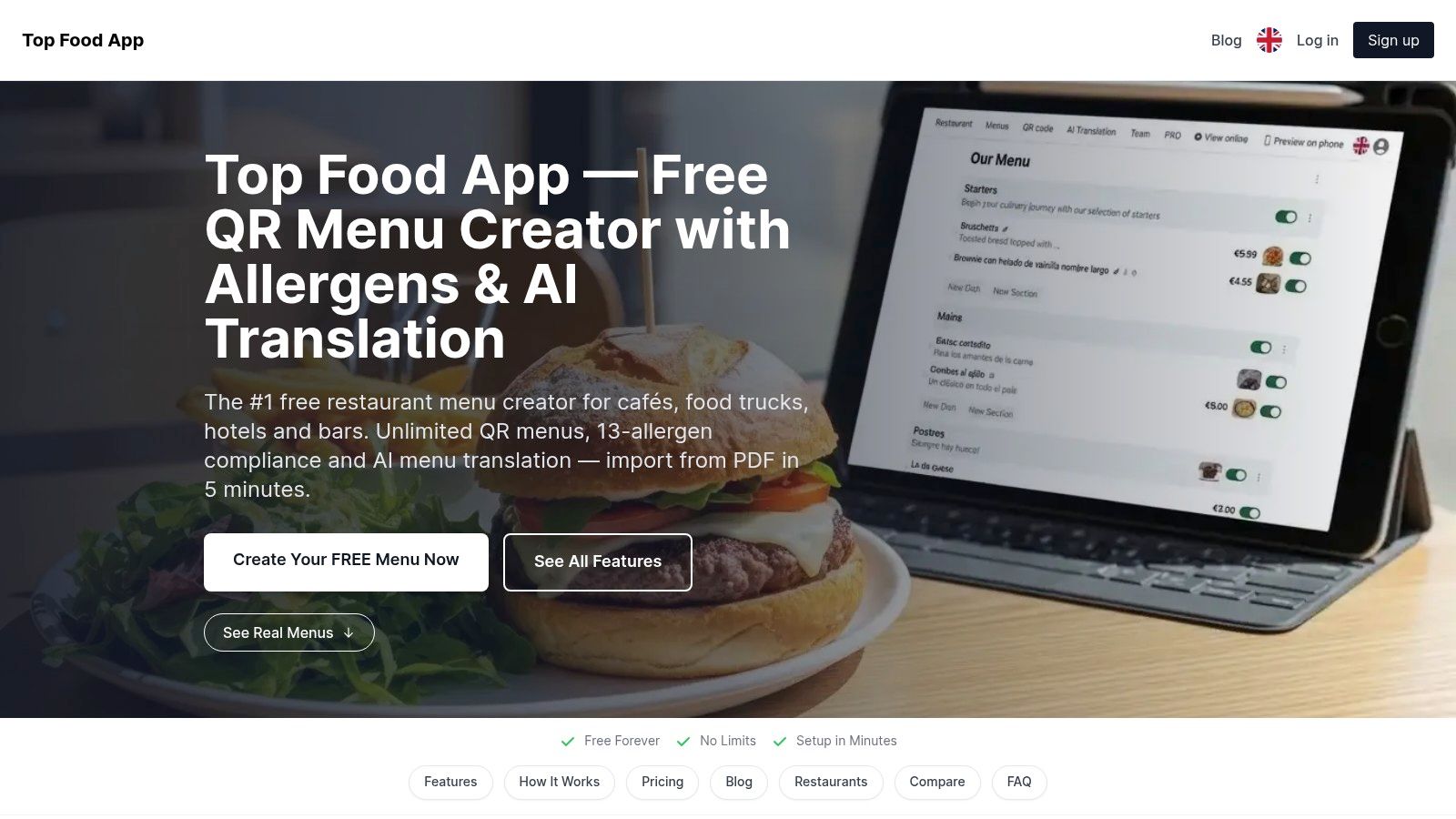
Digital menus shorten the gap between those decisions and what guests can order. TopFoodApp lets operators update QR menu items, control seasonal dish visibility, offer multiple pricing options, and manage allergen information without reprinting. The guide to updating a QR menu in real time shows how menu changes can follow stock availability.
Turn surplus into a planned special
A surplus special needs operating controls, not a last-minute description designed to conceal waste. Set the recipe, selling price, allergen details, portion standard, available quantity, and cutoff before service. The kitchen must know how much product can be sold and what staff should offer after it runs out.
Digital agility gives managers a faster response to changing stock. A seasonal preparation can be promoted while its ingredients are at their best, then removed once supply is exhausted. Guests stop ordering unavailable dishes, and servers no longer need to explain why a printed menu differs from the kitchen.
A digital menu does not reduce waste by itself. It gives operators a faster way to align what is being sold with what is actually in the building.
The same control applies to format and pricing. Smaller portions, sharing formats, or premium variations can be tested without another printed menu run. Review guest response, prep burden, sales mix, and plate returns before keeping the change. A format that looks efficient on paper can still create waste if it slows the line or leaves unpopular components untouched.
Use technology to remove menu friction
A digital menu earns its place when it reduces the delay between an operational decision and guest-facing information. TopFoodApp also supports AI-assisted menu digitization from PDFs or photos, multilingual setup, team access, searchable mobile presentation, and allergen filtering for the 13 EU regulated allergens, according to the publisher's product information. These features require an owner. Recipes, prices, availability, and allergen records must be updated as the operation changes.
The operational lesson is straightforward. Staff need a menu that reflects the building's stock, not yesterday's assumptions. Managers should set a review point before each service, confirm substitutions with the kitchen, and remove items as soon as the available quantity is committed.
Use the following demonstration as a prompt for discussion with the chef, manager, and service team:
Rethinking Service and Portion Control
Large portions do not automatically create value. They can signal generosity, yet they also increase plate returns, slow table clearing, and make it harder to distinguish dislike from an appetite limit.
Treat portion size as a service decision
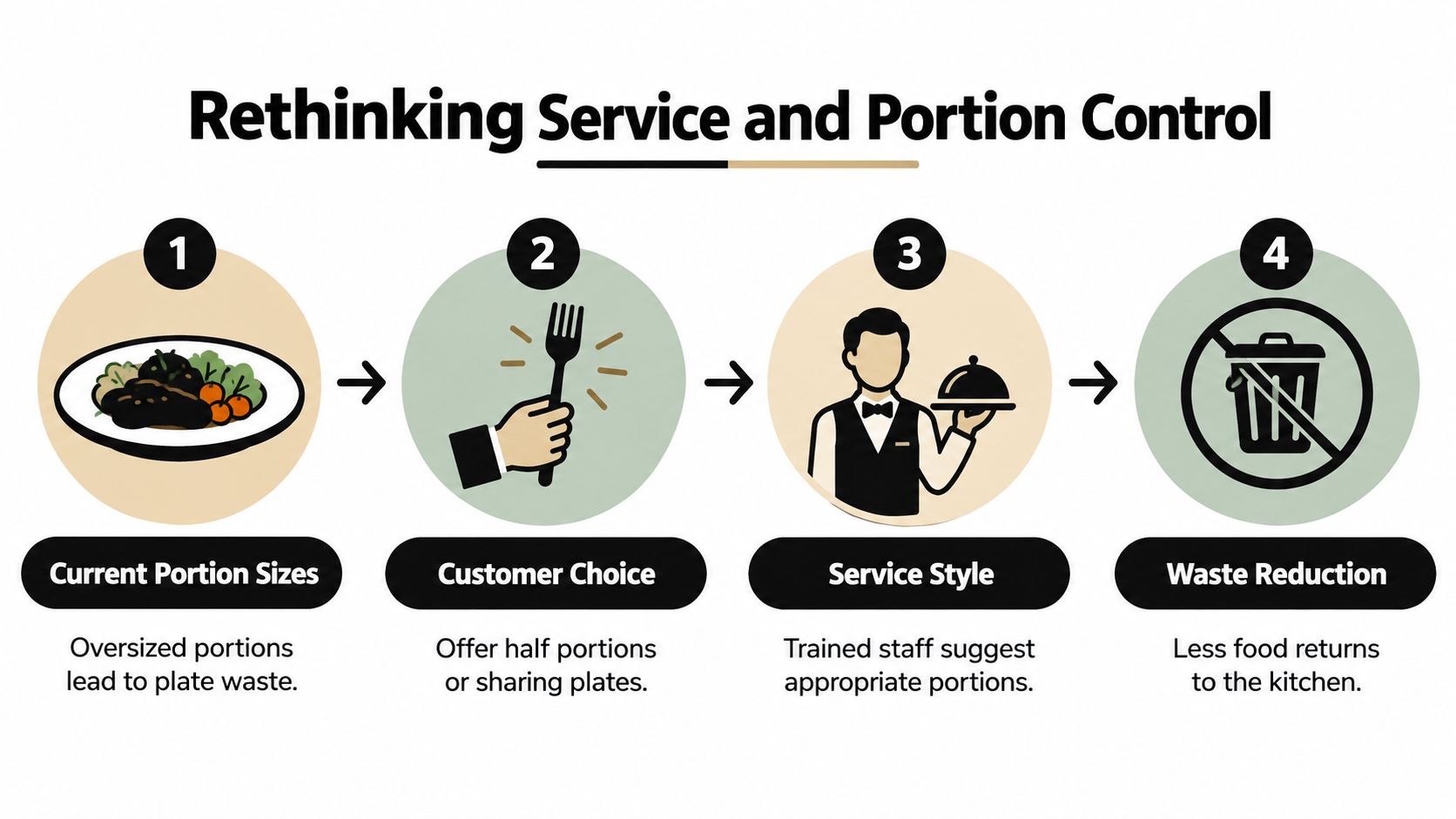
Test portion changes against both guest response and kitchen execution. Reduce the component most often returned, preserve elements guests value, and review complaints, satisfaction signals, sales mix, and plate waste together. Half portions and sharing plates give guests more control, but menu wording and pricing must make the choice feel deliberate rather than inferior.
Servers shape this decision at the table. They hear whether guests want a light meal, are ordering for children, plan to share, or have already chosen several substantial dishes. Training should provide practical prompts, not a sustainability lecture.
- Clarify appetite: Ask whether guests prefer full portions, lighter plates, or dishes to share.
- Flag abundance: Explain when several selected dishes are substantial enough to share.
- Offer flexibility: Present half portions or smaller formats only where the kitchen can execute them consistently.
- Capture patterns: Tell the manager which items regularly return unfinished and what guests say about them.
The restaurant's explanation of digital QR menu use shows how menu presentation can support clearer choices. Digital descriptions, visible options, and allergen details give guests information before ordering, although attentive service remains necessary.
Let the line identify the waste
Frontline staff see waste at the moment it occurs. A prep cook may notice a garnish being overproduced. A dishwasher may see the same side returned across several shifts. A server hears when a menu description causes confusion, while a purchaser sees produce arriving too mature.
Give those observations a short, regular channel. In each pre-shift meeting, ask for one waste point from the previous service and one proposed change. Assign an owner, set a review date, and check the relevant measure. Suggestions should become controlled experiments, not disappear into a box.
Managers also need to interpret results against service volume. A heavier bin after a busy shift may reflect more food produced, not weaker control. Compare like with like, record the reason for waste, and review whether the change reduced returns without adding prep time or slowing the pass.
The strongest portion-control program combines guest choice, accurate menu descriptions, consistent recipe yields, and staff observation. Posters can support the message, but staff authority and fast menu updates determine whether the change reaches the plate.
Tracking KPIs and Proving the ROI
A waste log becomes useful when it changes a decision. Recording that “food was wasted” isn't enough. The manager needs to know what was wasted, why it happened, which station owned the process, how much production or sales that waste represented, and whether the corrective action worked.
Establish a baseline that reflects service volume
Choose a measurement period that includes normal trading patterns. Weigh waste by category, such as spoilage, prep trim, overproduction, returned plates, and damaged goods. Record the item, quantity, reason, shift, and department. Keep the categories stable so the data remains comparable.
Never compare raw waste totals from shifts with very different output. Normalize waste against a meaningful denominator, such as covers served, sales value, meals produced, or the weight of food prepared. The right denominator depends on the waste stream. Plate waste may be most useful per cover, while batch overproduction may be clearer against the quantity produced.
The baseline should also include the intervention's cost. If a restaurant buys scales, software, storage containers, staff training, or additional prep labor, record those costs before judging the result.
Use a small set of decision-ready KPIs
| KPI Metric | Calculation Method | Operational Value |
|---|---|---|
| Waste by weight | Weighed waste grouped by reason and station | Shows where the physical loss occurs |
| Waste per cover | Total relevant waste weight divided by covers served | Compares shifts with different guest volumes |
| Waste cost | Discarded quantity multiplied by ingredient cost | Connects waste to food-cost performance |
| Overproduction rate | Unsold prepared quantity divided by total prepared quantity | Tests batch sizing and forecasting |
| Plate-return rate | Plates returned with avoidable food divided by plates served | Identifies portion and menu problems |
| Spoilage incidents | Count and value of items discarded before production | Exposes ordering, storage, and rotation failures |
| Intervention payback | Program cost divided by recurring savings | Shows how quickly the change earns back its cost |
These formulas are intentionally simple. A complicated dashboard won't compensate for inconsistent weighing or missing reasons. Assign one person per shift to verify entries, and have the manager review patterns with the chef and purchasing lead.
Calculate savings without overstating them
Separate avoided purchasing from theoretical value. If a restaurant throws away less cooked rice, the saving may appear through lower production, fewer replenishment orders, or better use of the same batch. If it reduces plate waste but keeps portion cost unchanged, the financial benefit may be indirect unless the change affects purchasing or production.
Track the cost of the intervention alongside the result. The European Commission restaurant food-waste study reports that participating restaurants achieved an average 26% reduction in food waste by weight over 12 months and 58% over three years. It also reports that 76% of sites recouped their investment within one year, and 89% within two years, with measurement, staff engagement, lower overproduction, and stronger inventory practices among the practical levers.
Those figures aren't a promise for every operation. They're evidence that structured programs can pay back when the intervention addresses a real operating loss. A small restaurant should still validate its own result using its own baseline, ingredient costs, and labor assumptions.
Close the loop every week
A weekly review should produce a short action list:
- Identify the largest avoidable waste category.
- Select one process change with a named owner.
- Set the measurement method before implementation.
- Train the affected staff on the new standard.
- Review the result and either adopt, adjust, or stop the change.
Avoid launching several changes at once. If ordering, portioning, and prep batches all change together, the restaurant may see movement without knowing what caused it. Controlled experiments are slower than slogans, but they produce decisions the team can trust.
Building a Sustainable Kitchen Culture
A lower-waste kitchen is built into daily work. The standard must hold during a busy Friday, a new hire's first week, a supplier substitution, a menu promotion, and a manager's day off. That takes routines aligned with existing workflows, not a separate sustainability project that disappears under service pressure.
Put waste into existing meetings
Add one waste observation to the pre-shift briefing. During the walk-in check, review one item approaching its use window. Give the closing manager a clear handoff covering leftover prepared food, priority-use ingredients, and production changes for the next service.
Training should match each station. A prep cook needs yield and storage standards. A line cook needs batch-size and holding guidance. A server needs portion and sharing prompts. A dishwasher or porter may be best placed to identify recurring plate waste. Everyone should know what to record, where it goes, and who acts on it.
Recognition keeps the feedback loop open. Credit the person who identifies recurring trim loss, improves a prep method, or catches a purchasing mismatch before product is discarded. If management discusses waste only after an error, staff will stop reporting early warnings.
Autonomy needs boundaries
Frontline input does not permit staff to alter food-safety controls or recipes without approval. It gives them a defined route to propose changes, test them safely, and review the result.
Managers should set limits around allergens, storage, holding times, recipe specifications, and pricing. Within those limits, the team can test smaller batches, approved alternate uses for ingredients, clearer service prompts, or a seasonal special built around stock already on hand. This converts observations from the line into controlled operating changes.
Technology helps when it removes clerical work. A digital menu can show current availability and support quick changes, but one accountable editor still needs to maintain it. Operators connecting environmental priorities with daily decisions may also find Nothing's 2026 restaurant sustainability roadmap useful as a planning reference.
Keep the system practical
A restaurant does not need a dedicated sustainability department. It needs accurate counts, sensible recipes, disciplined storage, useful menu flexibility, and staff who can act on what they see.
TopFoodApp's guide to creating a digital menu covers a practical part of that workflow. A QR menu can be updated without replacing printed menus, while operators manage seasonal visibility, pricing options, team access, and allergen information in one digital system. The operational benefit appears when those updates inform purchasing and production, rather than treating the menu as a separate marketing asset.
Food waste reduction lasts when the restaurant measures the loss, changes the process, and gives staff a controlled way to protect the standard. That combination supports tighter food-cost management and lets the kitchen respond to actual demand.
TopFoodApp provides tools for updateable QR menus, seasonal availability, pricing options, and allergen information without reprinting menus whenever operations change. Visit TopFoodApp to create a digital menu and connect guest-facing updates with a more controlled food-waste workflow.