What Cloud Kitchen Means for Modern Restaurants
A cloud kitchen means a delivery-only restaurant model with no physical dining area or storefront, operating through digital ordering and delivery channels. Global estimates place the market at US$83.1 billion in 2026, with a projection of US$156.3 billion by 2033 at a 9.4% CAGR.
The popular advice is to treat every delivery-only operation as the same low-cost restaurant format. That advice is incomplete. A shared commissary stall, a standalone delivery kitchen, and a virtual brand inside an existing restaurant have different rent structures, compliance obligations, capacity limits, and customer-acquisition problems. The label matters less than the operating model underneath it.
Table of Contents
- Defining the Cloud Kitchen Concept
- Three Distinct Operating Models Explained
- The Real Economics of Delivery-Only Foodservice
- Essential Technology and Digital Menu Integration
- Global Expansion Versus Local Market Realities
- Startup Costs and Key Performance Metrics
- Frequently Asked Questions for Operators
Defining the Cloud Kitchen Concept
A cloud kitchen is a real commercial food-production operation that removes the customer-facing dining room. Customers discover the brand online, place orders through a delivery platform or direct digital channel, and receive prepared food at home or another location. The business may also be called a ghost kitchen, dark kitchen, or virtual kitchen, although “virtual brand” more accurately describes the online concept than the physical kitchen producing the food.
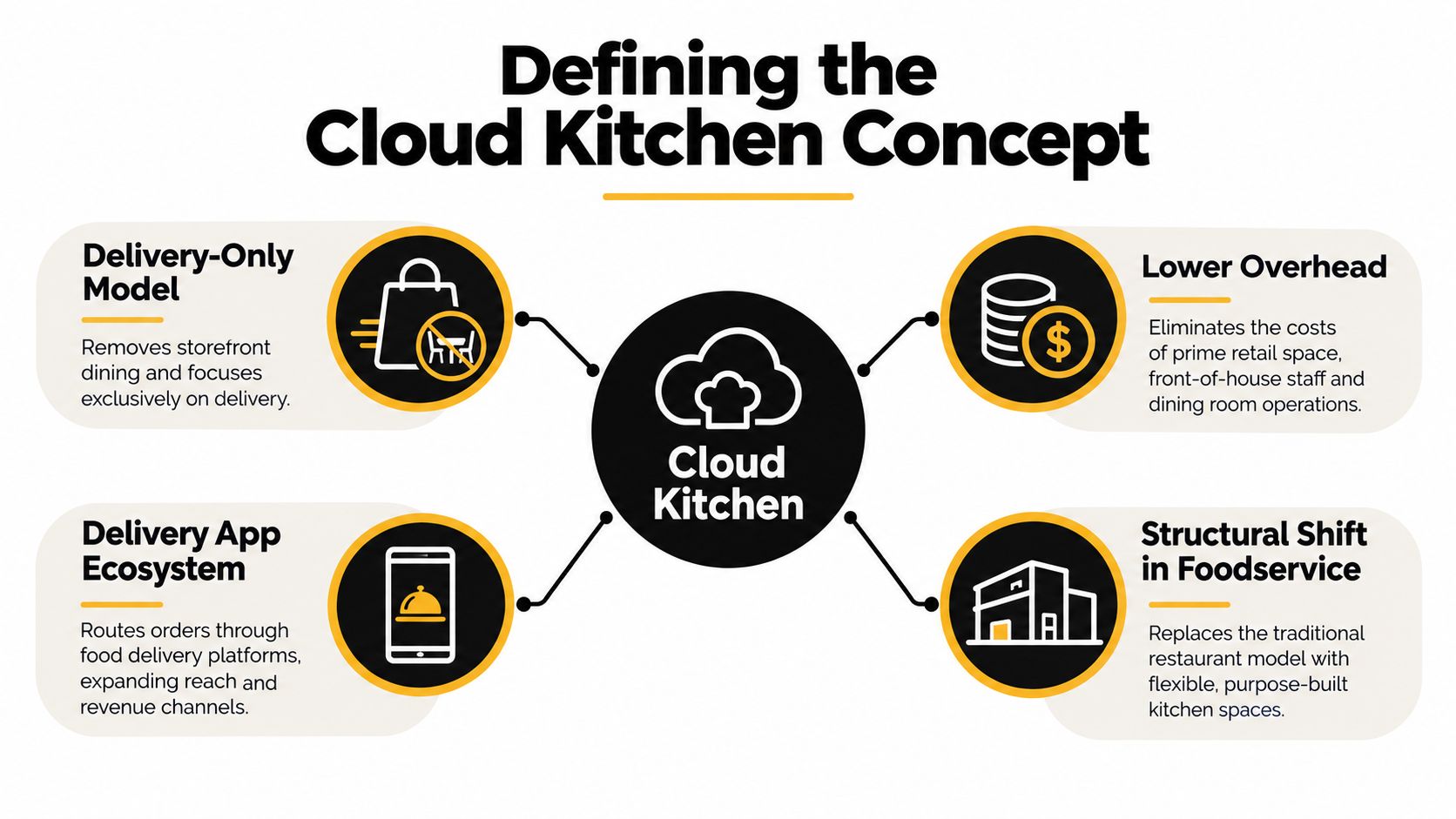
The difference from a traditional restaurant isn't just the absence of tables. It changes what the operator must optimize. A dine-in restaurant manages seating, service pacing, ambience, walk-in visibility, and front-of-house labor. A cloud kitchen manages digital discovery, order accuracy, preparation speed, packaging, dispatch timing, and delivery quality.
The model has become a substantial part of foodservice rather than a temporary response to unusual trading conditions. Mordor Intelligence's cloud kitchen market coverage identifies Asia-Pacific as the largest regional market in 2025, with a 41.22% revenue share, reflecting the concentration of delivery-led demand in dense urban markets. The same source estimates the global market at US$83.1 billion in 2026, projected to reach US$156.3 billion by 2033 at a 9.4% CAGR.
What the model removes
The delivery-only format can remove exposure to prime retail frontage, dining-room fit-out, servers, hosts, and table-service workflows. That doesn't make the business automatically cheap or profitable. It replaces visible costs with less obvious ones, including platform dependence, packaging requirements, digital advertising, delivery failures, and the need to maintain a fast kitchen during demand spikes.
A kitchen can also operate several brands from one site. That creates more opportunities to use equipment, prep areas, and staff across menus, but it also creates operational complexity. If multiple brands share the same fryer, oven, pass, or packing bench, one overloaded station can delay every order in the queue.
Practical rule: A cloud kitchen isn't a restaurant with the dining room removed. It's a production and fulfilment system designed around delivery.
The strongest operators design the menu, kitchen layout, packaging, technology, and marketing channel together. They choose food that travels well, limit unnecessary menu variation, and measure the time from accepted order to handoff. The weakest operators focus on launching an attractive online brand while treating the kitchen as an afterthought.
Three Distinct Operating Models Explained
“Cloud kitchen” covers three materially different operating arrangements. Recent market coverage from 360iResearch distinguishes a shared commissary stall, a standalone delivery-only kitchen, and a virtual brand operated from an existing restaurant. The differences affect capital exposure, regulatory responsibility, workflow control, and delivery performance.
| Model Type | Capital Required | Regulatory Burden | Best For |
|---|---|---|---|
| Shared commissary stall | Lower, because the operator rents licensed kitchen capacity and shares infrastructure | Shared-facility rules still apply, with operator-specific food handling and business obligations | Testing a menu, launching with limited capital, or producing at controlled volume |
| Standalone delivery-only kitchen | Higher, because the operator funds or leases a dedicated production site and equipment | Full responsibility for site approvals, food safety systems, staff procedures, and inspections | Operators with validated demand who need control over layout and throughput |
| Virtual brand inside an existing restaurant | Often lower incremental capital, because the kitchen and some staff already exist | Existing compliance systems must accommodate the additional menu, brand, storage, and production workflow | Restaurants with underused capacity or a need to extend delivery reach |
Shared commissary stall
A shared commissary is the lowest-commitment route. The operator rents a station or scheduled access inside a licensed commercial kitchen, often sharing storage, preparation areas, sinks, waste systems, and equipment. That setup lets a new concept test real order flow without taking on a long lease or full fit-out.
The trade-off is limited control. Other operators may work nearby, equipment access can restrict the menu, and facility hours may not match the brand's preferred trading window. Collection also depends on clear order separation and fast driver access to a shared site.
Standalone delivery-only kitchen
A standalone unit gives the operator control over workflow, equipment placement, storage, staff movement, and collection. That control matters when the menu has demanding preparation steps or several brands require coordinated production.
The operator also carries the full operating burden. Responsibilities include premises management, licensing, ventilation, refrigeration, cleaning, pest control, staff training, and maintenance. A lower-rent site can still underperform if it sits beyond an efficient delivery radius or creates slow handoffs for drivers.
Virtual brand within an existing restaurant
This model uses underused capacity in an existing restaurant to sell another concept online. It can work as a tactical channel when the operator already has equipment, trained staff, and compliant premises. Spare hours do not automatically mean spare capacity. During a restaurant's peak period, the virtual brand may compete for the same cooks, prep benches, fryers, and packing space.
The unit economics depend on the actual bottleneck. If the added orders use idle labour and equipment, incremental sales may be attractive. If they slow the core menu, increase errors, or require extra shifts, the apparent low-capital model becomes expensive.
Market estimates for the global category in 2026 range from about USD 47.28 billion to USD 99.30 billion. The wide range reflects different definitions of what counts as a ghost kitchen, so treat it as category sizing rather than a planning input. For an owner, reliable throughput, delivery radius, and available kitchen capacity matter more than the headline market size.
The Real Economics of Delivery-Only Foodservice
The financial appeal is obvious at first. A delivery-only operation doesn't need a customer dining room, prime storefront visibility, or the same front-of-house staffing model as a dine-in restaurant. Yet those savings don't eliminate cost. They move the cost centre toward platform commissions, customer acquisition, packaging, delivery reliability, and kitchen throughput.
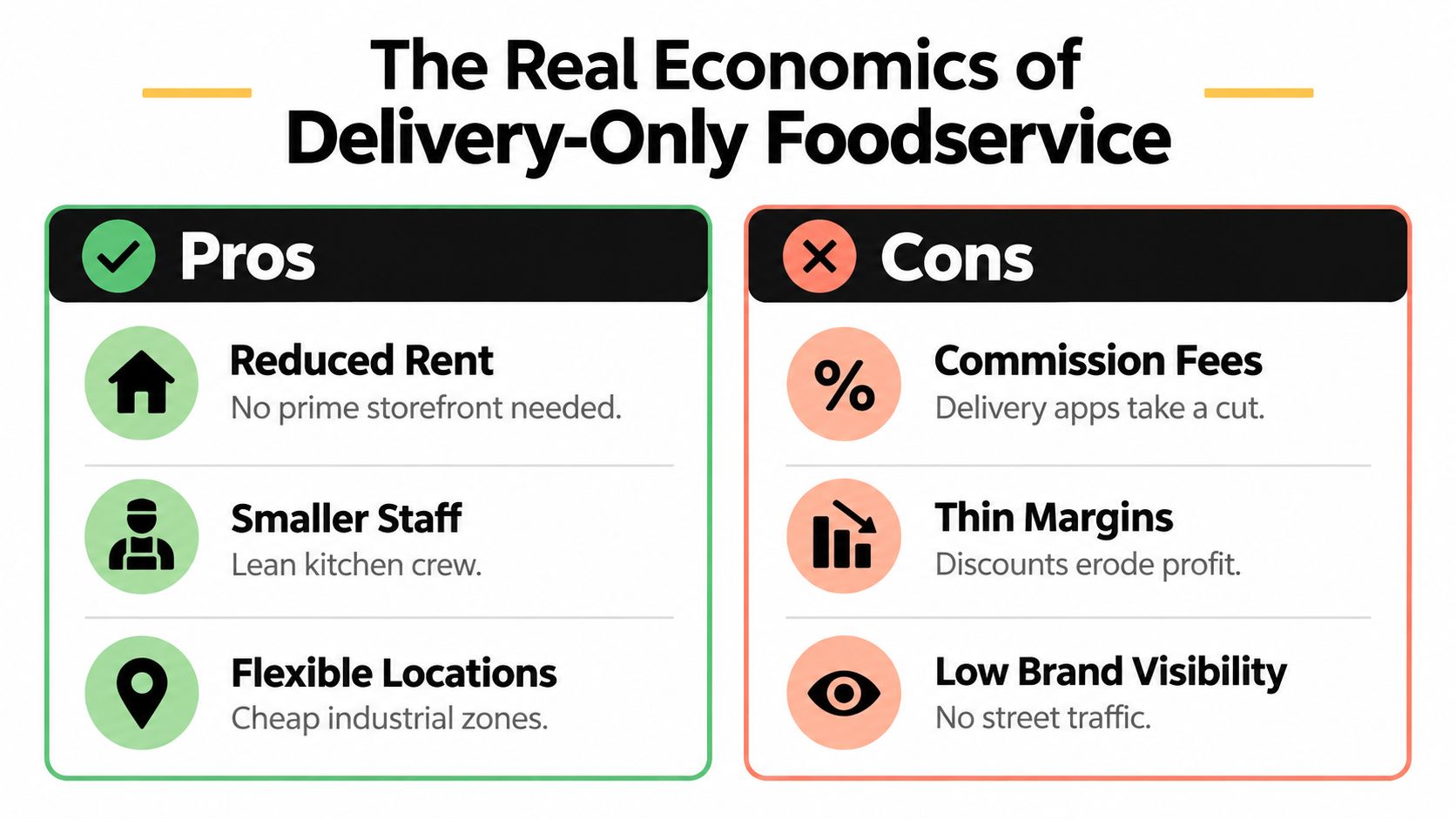
Third-party platforms can provide immediate access to customers, but the operator gives up part of the order value and often loses control of the customer relationship. The exact commercial terms vary by market, contract, service level, and promotional arrangement, so owners should model the actual agreement rather than rely on a generic industry assumption.
Packaging is another margin line that inexperienced operators underestimate. A container must protect temperature, texture, portion integrity, and presentation through handling and travel. The cheapest package can become expensive when it causes leaks, soggy food, damaged products, refunds, or poor reviews. Operators comparing materials and formats can use these practical NZ food packaging tips as a useful starting point.
Capacity is the hidden limit
One kitchen can support multiple virtual brands, but the physical site still has finite refrigeration, prep space, cooking equipment, packing benches, and staff attention. Adding another menu doesn't create another fryer or another expeditor. It creates more demand on shared resources.
A workable menu keeps the number of unique ingredients, preparation methods, and finishing steps under control. SKU reduction isn't about making the offer bland. It's about selecting dishes that share components, use the same equipment efficiently, and remain consistent during busy periods.
Batching can help with sauces, grains, proteins, or other suitable components, but it must be balanced against freshness and holding quality. The operator should identify the station that becomes the bottleneck first, then design the menu and order-release process around that constraint.
Grand View Research's cloud kitchen analysis describes the practical trade-off clearly: delivery-only infrastructure reduces exposure to prime retail rent and dine-in labor, while shifting pressure toward platform dependency, packaging control, and delivery-time reliability. The same source estimates a market value of USD 80.28 billion in 2025, projected to reach USD 203.72 billion by 2033 at a 12.6% CAGR. These estimates differ from other market forecasts, but both point to a large and expanding category. Neither guarantees that an individual kitchen will earn a healthy contribution per order.
Essential Technology and Digital Menu Integration
A cloud kitchen depends on its technology stack because every customer interaction, order, timing signal, and menu change happens digitally. The minimum practical setup usually includes an integrated point-of-sale system, a kitchen display system, delivery-platform connections, payment processing, inventory controls, and a direct ordering channel.
Build the order path first
Start by mapping the order from customer selection to kitchen handoff. Orders from delivery marketplaces should enter one controlled queue rather than arrive on separate tablets that staff must monitor manually. The POS should send clear item, modifier, allergy, timing, and fulfilment information to the kitchen display system.
The KDS should show what must be prepared, when it is due, and which orders share production steps. A screen that merely replaces printed tickets won't solve a badly designed workflow. The operator needs item routing, station visibility, order-status controls, and a way to identify delayed orders before the driver arrives.
Menu data must remain synchronized across channels. If an item sells out, staff should be able to hide it quickly. If a price, modifier, portion, or allergen statement changes, the update should reach every relevant customer-facing menu without creating conflicting versions.
Use digital menus to regain control
Marketplace listings help customers discover a new brand, but repeat orders should gradually move toward channels the operator controls. A direct mobile menu can support customer recognition, menu updates, first-party communication, and clearer ownership of ordering data. QR codes can support packaging inserts, collection points, promotional cards, or an existing restaurant's tables when a virtual brand is introduced.
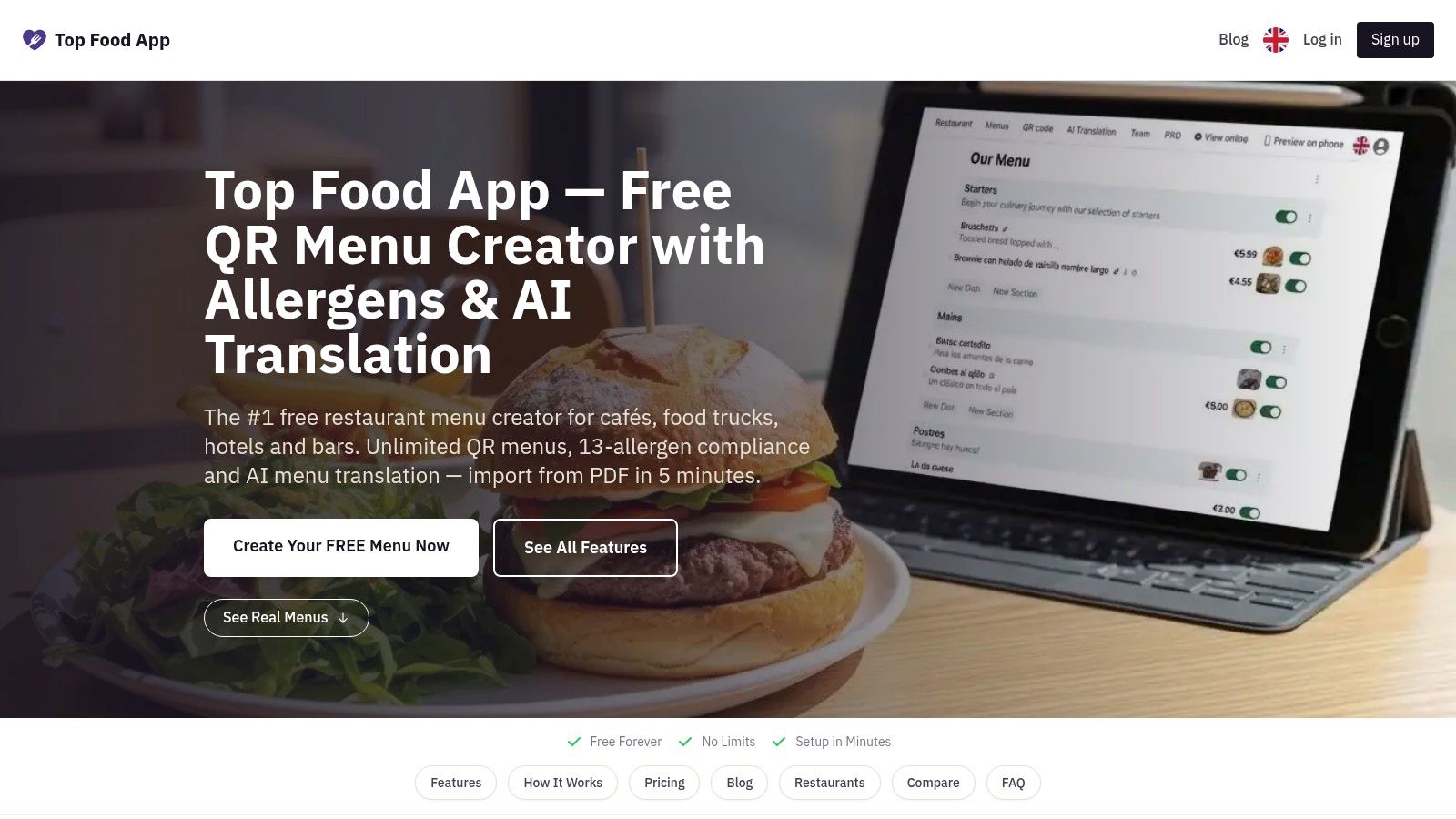
TopFoodApp is one option for creating and managing digital menus. Its documented features include AI conversion from PDFs or photos into structured menu content, multilingual presentation, customizable menu visibility, and allergen management for the 13 EU regulated allergens. That matters when an operator runs seasonal items, several menus, or brands serving customers with different language and dietary needs.
Allergen information still requires operational discipline. The software can display and filter menu data, but staff must maintain accurate recipes, supplier information, cross-contact controls, and change procedures. A digital menu improves access to information. It doesn't replace food-safety management.
Global Expansion Versus Local Market Realities
The cloud kitchen model rose alongside app-based food delivery through the 2010s and 2020s, when digital ordering became a normal route to restaurant food. That history explains the strong global forecasts, but it doesn't mean every local market offers the same opportunity.
A dense urban area can support short delivery routes, concentrated demand, shared facilities, and several orders moving through a kitchen at once. A dispersed market may produce longer travel times, lower order density, and higher delivery costs. The same menu and staffing model can perform very differently across those settings.
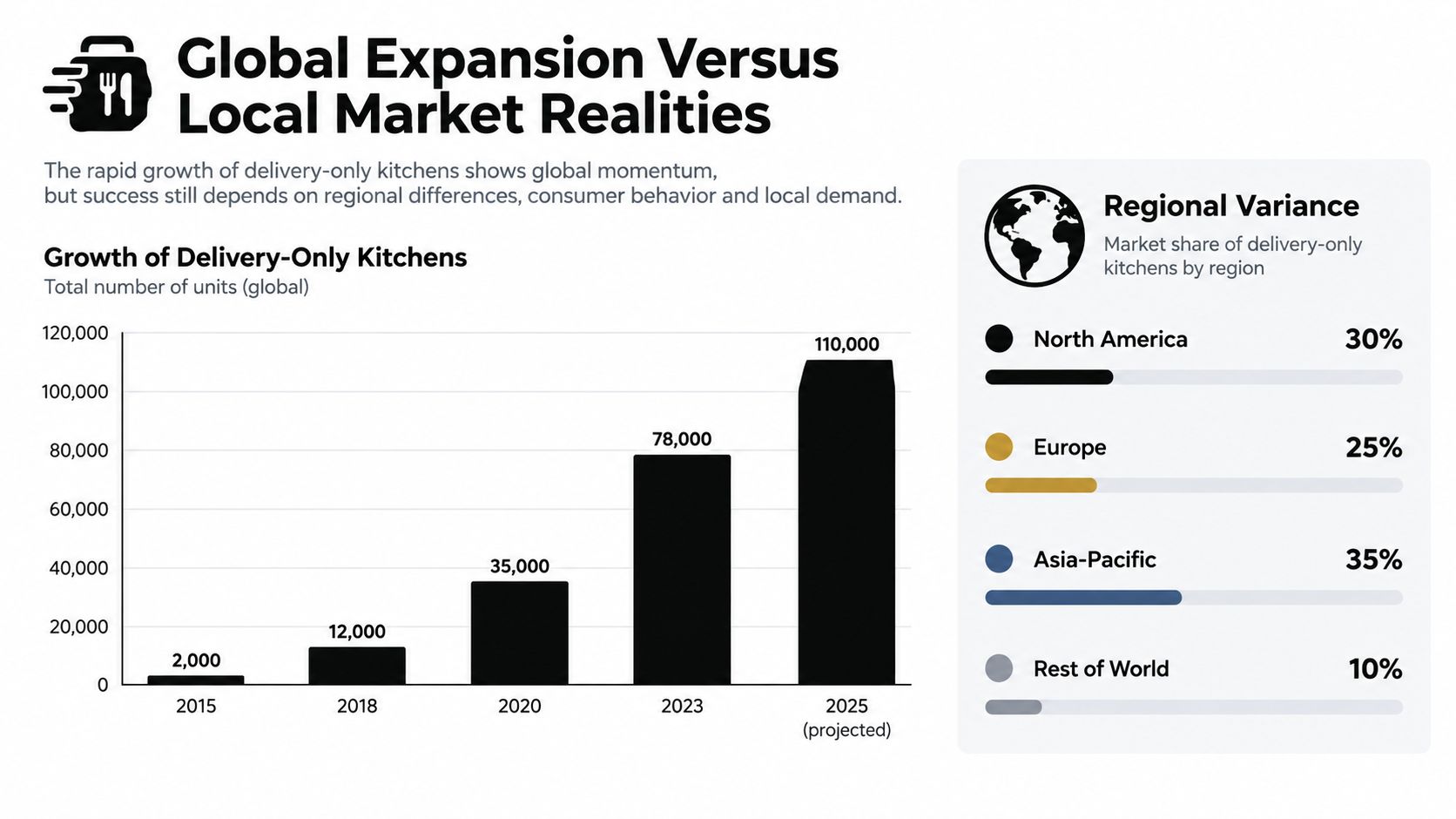
The contradiction between global expansion and local pressure is important. Coverage of cloud kitchen site selection from GrowthFactor notes that IBISWorld reported a 5.2% U.S. revenue decline in 2024, alongside negative growth since 2020. The same source contrasts that mature-market pressure with strong global forecasts. The lesson isn't that one side is wrong. It is that category growth and local unit economics are separate questions.
Choose the market before copying the model
An owner should test a location against practical conditions:
- Demand density: Can enough customers order within an efficient service radius?
- Platform economics: Do marketplace fees and promotional requirements leave room after food, labor, packaging, rent, and refunds?
- Collection reliability: Can drivers reach the kitchen, park, collect, and leave without creating a queue?
- Competitive visibility: Can the brand earn attention online without a storefront, walk-ins, or an established customer base?
The market may grow while individual operators struggle. A cloud kitchen is a viable long-term business only when repeat demand, production capacity, delivery performance, and contribution per order work together. Otherwise, it may be more useful as a tactical brand for filling underused kitchen hours.
Regional expansion also creates language and menu-management demands. Operators serving tourists, migrant communities, or multilingual neighborhoods can review AI translation for restaurant menus, while still having a human verify dish names, allergens, ingredients, and cultural context before publishing.
Startup Costs and Key Performance Metrics
A delivery-only launch still needs a commercial premises or kitchen access, suitable cooking and refrigeration equipment, extraction or ventilation where required, licenses, insurance, initial stock, packaging, technology, photography, and launch marketing. The exact budget depends on the model, menu, site condition, and local requirements, so a shared commissary and a purpose-built standalone kitchen shouldn't be treated as comparable investments.
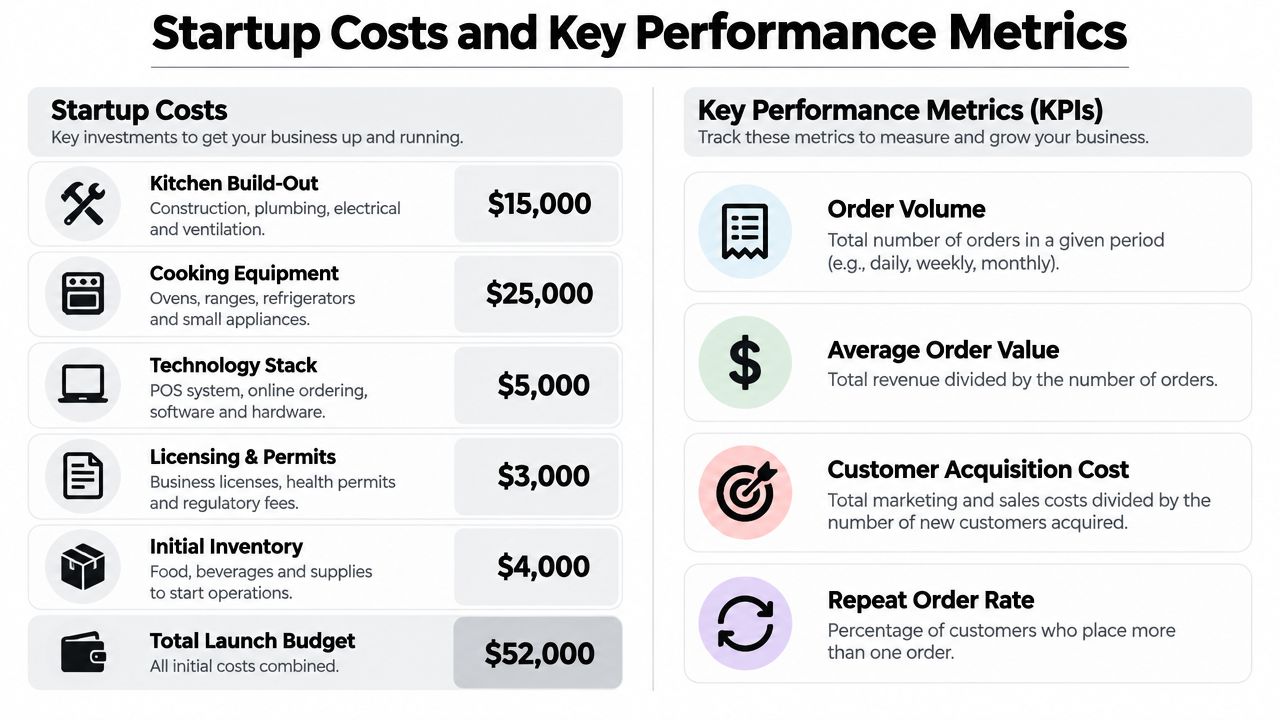
Before signing a lease, price the site-specific work. Ventilation upgrades, drainage, electrical capacity, grease management, refrigeration, fire compliance, waste handling, and delivery access can change the economics more than the cooking equipment itself. Packaging also deserves a test budget because the right format should be validated with real travel, stacking, sealing, and reheating conditions.
Track the numbers that govern delivery
Table turnover and seats per square metre don't help a delivery-only operator. The daily dashboard should focus on measures that reveal whether the kitchen can turn demand into profitable, accurate orders.
- Average order value: Track the value of the basket before and after fees, discounts, refunds, and packaging.
- Preparation time: Measure accepted order to ready-for-collection time by item, station, and trading period.
- Order defect rate: Record missing items, wrong modifiers, spills, temperature complaints, and failed handoffs.
- Customer acquisition cost: Separate the cost of paid discovery from repeat demand generated through owned channels.
- Repeat order rate: Watch whether customers return without requiring another expensive promotional incentive.
- Contribution per order: Calculate what remains after ingredients, labor, packaging, platform charges, discounts, refunds, and delivery-related costs.
TopFoodApp's guide to digital QR menus is relevant when an operator wants to place a controlled menu touchpoint on packaging or promotional material. The technology only helps if the business also gives customers a clear reason to order directly and delivers the same food quality they experienced through a marketplace.
Frequently Asked Questions for Operators
Does one cloud kitchen need separate food-safety systems for each virtual brand?
Not necessarily, but each brand must be covered by the same documented food-safety controls. Recipes, allergen data, storage, prep labels, cleaning, staff training, traceability, and corrective actions should apply across every menu. Separate online identities don't remove the physical kitchen's responsibility.
How can an operator reduce reliance on delivery apps?
Use marketplaces for discovery, then build a direct relationship through packaging inserts, a memorable brand, a mobile ordering page, loyalty communication, and consistent service. Don't remove the marketplace presence before direct demand can replace the lost visibility. Compare channels using contribution per order and repeat behavior, not gross sales alone.
Can a dine-in restaurant run a virtual brand during peak service?
It can, but only after testing the shared constraints. Map the busiest periods for fryers, ovens, prep benches, cold storage, packing space, and staff. If the virtual menu uses the same bottleneck as the dining menu, launch it in quieter windows or redesign the menu around equipment and ingredients that have genuine spare capacity.
Is a cloud kitchen a long-term business or a tactical channel?
It can be either. A standalone operation needs repeat demand and dependable unit economics. An existing restaurant may use a virtual brand tactically to monetize unused capacity, test a concept, or reach a different delivery area. The correct choice depends on local density, platform costs, kitchen constraints, and the operator's ability to build direct demand.
Owners considering a delivery-only launch should first map the kitchen's real capacity, then test a narrow menu, packaging, order flow, and contribution per order before adding brands. TopFoodApp can help organize mobile digital menus, allergen information, translations, and fast menu updates, so visit TopFoodApp to evaluate whether its menu tools fit your cloud kitchen workflow.